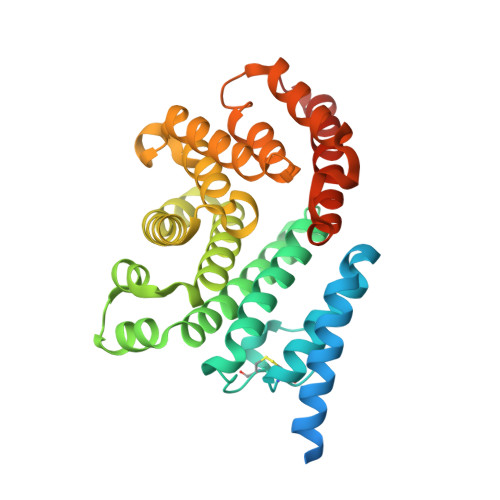
8G52 | pdb_00008g52

Crystal structure of a bacterial TPAT family transporter


Experimental Data Snapshot

  • Method: X-RAY DIFFRACTION
  • Resolution: 1.88 Å
  • R-Value Free: 
    0.222 (Depositor), 0.225 (DCC) 
  • R-Value Work: 
    0.183 (Depositor), 0.185 (DCC) 
  • R-Value Observed: 
    0.185 (Depositor) 

Starting Model: in silico
View more details

wwPDB Validation 3D Report Full Report

Validation slider image for 8G52

Ligand Structure Quality Assessment 


This is version 1.3 of the entry. See complete history

Literature

Structures and Mechanisms of a Novel Bacterial Transport System for Fatty Acids.

Zhai, L.Chou, J.C.Oo, H.Dassama, L.M.K.

(2023) Chembiochem 24: e202300156-e202300156

  • DOI: https://doi.org/10.1002/cbic.202300156
  • Primary Citation Related Structures: 
    8G52, 8G53

  • PubMed Abstract: 

    Bacterial acquisition of metabolites is largely facilitated by transporters with unique substrate scopes. The tripartite ATP-independent periplasmic (TRAP) transporters comprise a large family of bacterial proteins that facilitate the uptake of a variety of small molecules. It has been reported that some TRAP systems encode a fourth protein, the T component. The T-component, or TatT, is predicted to be a periplasmic-facing lipoprotein that enables the uptake of metabolites from the outer membrane. However, no substrates were revealed for any TatT and their functional role(s) remained enigmatic. We recently identified a homolog in Methylococcus capsulatus that binds to sterols, and herein, we report two additional homologs that demonstrate a preference for long-chain fatty acids. Our bioinformatics, quantitative analyses of protein-ligand interactions, and high-resolution crystal structures suggest that TatTs might facilitate the trafficking of hydrophobic or lipophilic substrates and represent a new class of bacterial lipid and fatty acid transporters.


  • Organizational Affiliation
    • Department of Chemistry and Sarafan ChEM-H Institute, Stanford University, Stanford, CA, 94305, USA.

Macromolecule Content 

  • Total Structure Weight: 72.54 kDa 
  • Atom Count: 4,548 
  • Modeled Residue Count: 558 
  • Deposited Residue Count: 658 
  • Unique protein chains: 1

Macromolecules

Find similar proteins by:|  3D Structure
Entity ID: 1
MoleculeChains  Sequence LengthOrganismDetailsImage
TPR_REGION domain-containing protein
A, B
329Enhygromyxa salinaMutation(s): 0 
Gene Names: DB30_07757
UniProt
Find proteins for A0A0C2DGE5 (Enhygromyxa salina)
Explore A0A0C2DGE5 
Go to UniProtKB:  A0A0C2DGE5
Entity Groups
Sequence Clusters30% Identity50% Identity70% Identity90% Identity95% Identity100% Identity
UniProt GroupA0A0C2DGE5
Sequence Annotations
Expand
Reference Sequence

Experimental Data & Validation

Experimental Data

  • Method: X-RAY DIFFRACTION
  • Resolution: 1.88 Å
  • R-Value Free:  0.222 (Depositor), 0.225 (DCC) 
  • R-Value Work:  0.183 (Depositor), 0.185 (DCC) 
  • R-Value Observed: 0.185 (Depositor) 
Space Group: P 1 21 1
Unit Cell:
Length ( Å )Angle ( ˚ )
a = 42.695α = 90
b = 85.409β = 90.14
c = 73.686γ = 90
Software Package:
Software NamePurpose
PHENIXrefinement
XDSdata reduction
XDSdata scaling
PHENIXphasing

Structure Validation

View Full Validation Report


Ligand Structure Quality Assessment 


Entry History 

& Funding Information

Deposition Data


Funding OrganizationLocationGrant Number
Not funded--

Revision History  (Full details and data files)

  • Version 1.0: 2023-05-24
    Type: Initial release
  • Version 1.1: 2023-08-09
    Changes: Database references
  • Version 1.2: 2023-09-20
    Changes: Data collection, Refinement description
  • Version 1.3: 2024-11-06
    Changes: Structure summary