8FY6 | pdb_00008fy6

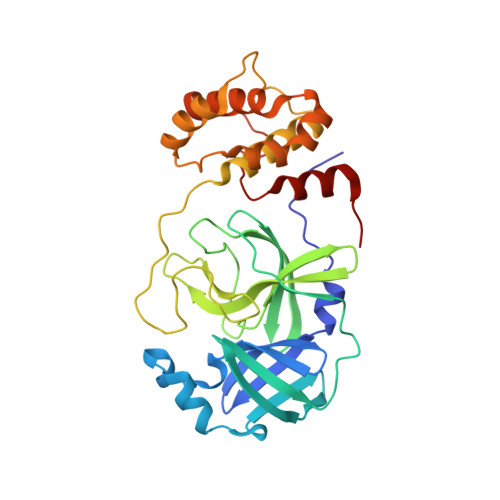
SARS-CoV-2 main protease in complex with covalent inhibitor


Experimental Data Snapshot

  • Method: X-RAY DIFFRACTION
  • Resolution: 2.00 Å
  • R-Value Free: 
    0.222 (Depositor), 0.222 (DCC) 
  • R-Value Work: 
    0.187 (Depositor), 0.187 (DCC) 
  • R-Value Observed: 
    0.189 (Depositor) 

Starting Model: experimental
View more details

wwPDB Validation 3D Report Full Report

Validation slider image for 8FY6

Ligand Structure Quality Assessment 


This is version 2.1 of the entry. See complete history

Literature

Alkyne as a Latent Warhead to Covalently Target SARS-CoV-2 Main Protease.

Ngo, C.Fried, W.Aliyari, S.Feng, J.Qin, C.Zhang, S.Yang, H.Shanaa, J.Feng, P.Cheng, G.Chen, X.S.Zhang, C.

(2023) J Med Chem 66: 12237-12248

  • DOI: https://doi.org/10.1021/acs.jmedchem.3c00810
  • Primary Citation Related Structures: 
    8FY6, 8FY7

  • PubMed Abstract: 

    There is an urgent need for improved therapy to better control the ongoing COVID-19 pandemic. The main protease M pro plays a pivotal role in SARS-CoV-2 replications, thereby representing an attractive target for antiviral development. We seek to identify novel electrophilic warheads for efficient, covalent inhibition of M pro . By comparing the efficacy of a panel of warheads installed on a common scaffold against M pro , we discovered that the terminal alkyne could covalently modify M pro as a latent warhead. Our biochemical and X-ray structural analyses revealed the irreversible formation of the vinyl-sulfide linkage between the alkyne and the catalytic cysteine of M pro . Clickable probes based on the alkyne inhibitors were developed to measure target engagement, drug residence time, and off-target effects. The best alkyne-containing inhibitors potently inhibited SARS-CoV-2 infection in cell infection models. Our findings highlight great potentials of alkyne as a latent warhead to target cystine proteases in viruses and beyond.


  • Organizational Affiliation
    • Department of Chemistry and Loker Hydrocarbon Research Institute, University of Southern California, Los Angeles, California 90089, United States.

Macromolecule Content 

  • Total Structure Weight: 34.33 kDa 
  • Atom Count: 2,543 
  • Modeled Residue Count: 305 
  • Deposited Residue Count: 306 
  • Unique protein chains: 1

Macromolecules

Find similar proteins by:|  3D Structure
Entity ID: 1
MoleculeChains  Sequence LengthOrganismDetailsImage
3C-like proteinase nsp5306Severe acute respiratory syndrome coronavirus 2Mutation(s): 0 
Gene Names: rep1a-1b
EC: 3.4.22.69
UniProt
Find proteins for P0DTD1 (Severe acute respiratory syndrome coronavirus 2)
Explore P0DTD1 
Go to UniProtKB:  P0DTD1
Entity Groups
Sequence Clusters30% Identity50% Identity70% Identity90% Identity95% Identity100% Identity
UniProt GroupP0DTD1
Sequence Annotations
Expand
Reference Sequence

Small Molecules

Ligands 1 Unique
IDChains Name / Formula / InChI Key2D Diagram3D Interactions
YVZ
(Subject of Investigation/LOI)

Query on YVZ


Download:Ideal Coordinates CCD File
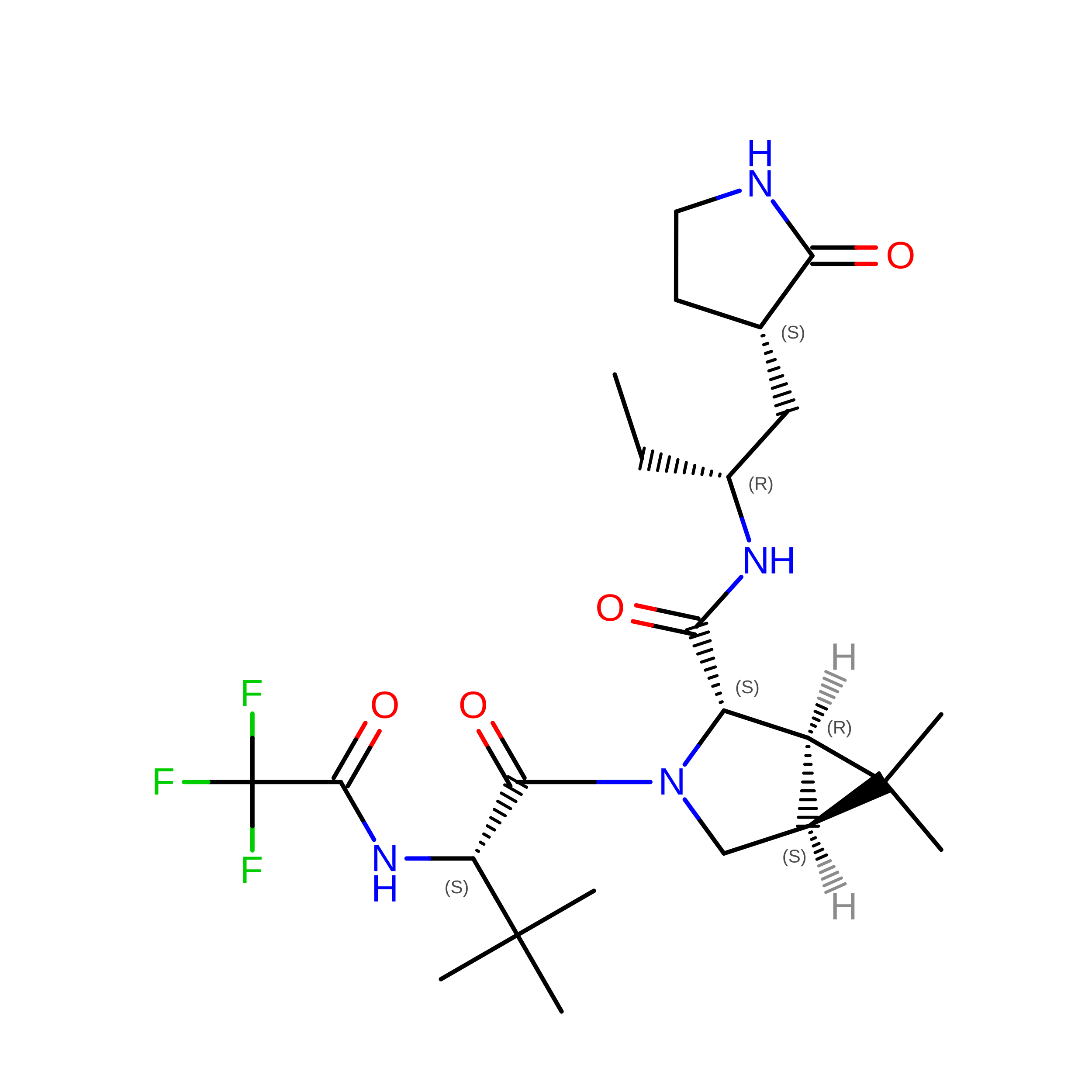
B [auth A](1R,2S,5S)-6,6-dimethyl-3-[3-methyl-N-(trifluoroacetyl)-L-valyl]-N-{(2R)-1-[(3S)-2-oxopyrrolidin-3-yl]butan-2-yl}-3-azabicyclo[3.1.0]hexane-2-carboxamide
C24 H37 F3 N4 O4
QIKPVUMAJHNNAL-FHULIHMCSA-N

Experimental Data & Validation

Experimental Data

  • Method: X-RAY DIFFRACTION
  • Resolution: 2.00 Å
  • R-Value Free:  0.222 (Depositor), 0.222 (DCC) 
  • R-Value Work:  0.187 (Depositor), 0.187 (DCC) 
  • R-Value Observed: 0.189 (Depositor) 
Space Group: P 21 21 2
Unit Cell:
Length ( Å )Angle ( ˚ )
a = 45.455α = 90
b = 63.276β = 90
c = 103.843γ = 90
Software Package:
Software NamePurpose
PHENIXrefinement
PHENIXphasing
Cootmodel building
xia2data scaling
xia2data reduction
JBluIce-EPICSdata collection

Structure Validation

View Full Validation Report


Ligand Structure Quality Assessment 


Entry History 

& Funding Information

Deposition Data


Funding OrganizationLocationGrant Number
National Institutes of Health/National Institute Of Allergy and Infectious Diseases (NIH/NIAID)United StatesR01 AI150524

Revision History  (Full details and data files)

  • Version 1.0: 2023-08-30
    Type: Initial release
  • Version 1.1: 2023-09-27
    Changes: Database references
  • Version 2.0: 2024-07-24
    Changes: Advisory, Atomic model, Author supporting evidence, Data collection, Derived calculations, Non-polymer description, Structure summary
  • Version 2.1: 2024-10-23
    Changes: Structure summary