Download Mendeley
Crystallographic and Thermodynamic Evidence of Negative Coupling in the Flavin-Dependent Tryptophan Halogenases AbeH and BorH.
Ashaduzzaman, M., Lingkon, K., De Silva, A.J., Bellizzi 3rd, J.J.(2025) ACS Omega 10: 5849-5865
- PubMed: 39989782 Search on PubMedSearch on PubMed Central
- DOI: https://doi.org/10.1021/acsomega.4c09590
- Primary Citation Related Structures:
8FOV, 8FOX, 8TTI, 8TTJ, 8TTK - PubMed Abstract:
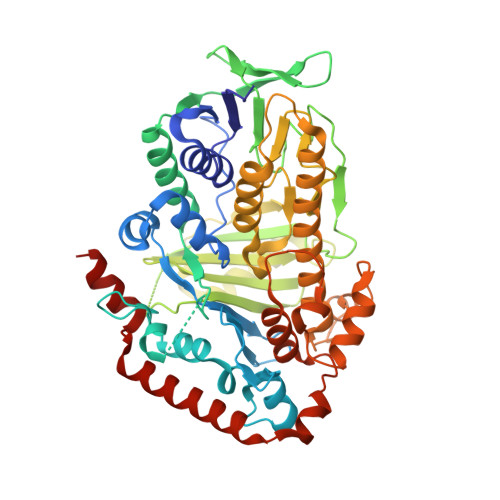
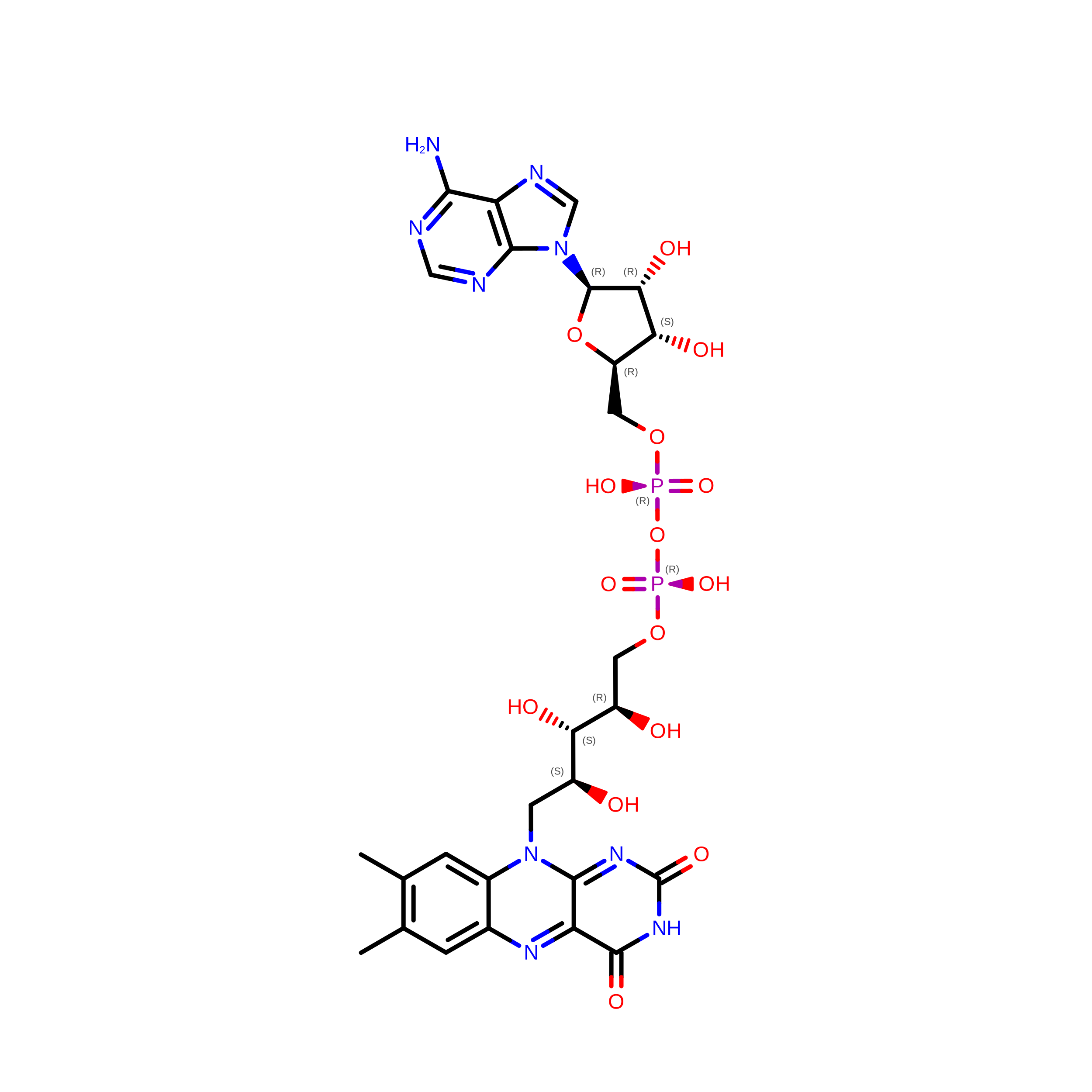
Flavin-dependent halogenases (FDHs) regioselectively halogenate aromatic substrates using halide ions, O 2 , and reduced flavin (FADH 2 ) at physiological temperatures in aqueous solution, making them a green alternative to conventional synthetic methods for aryl halide preparation. To better understand mechanistic details that limit FDH catalytic efficiency and potentially hinder their application as in vitro biocatalysts, we investigated the halogenation activity, substrate scope, crystal structures, and ligand binding of the Trp-5-halogenase AbeH and the Trp-6-halogenase BorH. Partitioning of FAD and Trp into different subunits of BorH crystals and an inability to incorporate Trp into AbeH/FAD crystals suggested that binding of flavin and Trp are negatively coupled in both proteins. Isothermal titration calorimetry and fluorescence quenching experiments confirmed that both AbeH and BorH formed binary complexes with FAD or Trp, but Trp could not form ternary complexes with preincubated AbeH/FAD or BorH/FAD complexes. FAD could not bind to BorH/Trp complexes, but FAD appears to displace Trp from AbeH/Trp complexes in an endothermic entropically driven process. Observation of negative coupling in halogenases from two different clades with topological differences in their substrate binding sites suggests that this property and the limitations it places on catalytic efficiency may be a general characteristic of the FDH family.
- Department of Chemistry and Biochemistry, The University of Toledo, Toledo, Ohio 43606, United States.
Organizational Affiliation: