Download Mendeley
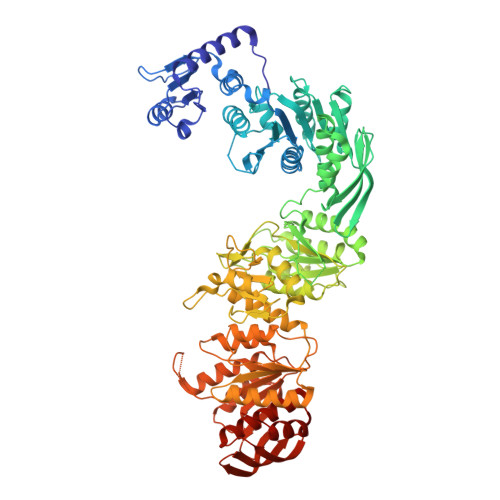
Architecture and genomic arrangement of the MurE-MurF bacterial cell wall biosynthesis complex.
Shirakawa, K.T., Sala, F.A., Miyachiro, M.M., Job, V., Trindade, D.M., Dessen, A.(2023) Proc Natl Acad Sci U S A 120: e2219540120-e2219540120
- PubMed: 37186837 Search on PubMedSearch on PubMed Central
- DOI: https://doi.org/10.1073/pnas.2219540120
- Primary Citation Related Structures:
8F5D - PubMed Abstract:
Peptidoglycan (PG) is a central component of the bacterial cell wall, and the disruption of its biosynthetic pathway has been a successful antibacterial strategy for decades. PG biosynthesis is initiated in the cytoplasm through sequential reactions catalyzed by Mur enzymes that have been suggested to associate into a multimembered complex. This idea is supported by the observation that in many eubacteria, mur genes are present in a single operon within the well conserved dcw cluster, and in some cases, pairs of mur genes are fused to encode a single, chimeric polypeptide. We performed a vast genomic analysis using >140 bacterial genomes and mapped Mur chimeras in numerous phyla, with Proteobacteria carrying the highest number. MurE-MurF, the most prevalent chimera, exists in forms that are either directly associated or separated by a linker. The crystal structure of the MurE-MurF chimera from Bordetella pertussis reveals a head-to-tail, elongated architecture supported by an interconnecting hydrophobic patch that stabilizes the positions of the two proteins. Fluorescence polarization assays reveal that MurE-MurF interacts with other Mur ligases via its central domains with K D s in the high nanomolar range, backing the existence of a Mur complex in the cytoplasm. These data support the idea of stronger evolutionary constraints on gene order when encoded proteins are intended for association, establish a link between Mur ligase interaction, complex assembly and genome evolution, and shed light on regulatory mechanisms of protein expression and stability in pathways of critical importance for bacterial survival.
- Brazilian Biosciences National Laboratory, Brazilian Center for Research in Energy and Materials, Campinas, São Paulo 13084-971, Brazil.
Organizational Affiliation: