8F2E | pdb_00008f2e

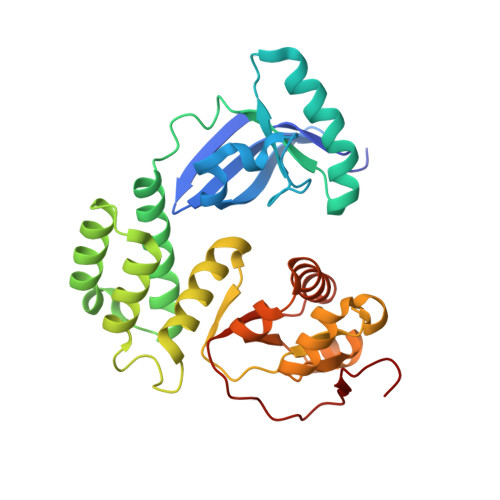
Crystal Structure of the CoV-Y domain of SARS-CoV-2 Nonstructural Protein 3


Experimental Data Snapshot

  • Method: X-RAY DIFFRACTION
  • Resolution: 2.43 Å
  • R-Value Free: 
    0.232 (Depositor), 0.240 (DCC) 
  • R-Value Work: 
    0.190 (Depositor), 0.198 (DCC) 
  • R-Value Observed: 
    0.192 (Depositor) 

Starting Model: experimental
View more details

wwPDB Validation 3D Report Full Report

Validation slider image for 8F2E

This is version 1.1 of the entry. See complete history

Literature

Crystal structure of the CoV-Y domain of SARS-CoV-2 nonstructural protein 3.

Li, Y.Pustovalova, Y.Shi, W.Gorbatyuk, O.Sreeramulu, S.Schwalbe, H.Hoch, J.C.Hao, B.

(2023) Sci Rep 13: 2890-2890

  • DOI: https://doi.org/10.1038/s41598-023-30045-9
  • Primary Citation Related Structures: 
    8F2E

  • PubMed Abstract: 

    Replication of the coronavirus genome starts with the formation of viral RNA-containing double-membrane vesicles (DMV) following viral entry into the host cell. The multi-domain nonstructural protein 3 (nsp3) is the largest protein encoded by the known coronavirus genome and serves as a central component of the viral replication and transcription machinery. Previous studies demonstrated that the highly-conserved C-terminal region of nsp3 is essential for subcellular membrane rearrangement, yet the underlying mechanisms remain elusive. Here we report the crystal structure of the CoV-Y domain, the most C-terminal domain of the SARS-CoV-2 nsp3, at 2.4 Å-resolution. CoV-Y adopts a previously uncharacterized V-shaped fold featuring three distinct subdomains. Sequence alignment and structure prediction suggest that this fold is likely shared by the CoV-Y domains from closely related nsp3 homologs. NMR-based fragment screening combined with molecular docking identifies surface cavities in CoV-Y for interaction with potential ligands and other nsps. These studies provide the first structural view on a complete nsp3 CoV-Y domain, and the molecular framework for understanding the architecture, assembly and function of the nsp3 C-terminal domains in coronavirus replication. Our work illuminates nsp3 as a potential target for therapeutic interventions to aid in the on-going battle against the COVID-19 pandemic and diseases caused by other coronaviruses.


  • Organizational Affiliation
    • Department of Molecular Biology and Biophysics, University of Connecticut Health Center, 263 Farmington Avenue, Farmington, CT, 06030-3305, USA.

Macromolecule Content 

  • Total Structure Weight: 32.16 kDa 
  • Atom Count: 2,245 
  • Modeled Residue Count: 281 
  • Deposited Residue Count: 287 
  • Unique protein chains: 1

Macromolecules

Find similar proteins by:|  3D Structure
Entity ID: 1
MoleculeChains  Sequence LengthOrganismDetailsImage
Papain-like protease nsp3287Severe acute respiratory syndrome coronavirus 2Mutation(s): 0 
Gene Names: rep1a-1b
EC: 3.4.19.12 (PDB Primary Data), 3.4.22 (PDB Primary Data)
UniProt
Find proteins for P0DTD1 (Severe acute respiratory syndrome coronavirus 2)
Explore P0DTD1 
Go to UniProtKB:  P0DTD1
Entity Groups
Sequence Clusters30% Identity50% Identity70% Identity90% Identity95% Identity100% Identity
UniProt GroupP0DTD1
Sequence Annotations
Expand
Reference Sequence

Experimental Data & Validation

Experimental Data

  • Method: X-RAY DIFFRACTION
  • Resolution: 2.43 Å
  • R-Value Free:  0.232 (Depositor), 0.240 (DCC) 
  • R-Value Work:  0.190 (Depositor), 0.198 (DCC) 
  • R-Value Observed: 0.192 (Depositor) 
Space Group: P 65
Unit Cell:
Length ( Å )Angle ( ˚ )
a = 109.415α = 90
b = 109.415β = 90
c = 61.226γ = 120
Software Package:
Software NamePurpose
BUSTERrefinement
autoPROCdata reduction
autoPROCdata scaling
PHENIXphasing

Structure Validation

View Full Validation Report


Entry History 

& Funding Information

Deposition Data


Funding OrganizationLocationGrant Number
National Institutes of Health/National Institute of General Medical Sciences (NIH/NIGMS)United StatesGM135592

Revision History  (Full details and data files)

  • Version 1.0: 2023-03-08
    Type: Initial release
  • Version 1.1: 2024-04-03
    Changes: Data collection, Refinement description