8ETR | pdb_00008etr

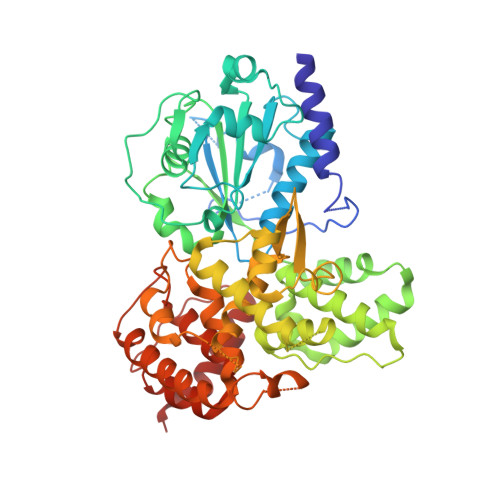
CryoEM Structure of NLRP3 NACHT domain in complex with G2394


Experimental Data Snapshot

  • Method: ELECTRON MICROSCOPY
  • Resolution: 3.50 Å
  • Aggregation State: PARTICLE 
  • Reconstruction Method: SINGLE PARTICLE 

wwPDB Validation 3D Report Full Report

Validation slider image for 8ETR

This is version 1.2 of the entry. See complete history

Literature

Overcoming Preclinical Safety Obstacles to Discover ( S )- N -((1,2,3,5,6,7-Hexahydro- s -indacen-4-yl)carbamoyl)-6-(methylamino)-6,7-dihydro-5 H -pyrazolo[5,1- b ][1,3]oxazine-3-sulfonamide (GDC-2394): A Potent and Selective NLRP3 Inhibitor.

McBride, C.Trzoss, L.Povero, D.Lazic, M.Ambrus-Aikelin, G.Santini, A.Pranadinata, R.Bain, G.Stansfield, R.Stafford, J.A.Veal, J.Takahashi, R.Ly, J.Chen, S.Liu, L.Nespi, M.Blake, R.Katewa, A.Kleinheinz, T.Sujatha-Bhaskar, S.Ramamoorthi, N.Sims, J.McKenzie, B.Chen, M.Ultsch, M.Johnson, M.Murray, J.Ciferri, C.Staben, S.T.Townsend, M.J.Stivala, C.E.

(2022) J Med Chem 65: 14721-14739

  • DOI: https://doi.org/10.1021/acs.jmedchem.2c01250
  • Primary Citation Related Structures: 
    8ETR

  • PubMed Abstract: 

    Inappropriate activation of the NLRP3 inflammasome has been implicated in multiple inflammatory and autoimmune diseases. Herein, we aimed to develop novel NLRP3 inhibitors that could minimize the risk of drug-induced liver injury. Lipophilic ligand efficiency was used as a guiding metric to identify a series of 6,7-dihydro-5H-pyrazolo[5,1- b ][1,3]oxazinesulfonylureas. A leading compound from this series was advanced into safety studies in cynomolgus monkeys, and renal toxicity, due to compound precipitation, was observed. To overcome this obstacle, we focused on improving the solubility of our compounds, specifically by introducing basic amine substituents into the scaffold. This led to the identification of GDC-2394, a potent and selective NLRP3 inhibitor, with an in vitro and in vivo safety profile suitable for advancement into human clinical trials.


  • Organizational Affiliation
    • Jecure Therapeutics, San Diego, California 92121, United States.

Macromolecule Content 

  • Total Structure Weight: 64.26 kDa 
  • Atom Count: 3,937 
  • Modeled Residue Count: 471 
  • Deposited Residue Count: 543 
  • Unique protein chains: 1

Macromolecules

Find similar proteins by:|  3D Structure
Entity ID: 1
MoleculeChains  Sequence LengthOrganismDetailsImage
NACHT, LRR and PYD domains-containing protein 3543Homo sapiensMutation(s): 0 
Gene Names: NLRP3C1orf7CIAS1NALP3PYPAF1
EC: 3.6.4
UniProt & NIH Common Fund Data Resources
Find proteins for Q96P20 (Homo sapiens)
Explore Q96P20 
Go to UniProtKB:  Q96P20
PHAROS:  Q96P20
Entity Groups
Sequence Clusters30% Identity50% Identity70% Identity90% Identity95% Identity100% Identity
UniProt GroupQ96P20
Sequence Annotations
Expand
Reference Sequence

Small Molecules

Ligands 3 Unique
IDChains Name / Formula / InChI Key2D Diagram3D Interactions
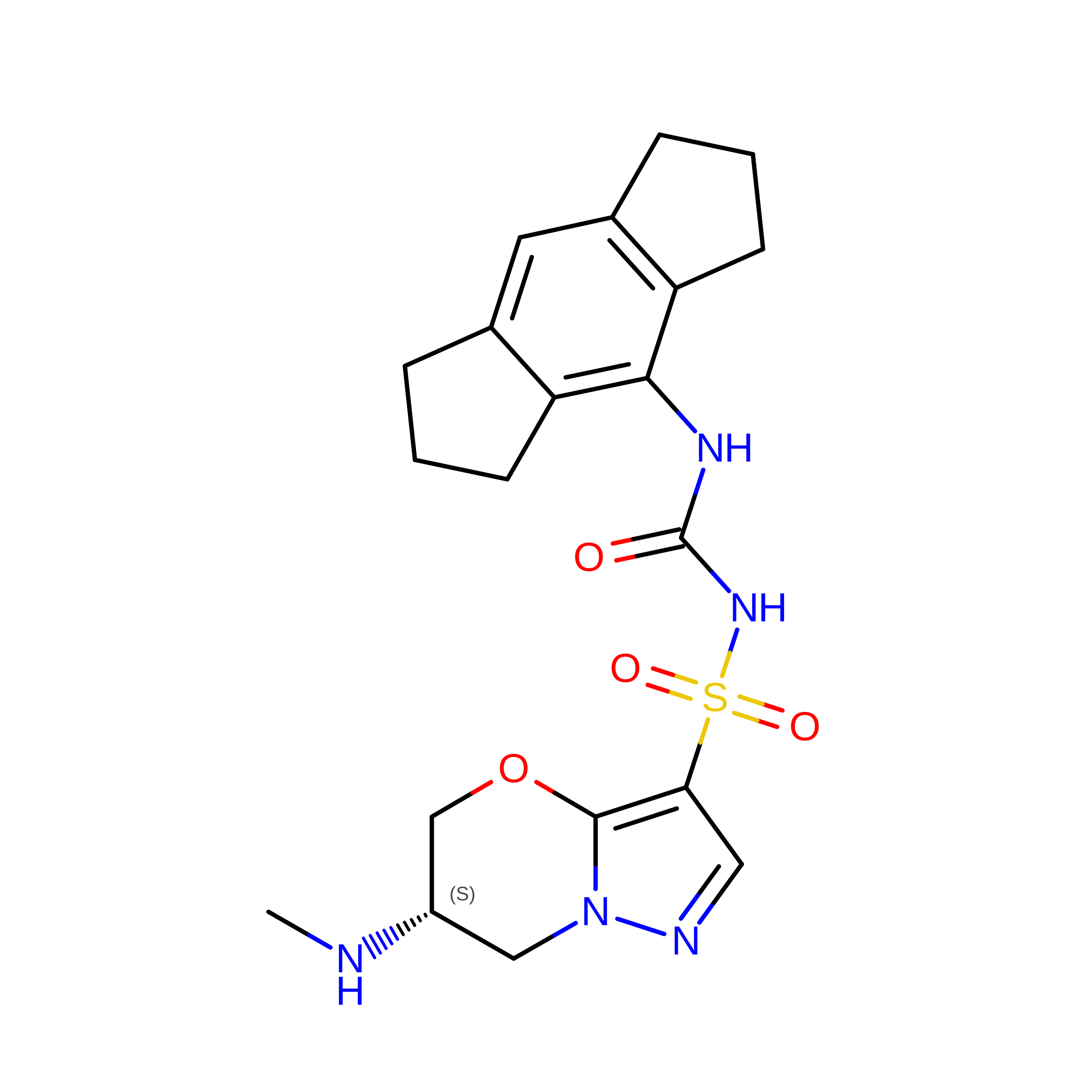
WTN
(Subject of Investigation/LOI)

Query on WTN


Download:Ideal Coordinates CCD File
D [auth A](6S,8R)-N-[(1,2,3,5,6,7-hexahydro-s-indacen-4-yl)carbamoyl]-6-(methylamino)-6,7-dihydro-5H-pyrazolo[5,1-b][1,3]oxazine-3-sulfonamide
C20 H25 N5 O4 S
NDRARVKETDZHBS-AWEZNQCLSA-N
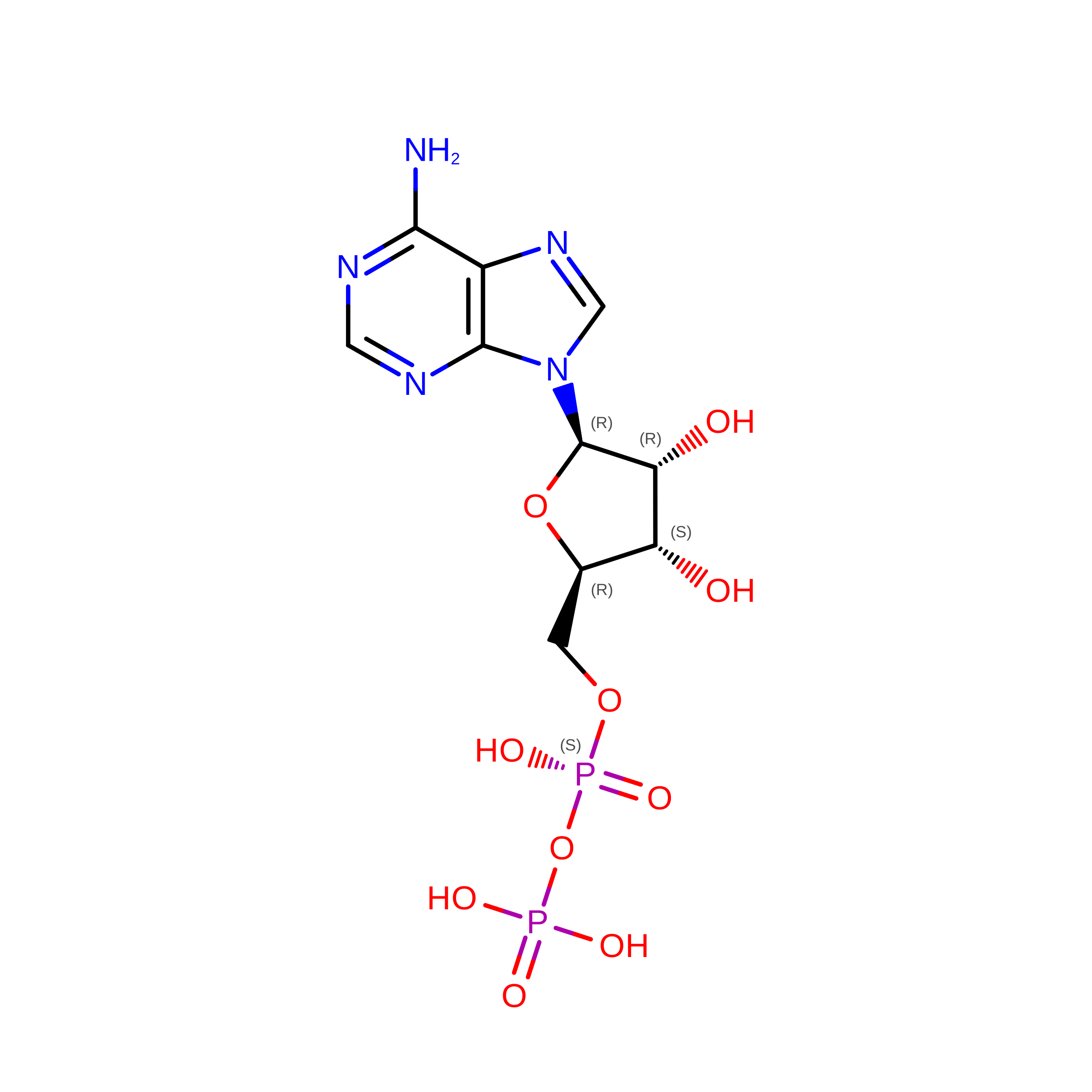
ADP

Query on ADP


Download:Ideal Coordinates CCD File
C [auth A]ADENOSINE-5'-DIPHOSPHATE
C10 H15 N5 O10 P2
XTWYTFMLZFPYCI-KQYNXXCUSA-N
MG

Query on MG


Download:Ideal Coordinates CCD File
B [auth A]MAGNESIUM ION
Mg
JLVVSXFLKOJNIY-UHFFFAOYSA-N
Binding Affinity Annotations 
IDSourceBinding Affinity
WTN BindingDB:  8ETR IC50: min: 5.4, max: 490 (nM) from 10 assay(s)

Experimental Data & Validation

Experimental Data

  • Method: ELECTRON MICROSCOPY
  • Resolution: 3.50 Å
  • Aggregation State: PARTICLE 
  • Reconstruction Method: SINGLE PARTICLE 
EM Software:
TaskSoftware PackageVersion
MODEL REFINEMENTPHENIX
RECONSTRUCTIONRELION3.1

Structure Validation

View Full Validation Report


Entry History 

& Funding Information

Deposition Data


Funding OrganizationLocationGrant Number
Other private--

Revision History  (Full details and data files)

  • Version 1.0: 2022-11-02
    Type: Initial release
  • Version 1.1: 2022-11-23
    Changes: Database references
  • Version 1.2: 2024-06-19
    Changes: Data collection