8EC6 | pdb_00008ec6

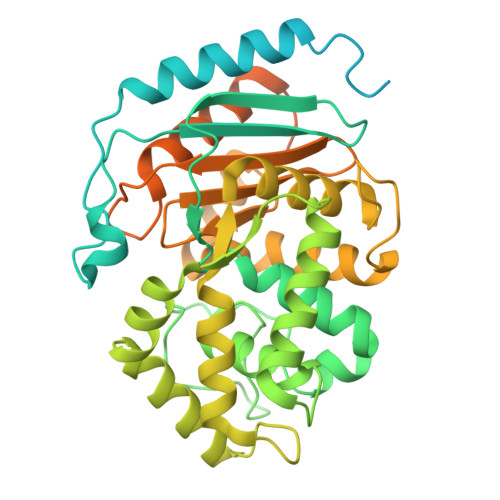
Cryo-EM structure of the Glutaminase C core filament (fGAC)


Experimental Data Snapshot

  • Method: ELECTRON MICROSCOPY
  • Resolution: 3.10 Å
  • Aggregation State: FILAMENT 
  • Reconstruction Method: SINGLE PARTICLE 

Starting Model: experimental
View more details

wwPDB Validation 3D Report Full Report

Validation slider image for 8EC6

This is version 1.3 of the entry. See complete history

Literature

Molecular mechanism of glutaminase activation through filamentation and the role of filaments in mitophagy protection.

Adamoski, D.Dias, M.M.Quesnay, J.E.N.Yang, Z.Zagoriy, I.Steyer, A.M.Rodrigues, C.T.da Silva Bastos, A.C.da Silva, B.N.Costa, R.K.E.de Abreu, F.M.O.Islam, Z.Cassago, A.van Heel, M.G.Consonni, S.R.Mattei, S.Mahamid, J.Portugal, R.V.Ambrosio, A.L.B.Dias, S.M.G.

(2023) Nat Struct Mol Biol 30: 1902-1912

  • DOI: https://doi.org/10.1038/s41594-023-01118-0
  • Primary Citation Related Structures: 
    8EC6

  • PubMed Abstract: 

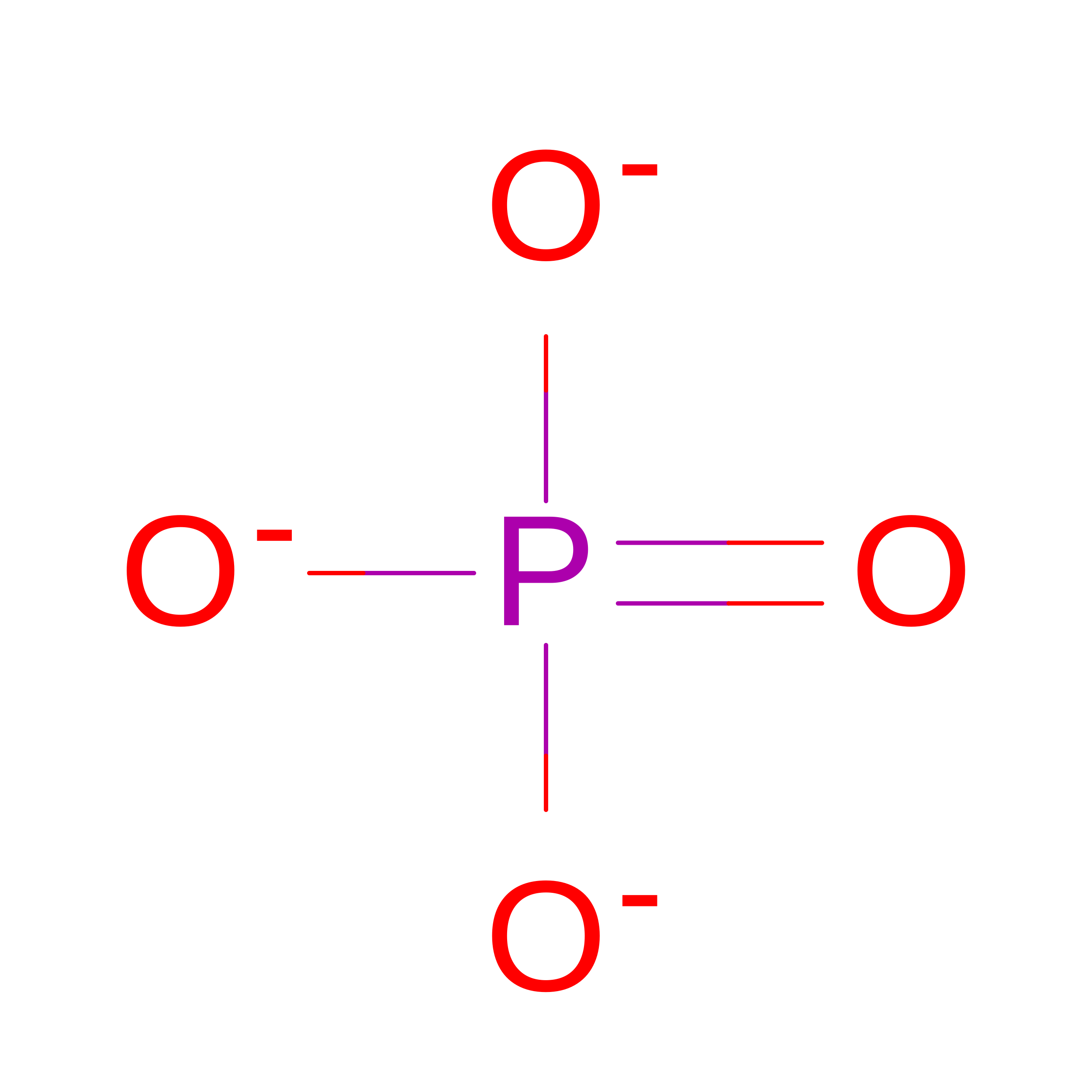
    Glutaminase (GLS), which deaminates glutamine to form glutamate, is a mitochondrial tetrameric protein complex. Although inorganic phosphate (Pi) is known to promote GLS filamentation and activation, the molecular basis of this mechanism is unknown. Here we aimed to determine the molecular mechanism of Pi-induced mouse GLS filamentation and its impact on mitochondrial physiology. Single-particle cryogenic electron microscopy revealed an allosteric mechanism in which Pi binding at the tetramer interface and the activation loop is coupled to direct nucleophile activation at the active site. The active conformation is prone to enzyme filamentation. Notably, human GLS filaments form inside tubulated mitochondria following glutamine withdrawal, as shown by in situ cryo-electron tomography of cells thinned by cryo-focused ion beam milling. Mitochondria with GLS filaments exhibit increased protection from mitophagy. We reveal roles of filamentous GLS in mitochondrial morphology and recycling.


  • Organizational Affiliation
    • Brazilian Biosciences National Laboratory, Brazilian Center for Research in Energy and Materials, Campinas, Brazil.

Macromolecule Content 

  • Total Structure Weight: 427.38 kDa 
  • Atom Count: 19,133 
  • Modeled Residue Count: 2,479 
  • Deposited Residue Count: 3,832 
  • Unique protein chains: 1

Macromolecules

Find similar proteins by:|  3D Structure
Entity ID: 1
MoleculeChains  Sequence LengthOrganismDetailsImage
Isoform 2 of Glutaminase kidney isoform, mitochondrial
A, B, C, D, E
A, B, C, D, E, F, G, H
479Mus musculusMutation(s): 0 
Gene Names: GlsGls1Kiaa0838
EC: 3.5.1.2
UniProt & NIH Common Fund Data Resources
Find proteins for D3Z7P3 (Mus musculus)
Explore D3Z7P3 
Go to UniProtKB:  D3Z7P3
IMPC:  MGI:95752
Entity Groups
Sequence Clusters30% Identity50% Identity70% Identity90% Identity95% Identity100% Identity
UniProt GroupD3Z7P3
Sequence Annotations
Expand
Reference Sequence

Experimental Data & Validation

Experimental Data

  • Method: ELECTRON MICROSCOPY
  • Resolution: 3.10 Å
  • Aggregation State: FILAMENT 
  • Reconstruction Method: SINGLE PARTICLE 
EM Software:
TaskSoftware PackageVersion
MODEL REFINEMENTPHENIX1.20.1
RECONSTRUCTIONcryoSPARC

Structure Validation

View Full Validation Report


Entry History 

& Funding Information

Deposition Data


Funding OrganizationLocationGrant Number
Sao Paulo Research Foundation (FAPESP)Brazil2017/11766-5

Revision History  (Full details and data files)

  • Version 1.0: 2023-09-20
    Type: Initial release
  • Version 1.1: 2023-10-18
    Changes: Database references
  • Version 1.2: 2023-11-01
    Changes: Database references
  • Version 1.3: 2023-12-27
    Changes: Database references