Download Mendeley
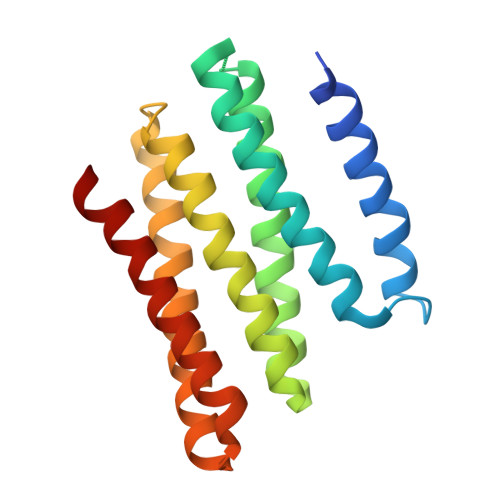
Design of pseudosymmetric protein hetero-oligomers.
Kibler, R.D., Lee, S., Kennedy, M.A., Wicky, B.I.M., Lai, S.M., Kostelic, M.M., Carr, A., Li, X., Chow, C.M., Nguyen, T.K., Carter, L., Wysocki, V.H., Stoddard, B.L., Baker, D.(2024) Nat Commun 15: 10684-10684
- PubMed: 39695145 Search on PubMedSearch on PubMed Central
- DOI: https://doi.org/10.1038/s41467-024-54913-8
- Primary Citation Related Structures:
8E0L, 8E0M, 8E0N, 8E0O, 8E12 - PubMed Abstract:
Pseudosymmetric hetero-oligomers with three or more unique subunits with overall structural (but not sequence) symmetry play key roles in biology, and systematic approaches for generating such proteins de novo would provide new routes to controlling cell signaling and designing complex protein materials. However, the de novo design of protein hetero-oligomers with three or more distinct chains with nearly identical structures is a challenging unsolved problem because it requires the accurate design of multiple protein-protein interfaces simultaneously. Here, we describe a divide-and-conquer approach that breaks the multiple-interface design challenge into a set of more tractable symmetric single-interface redesign tasks, followed by structural recombination of the validated homo-oligomers into pseudosymmetric hetero-oligomers. Starting from de novo designed circular homo-oligomers composed of 9 or 24 tandemly repeated units, we redesigned the inter-subunit interfaces to generate 19 new homo-oligomers and structurally recombined them to make 24 new hetero-oligomers, including ABC heterotrimers, A2B2 heterotetramers, and A3B3 and A2B2C2 heterohexamers which assemble with high structural specificity. The symmetric homo-oligomers and pseudosymmetric hetero-oligomers generated for each system have identical or nearly identical backbones, and hence are ideal building blocks for generating and functionalizing larger symmetric and pseudosymmetric assemblies.
- Department of Biochemistry, University of Washington, Seattle, WA, 98195, USA.
Organizational Affiliation: