8DOT | pdb_00008dot

Structure of a methane clathrate binding protein


Experimental Data Snapshot

  • Method: X-RAY DIFFRACTION
  • Resolution: 3.05 Å
  • R-Value Free: 
    0.231 (Depositor), 0.232 (DCC) 
  • R-Value Work: 
    0.192 (Depositor), 0.192 (DCC) 
  • R-Value Observed: 
    0.196 (Depositor) 

Starting Model: in silico
View more details

wwPDB Validation 3D Report Full Report

Validation slider image for 8DOT

This is version 1.1 of the entry. See complete history

Literature

Molecular basis for inhibition of methane clathrate growth by a deep subsurface bacterial protein.

Huard, D.J.E.Johnson, A.M.Fan, Z.Kenney, L.G.Xu, M.Drori, R.Gumbart, J.C.Dai, S.Lieberman, R.L.Glass, J.B.

(2023) PNAS Nexus 2: pgad268-pgad268

  • DOI: https://doi.org/10.1093/pnasnexus/pgad268
  • Primary Citation Related Structures: 
    8DOT

  • PubMed Abstract: 

    Methane clathrates on continental margins contain the largest stores of hydrocarbons on Earth, yet the role of biomolecules in clathrate formation and stability remains almost completely unknown. Here, we report new methane clathrate-binding proteins (CbpAs) of bacterial origin discovered in metagenomes from gas clathrate-bearing ocean sediments. CbpAs show similar suppression of methane clathrate growth as the commercial gas clathrate inhibitor polyvinylpyrrolidone and inhibit clathrate growth at lower concentrations than antifreeze proteins (AFPs) previously tested. Unlike AFPs, CbpAs are selective for clathrate over ice. CbpA 3 adopts a nonglobular, extended structure with an exposed hydrophobic surface, and, unexpectedly, its TxxxAxxxAxx motif common to AFPs is buried and not involved in clathrate binding. Instead, simulations and mutagenesis suggest a bipartite interaction of CbpAs with methane clathrate, with the pyrrolidine ring of a highly conserved proline residue mediating binding by filling empty clathrate cages. The discovery that CbpAs exert such potent control on methane clathrate properties implies that biomolecules from native sediment bacteria may be important for clathrate stability and habitability.


  • Organizational Affiliation
    • School of Chemistry and Biochemistry, Georgia Institute of Technology, 901 Atlantic Drive NW, Atlanta, GA 30332, USA.

Macromolecule Content 

  • Total Structure Weight: 47.38 kDa 
  • Atom Count: 1,313 
  • Modeled Residue Count: 170 
  • Deposited Residue Count: 458 
  • Unique protein chains: 1

Macromolecules

Find similar proteins by:|  3D Structure
Entity ID: 1
MoleculeChains  Sequence LengthOrganismDetailsImage
methane clathrate binding protein458marine sediment metagenomeMutation(s): 0 
Gene Names: S12H4_00347
UniProt
Find proteins for X1QJA1 (marine sediment metagenome)
Explore X1QJA1 
Go to UniProtKB:  X1QJA1
Entity Groups
Sequence Clusters30% Identity50% Identity70% Identity90% Identity95% Identity100% Identity
UniProt GroupX1QJA1
Sequence Annotations
Expand
Reference Sequence

Small Molecules

Ligands 1 Unique
IDChains Name / Formula / InChI Key2D Diagram3D Interactions
PG4

Query on PG4


Download:Ideal Coordinates CCD File
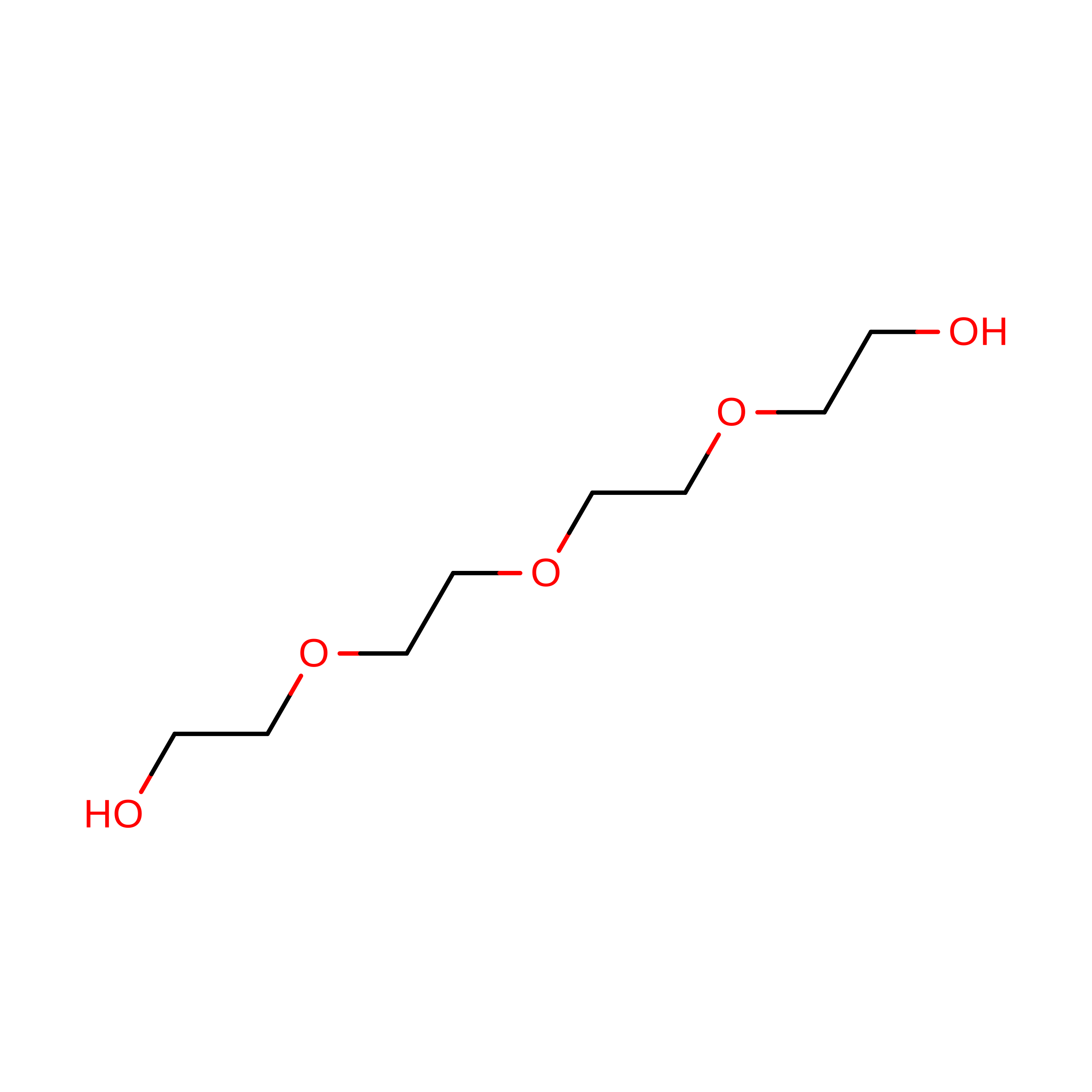
B [auth A]TETRAETHYLENE GLYCOL
C8 H18 O5
UWHCKJMYHZGTIT-UHFFFAOYSA-N

Experimental Data & Validation

Experimental Data

  • Method: X-RAY DIFFRACTION
  • Resolution: 3.05 Å
  • R-Value Free:  0.231 (Depositor), 0.232 (DCC) 
  • R-Value Work:  0.192 (Depositor), 0.192 (DCC) 
  • R-Value Observed: 0.196 (Depositor) 
Space Group: P 43 21 2
Unit Cell:
Length ( Å )Angle ( ˚ )
a = 79.05α = 90
b = 79.05β = 90
c = 109.1γ = 90
Software Package:
Software NamePurpose
PHENIXrefinement
XDSdata reduction
XSCALEdata scaling
PHASERphasing

Structure Validation

View Full Validation Report


Entry History 

& Funding Information

Deposition Data


Funding OrganizationLocationGrant Number
National Aeronautic Space Administration (NASA, United States)United States80NSSC19K0477

Revision History  (Full details and data files)

  • Version 1.0: 2023-09-13
    Type: Initial release
  • Version 1.1: 2026-03-04
    Changes: Refinement description, Structure summary