8DE0 | pdb_00008de0

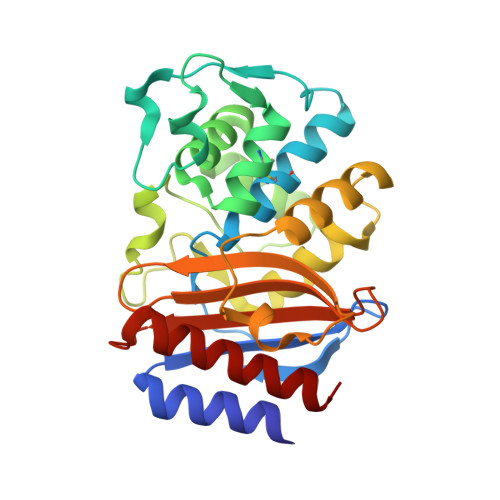
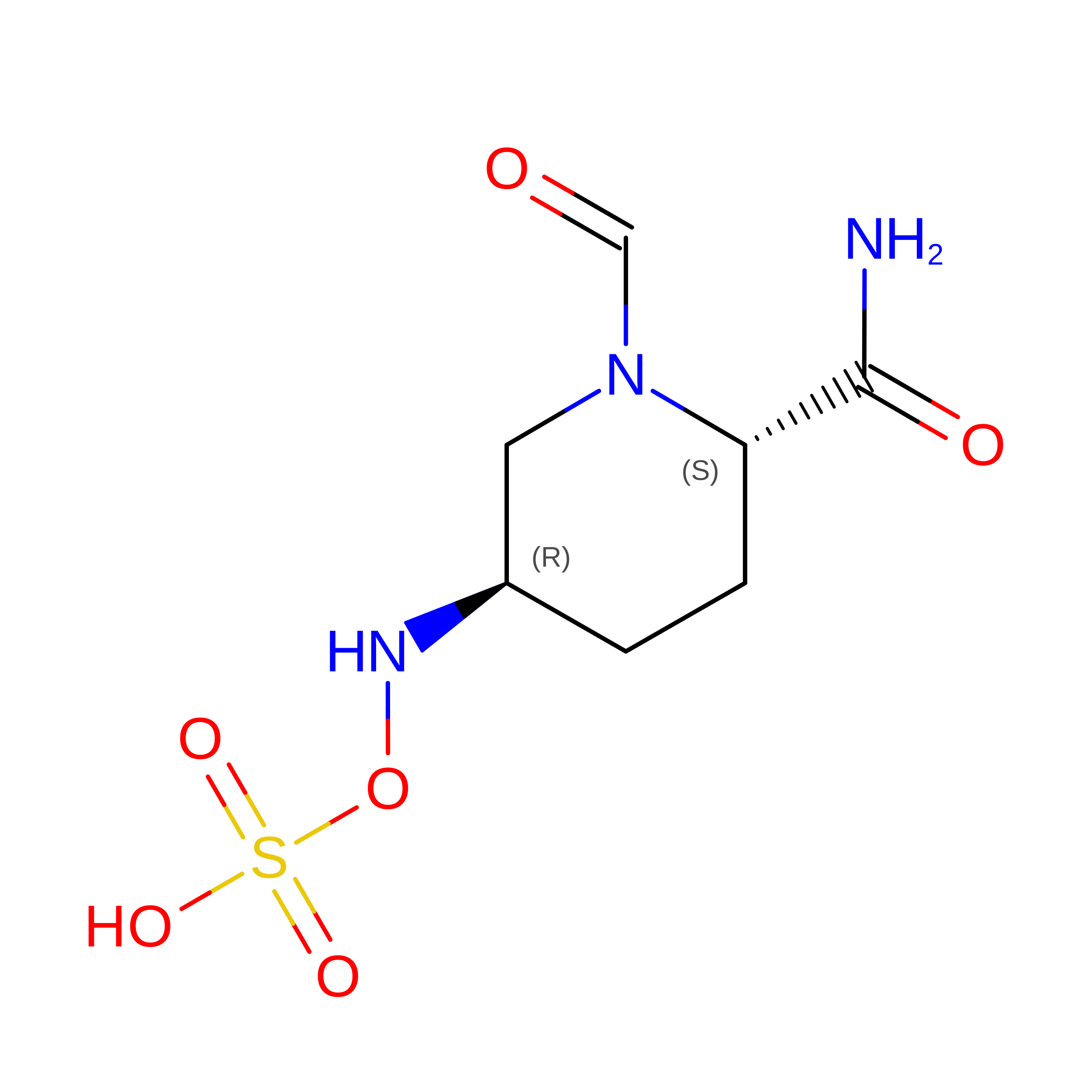
TEM-1 beta-lactamase covalently bound to avibactam


Experimental Data Snapshot

  • Method: X-RAY DIFFRACTION
  • Resolution: 1.72 Å
  • R-Value Free: 
    0.198 (Depositor), 0.198 (DCC) 
  • R-Value Work: 
    0.173 (Depositor), 0.173 (DCC) 
  • R-Value Observed: 
    0.174 (Depositor) 

Starting Model: experimental
View more details

wwPDB Validation 3D Report Full Report

Validation slider image for 8DE0

Ligand Structure Quality Assessment 


This is version 1.3 of the entry. See complete history

Literature

Protein Electric Fields Enable Faster and Longer-Lasting Covalent Inhibition of beta-Lactamases.

Ji, Z.Kozuch, J.Mathews, I.I.Diercks, C.S.Shamsudin, Y.Schulz, M.A.Boxer, S.G.

(2022) J Am Chem Soc 144: 20947-20954

  • DOI: https://doi.org/10.1021/jacs.2c09876
  • Primary Citation Related Structures: 
    7U6Q, 8DDZ, 8DE0, 8DE1, 8DE2

  • PubMed Abstract: 

    The widespread design of covalent drugs has focused on crafting reactive groups of proper electrophilicity and positioning toward targeted amino-acid nucleophiles. We found that environmental electric fields projected onto a reactive chemical bond, an overlooked design element, play essential roles in the covalent inhibition of TEM-1 β-lactamase by avibactam. Using the vibrational Stark effect, the magnitudes of the electric fields that are exerted by TEM active sites onto avibactam's reactive C═O were measured and demonstrate an electrostatic gating effect that promotes bond formation yet relatively suppresses the reverse dissociation. These results suggest new principles of covalent drug design and off-target site prediction. Unlike shape and electrostatic complementary which address binding constants, electrostatic catalysis drives reaction rates, essential for covalent inhibition, and deepens our understanding of chemical reactivity, selectivity, and stability in complex systems.


  • Organizational Affiliation
    • Department of Chemistry, Stanford University, Stanford, California 94305, United States.

Macromolecule Content 

  • Total Structure Weight: 116.94 kDa 
  • Atom Count: 9,284 
  • Modeled Residue Count: 1,048 
  • Deposited Residue Count: 1,056 
  • Unique protein chains: 1

Macromolecules

Find similar proteins by:|  3D Structure
Entity ID: 1
MoleculeChains  Sequence LengthOrganismDetailsImage
Beta-lactamase TEM
A, B, C, D
264Escherichia coliMutation(s): 1 
Gene Names: blaTEM-1
EC: 3.5.2.6
UniProt
Find proteins for P62593 (Escherichia coli)
Explore P62593 
Go to UniProtKB:  P62593
Entity Groups
Sequence Clusters30% Identity50% Identity70% Identity90% Identity95% Identity100% Identity
UniProt GroupP62593
Sequence Annotations
Expand
Reference Sequence

Experimental Data & Validation

Experimental Data

  • Method: X-RAY DIFFRACTION
  • Resolution: 1.72 Å
  • R-Value Free:  0.198 (Depositor), 0.198 (DCC) 
  • R-Value Work:  0.173 (Depositor), 0.173 (DCC) 
  • R-Value Observed: 0.174 (Depositor) 
Space Group: P 1 21 1
Unit Cell:
Length ( Å )Angle ( ˚ )
a = 60.65α = 90
b = 83.69β = 90.19
c = 95.57γ = 90
Software Package:
Software NamePurpose
XSCALEdata scaling
PHENIXrefinement
PDB_EXTRACTdata extraction
XDSdata reduction
MOLREPphasing

Structure Validation

View Full Validation Report


Ligand Structure Quality Assessment 


Entry History 

& Funding Information

Deposition Data


Funding OrganizationLocationGrant Number
National Institutes of Health/National Institute of General Medical Sciences (NIH/NIGMS)United StatesGM118044
National Institutes of Health/National Institute of General Medical Sciences (NIH/NIGMS)United StatesP30GM133894

Revision History  (Full details and data files)

  • Version 1.0: 2022-09-07
    Type: Initial release
  • Version 1.1: 2023-03-22
    Changes: Database references
  • Version 1.2: 2023-10-25
    Changes: Data collection, Refinement description
  • Version 1.3: 2024-11-13
    Changes: Structure summary