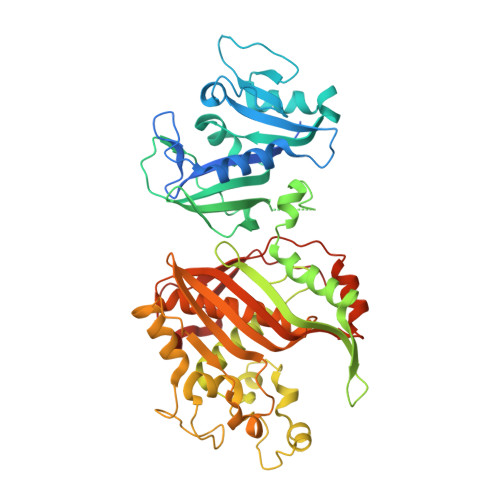
8DAE | pdb_00008dae

Arabidopsis thaliana bifunctional dihydrofolate reductase-thymidylate synthase


Experimental Data Snapshot

  • Method: X-RAY DIFFRACTION
  • Resolution: 2.00 Å
  • R-Value Free: 
    0.237 (Depositor), 0.238 (DCC) 
  • R-Value Work: 
    0.202 (Depositor), 0.203 (DCC) 

Starting Model: experimental
View more details

wwPDB Validation 3D Report Full Report

Validation slider image for 8DAE

This is version 1.2 of the entry. See complete history. 

Literature

Structural insights into a plant-conserved DHFR-TS reveal a selective herbicide target.

Haywood, J., Breese, K.J., McDougal, D.P., Verdonk, C., Partridge, A., Lo, A.F., Zhang, J., Yang, W.C., Bruning, J.B., Saliba, K.J., Bond, C.S., Stubbs, K.A., Mylne, J.S.

(2025) Mol Plant 18: 1294-1309

  • DOI: https://doi.org/10.1016/j.molp.2025.06.016
  • Primary Citation Related Structures: 
    8DAE

  • PubMed Abstract: 

    Modern agricultural practices rely on herbicides to reduce yield losses. Herbicide-resistant weeds threaten herbicide utility and, hence, food security. New herbicide modes of action and integrated pest-management practices are vital to mitigate this threat. As the antimalarials that target the bifunctional enzyme dihydrofolate reductase-thymidylate synthase (DHFR-TS) have been shown to be herbicidal, DHFR-TS might represent a mode-of-action target for the development of herbicides. Here, we present the crystal structure of a DHFR-TS (AtDHFR-TS1) from the model dicot Arabidopsis thaliana. It shows a divergent DHFR active site and a linker domain that challenges previous classifications of bifunctional DHFR-TS proteins. This plant-conserved architecture enabled us to develop highly selective herbicidal inhibitors of AtDHFR-TS1 over human DHFR and identify inhibitors with unique scaffolds via a large-library virtual screen. These results suggest that DHFR-TS is a viable herbicide target.


  • Organizational Affiliation: 
    • School of Molecular Sciences, The University of Western Australia, 35 Stirling Highway, Crawley, Perth, WA 6009, Australia; Centre for Crop and Disease Management, School of Molecular and Life Sciences, Curtin University, Kent Street, Bentley, Perth, WA 6102, Australia. Electronic address: joel.haywood@curtin.edu.au.

Macromolecule Content 

  • Total Structure Weight: 60.28 kDa 
  • Atom Count: 3,803 
  • Modeled Residue Count: 470 
  • Deposited Residue Count: 536 
  • Unique protein chains: 1

Macromolecules

Find similar proteins by:|  3D Structure
Entity ID: 1
MoleculeChains  Sequence LengthOrganismDetailsImage
Bifunctional dihydrofolate reductase-thymidylate synthase 1536Arabidopsis thalianaMutation(s): 0 
Gene Names: THY-1, At2g16370, F16F14.13
EC: 1.5.1.3 (PDB Primary Data), 2.1.1.45 (PDB Primary Data)
UniProt
Find proteins for Q05762 (Arabidopsis thaliana)
Explore Q05762 
Go to UniProtKB:  Q05762
Entity Groups
Sequence Clusters30% Identity50% Identity70% Identity90% Identity95% Identity100% Identity
UniProt GroupQ05762
Sequence Annotations
Expand
Reference Sequence

Experimental Data & Validation

Experimental Data

  • Method: X-RAY DIFFRACTION
  • Resolution: 2.00 Å
  • R-Value Free:  0.237 (Depositor), 0.238 (DCC) 
  • R-Value Work:  0.202 (Depositor), 0.203 (DCC) 
Space Group: P 42 21 2
Unit Cell:
Length ( Å )Angle ( ˚ )
a = 80.717α = 90
b = 80.717β = 90
c = 181.757γ = 90
Software Package:
Software NamePurpose
REFMACrefinement
XDSdata reduction
Aimlessdata scaling
PHASERphasing

Structure Validation

View Full Validation Report


Entry History 

& Funding Information

Deposition Data


Funding OrganizationLocationGrant Number
Australian Research Council (ARC)AustraliaDE180101445
Australian Research Council (ARC)AustraliaDP190101048

Revision History  (Full details and data files)

  • Version 1.0: 2023-06-21
    Type: Initial release
  • Version 1.1: 2023-10-25
    Changes: Data collection, Refinement description
  • Version 1.2: 2026-02-04
    Changes: Database references, Structure summary