Download Mendeley
Development of a highly active engineered PETase enzyme for polyester degradation.
Bhattacharya, S., Castagna, R., Estiri, H., Upmanis, T., Ricci, A., Gautieri, A., Parisini, E.(2026) FEBS J 293: 443-455
- PubMed: 40847613 Search on PubMedSearch on PubMed Central
- DOI: https://doi.org/10.1111/febs.70228
- Primary Citation Related Structures:
8CMV - PubMed Abstract:
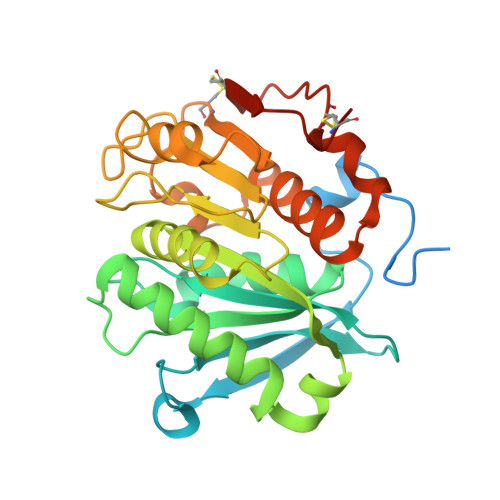
Polyethylene terephthalate (PET) accounts for ≈6% of global plastic production, contributing considerably to the global solid-waste stream and environmental plastic pollution. Since the discovery of PET-depolymerizing enzymes, enzymatic PET recycling has been regarded as a promising method for plastic disposal, particularly in the context of a circular economy strategy. However, because the PET-degrading enzymes developed so far suffer from relatively limited thermostability and low catalytic efficiency, as well as degradation product inhibition, their large-scale industrial applications are still largely hampered. To overcome these limitations, we engineered the current PET-hydrolyzing enzyme gold standard [the ICCG variant of leaf-branch compost cutinase (LCC-ICCG)] using in silico protein design methods to develop a PET-hydrolyzing enzyme that features enhanced thermal stability and PET depolymerization activity. Our mutant, LCC-ICCG-C09, features a 3.5 °C increase in melting temperature relative to the LCC-ICCG enzyme. Under optimal reaction conditions (68 °C), the engineered enzyme hydrolyzes amorphous PET material into terephthalic acid (TPA) with a two-fold higher efficiency compared to LCC-ICCG. Owing to its enhanced properties, LCC-ICCG-C09 may be a promising candidate for future applications in industrial PET recycling processes.
- Department of Biotechnology, Latvian Institute of Organic Synthesis, Riga, Latvia.
Organizational Affiliation: