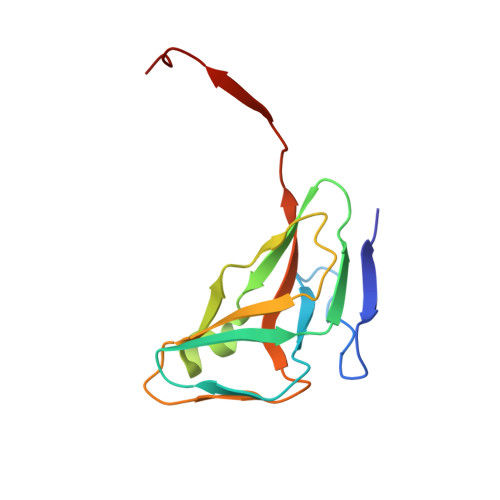
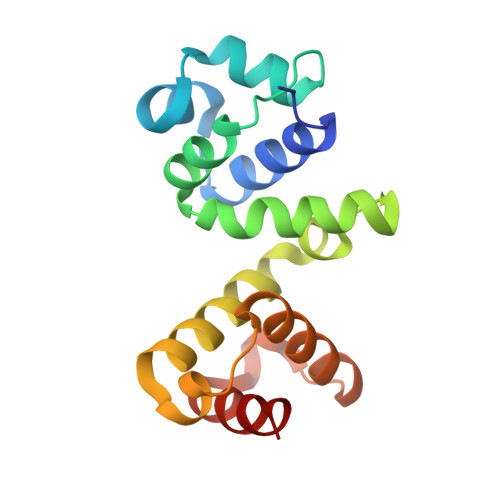
8C8I | pdb_00008c8i

Human dUTPase in complex with a potent proteinaceous inhibitor (Stl)


Experimental Data Snapshot

  • Method: X-RAY DIFFRACTION
  • Resolution: 3.20 Å
  • R-Value Free: 
    0.251 (Depositor), 0.240 (DCC) 
  • R-Value Work: 
    0.193 (Depositor), 0.190 (DCC) 
  • R-Value Observed: 
    0.196 (Depositor) 

Starting Models: experimental
View more details

wwPDB Validation   3D Report Full Report


This is version 1.1 of the entry. See complete history


Literature

Full-length inhibitor protein is the most effective to perturb human dUTPase activity.

Kohegyi, B.Toth, Z.S.Gal, E.Laczkovich, M.Benedek, A.Vertessy, B.G.Nyiri, K.

(2025) Sci Rep 15: 4836-4836

  • DOI: https://doi.org/10.1038/s41598-025-86131-7
  • Primary Citation of Related Structures:  
    8C8I

  • PubMed Abstract: 

    It has been demonstrated recently that knockout of the dUTPase enzyme leads to early embryonic lethality in mice. However, to explore the physiological processes arising upon the lack of dUTPase an effective and selective enzyme inhibitor is much needed. A highly specific and strong binding proteinaceous human dUTPase inhibitor described by us recently was a promising starting point to develop a molecular tool to study temporal and conditional dUTPase inhibition in cellulo. Towards this end we determined the 3D crystal structure of the crystallizable amino terminal domain of inhibitor protein, named Stl NT in complex with the human dUTPase and designed several point mutants based on the structure to improve the inhibition effectivity. The effect of Stl NT and a peptide derived from the full-length inhibitor on the activity of the human dUTPase was also tested. We showed that the C-terminal part of the Stl protein omitted from the crystal structure has an important role in the enzyme inhibition as the full-length Stl is needed to exert maximal inhibition on the human dUTPase.


  • Organizational Affiliation
    • Department of Applied Biotechnology and Food Science, Faculty of Chemical Technology and Biotechnology, Budapest University of Technology and Economics, Műegyetem rkp. 3, Budapest, 111, Hungary.

Macromolecules
Find similar proteins by:  (by identity cutoff)  |  3D Structure
Entity ID: 1
MoleculeChains Sequence LengthOrganismDetailsImage
Deoxyuridine 5'-triphosphate nucleotidohydrolase, mitochondrial
A, B, C
128Homo sapiensMutation(s): 0 
Gene Names: DUT
EC: 3.6.1.23
UniProt & NIH Common Fund Data Resources
Find proteins for P33316 (Homo sapiens)
Explore P33316 
Go to UniProtKB:  P33316
PHAROS:  P33316
GTEx:  ENSG00000128951 
Entity Groups  
Sequence Clusters30% Identity50% Identity70% Identity90% Identity95% Identity100% Identity
UniProt GroupP33316
Sequence Annotations
Expand
  • Reference Sequence
Find similar proteins by:  (by identity cutoff)  |  3D Structure
Entity ID: 2
MoleculeChains Sequence LengthOrganismDetailsImage
Orf20
D, E, F
147Staphylococcus aureusMutation(s): 0 
UniProt
Find proteins for Q9F0J8 (Staphylococcus aureus)
Explore Q9F0J8 
Go to UniProtKB:  Q9F0J8
Entity Groups  
Sequence Clusters30% Identity50% Identity70% Identity90% Identity95% Identity100% Identity
UniProt GroupQ9F0J8
Sequence Annotations
Expand
  • Reference Sequence
Small Molecules
Experimental Data & Validation

Experimental Data

  • Method: X-RAY DIFFRACTION
  • Resolution: 3.20 Å
  • R-Value Free:  0.251 (Depositor), 0.240 (DCC) 
  • R-Value Work:  0.193 (Depositor), 0.190 (DCC) 
  • R-Value Observed: 0.196 (Depositor) 
Space Group: P 21 21 21
Unit Cell:
Length ( Å )Angle ( ˚ )
a = 78.45α = 90
b = 82.66β = 90
c = 139.6γ = 90
Software Package:
Software NamePurpose
PHENIXrefinement
XDSdata reduction
SCALAdata scaling
PHASERphasing

Structure Validation

View Full Validation Report


Entry History & Funding Information

Deposition Data


Funding OrganizationLocationGrant Number
Hungarian National Research, Development and Innovation OfficeHungaryPD134324

Revision History  (Full details and data files)

  • Version 1.0: 2024-05-01
    Type: Initial release
  • Version 1.1: 2025-04-16
    Changes: Database references, Structure summary