Download Mendeley
Insight into Tetramolecular DNA G-Quadruplexes Associated with ALS and FTLD: Cation Interactions and Formation of Higher-Ordered Structure.
Zalar, M., Wang, B., Plavec, J., Sket, P.(2023) Int J Mol Sci 24
- PubMed: 37686239 Search on PubMedSearch on PubMed Central
- DOI: https://doi.org/10.3390/ijms241713437
- Primary Citation Related Structures:
8C7A, 8C7B - PubMed Abstract:
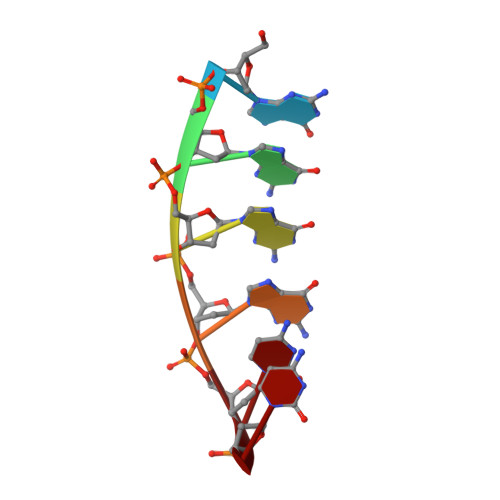
The G 4 C 2 hexanucleotide repeat expansion in the c9orf72 gene is a major genetic cause of familial amyotrophic lateral sclerosis (ALS) and frontotemporal lobar degeneration (FTLD), with the formation of G-quadruplexes directly linked to the development of these diseases. Cations play a crucial role in the formation and structure of G-quadruplexes. In this study, we investigated the impact of biologically relevant potassium ions on G-quadruplex structures and utilized 15 N-labeled ammonium cations as a substitute for K + ions to gain further insights into cation binding and exchange dynamics. Through nuclear magnetic resonance spectroscopy and molecular dynamics simulations, we demonstrate that the single d(G 4 C 2 ) repeat, in the presence of 15 NH 4 + ions, adopts a tetramolecular G-quadruplex with an all- syn quartet at the 5'-end. The movement of 15 NH 4 + ions through the central channel of the G-quadruplex, as well as to the bulk solution, is governed by the vacant cation binding site, in addition to the all- syn quartet at the 5'-end. Furthermore, the addition of K + ions to G-quadruplexes folded in the presence of 15 NH 4 + ions induces stacking of G-quadruplexes via their 5'-end G-quartets, leading to the formation of stable higher-ordered species.
- Slovenian NMR Center, National Institute of Chemistry, Hajdrihova 19, SI-1000 Ljubljana, Slovenia.
Organizational Affiliation: