8BDC | pdb_00008bdc

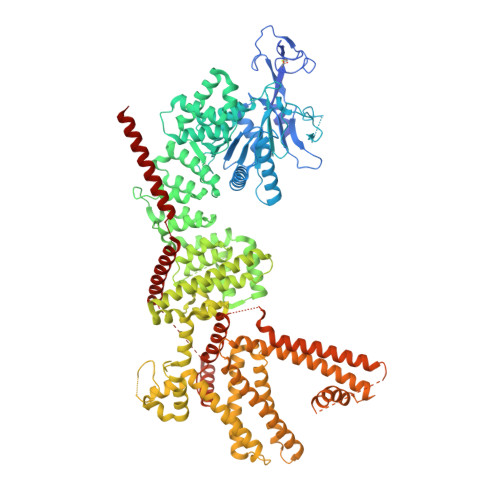
Human apo TRPM8 in a closed state (composite map)


Experimental Data Snapshot

  • Method: ELECTRON MICROSCOPY
  • Resolution: 2.65 Å
  • Aggregation State: PARTICLE 
  • Reconstruction Method: SINGLE PARTICLE 

wwPDB Validation 3D Report Full Report

Validation slider image for 8BDC

This is version 1.1 of the entry. See complete history

Literature

Structure of human TRPM8 channel.

Palchevskyi, S.Czarnocki-Cieciura, M.Vistoli, G.Gervasoni, S.Nowak, E.Beccari, A.R.Nowotny, M.Talarico, C.

(2023) Commun Biol 6: 1065-1065

  • DOI: https://doi.org/10.1038/s42003-023-05425-6
  • Primary Citation Related Structures: 
    8BDC

  • PubMed Abstract: 

    TRPM8 is a non-selective cation channel permeable to both monovalent and divalent cations that is activated by multiple factors, such as temperature, voltage, pressure, and changes in osmolality. It is a therapeutic target for anticancer drug development, and its modulators can be utilized for several pathological conditions. Here, we present a cryo-electron microscopy structure of a human TRPM8 channel in the closed state that was solved at 2.7 Å resolution. Our structure comprises the most complete model of the N-terminal pre-melastatin homology region. We also visualized several lipids that are bound by the protein and modeled how the human channel interacts with icilin. Analyses of pore helices in available TRPM structures showed that all these structures can be grouped into different closed, desensitized and open state conformations based on the register of the pore helix S6 which positions particular amino acid residues at the channel constriction.


  • Organizational Affiliation
    • Laboratory of Protein Structure, International Institute of Molecular and Cell Biology in Warsaw, 02-109, Warsaw, Poland.

Macromolecule Content 

  • Total Structure Weight: 519.36 kDa 
  • Atom Count: 30,132 
  • Modeled Residue Count: 3,852 
  • Deposited Residue Count: 4,420 
  • Unique protein chains: 1

Macromolecules

Find similar proteins by:|  3D Structure
Entity ID: 1
MoleculeChains  Sequence LengthOrganismDetailsImage
Transient receptor potential cation channel subfamily M member 8
A, B, C, D
1,105Homo sapiensMutation(s): 0 
Gene Names: TRPM8LTRPC6TRPP8
Membrane Entity: Yes 
UniProt & NIH Common Fund Data Resources
Find proteins for Q7Z2W7 (Homo sapiens)
Explore Q7Z2W7 
Go to UniProtKB:  Q7Z2W7
PHAROS:  Q7Z2W7
GTEx:  ENSG00000144481 
Entity Groups
Sequence Clusters30% Identity50% Identity70% Identity90% Identity95% Identity100% Identity
UniProt GroupQ7Z2W7
Sequence Annotations
Expand
Reference Sequence

Small Molecules

Ligands 4 Unique
IDChains Name / Formula / InChI Key2D Diagram3D Interactions
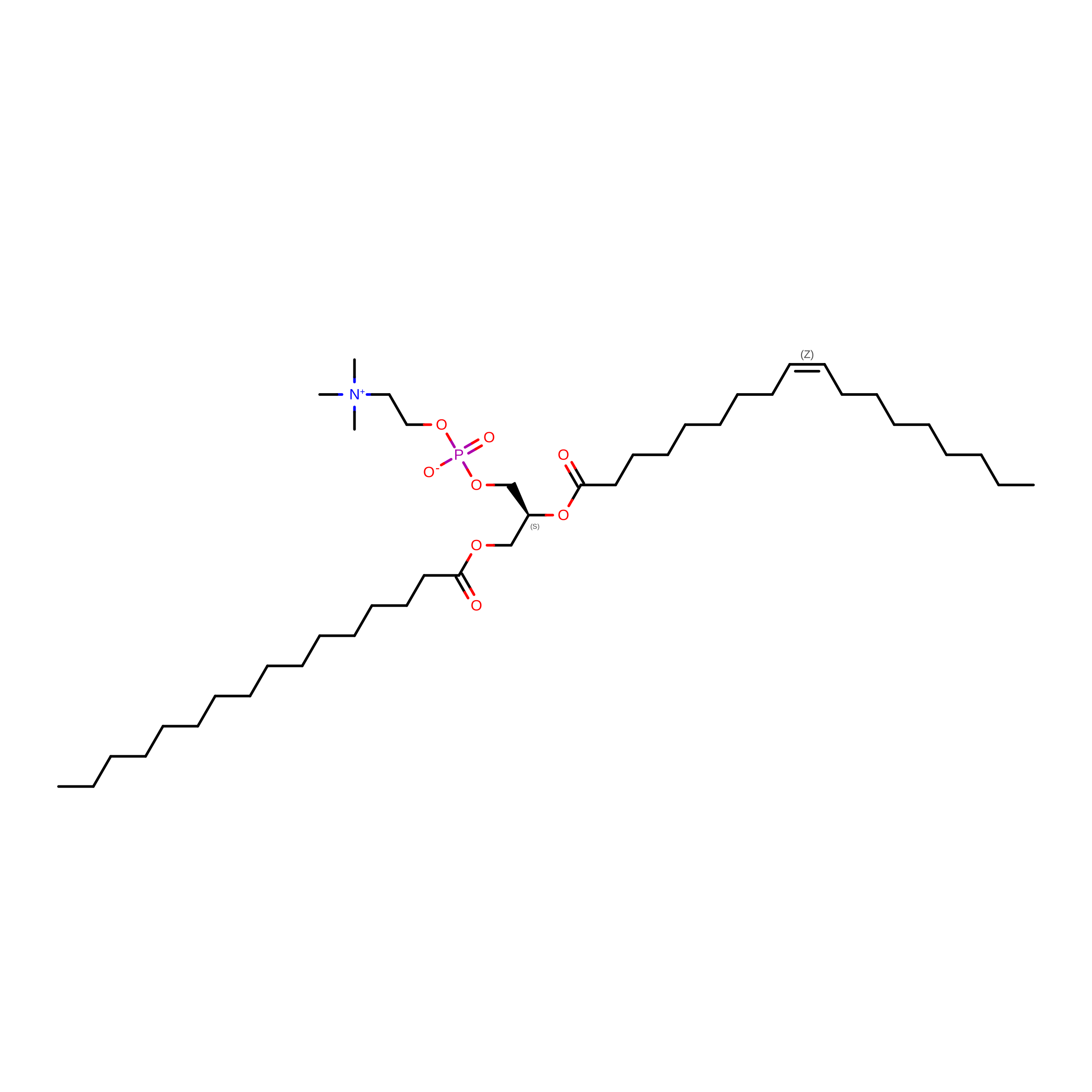
POV

Query on POV


Download:Ideal Coordinates CCD File
F [auth A],
L [auth B],
R [auth C],
X [auth D]
(2S)-3-(hexadecanoyloxy)-2-[(9Z)-octadec-9-enoyloxy]propyl 2-(trimethylammonio)ethyl phosphate
C42 H82 N O8 P
WTJKGGKOPKCXLL-PFDVCBLKSA-N
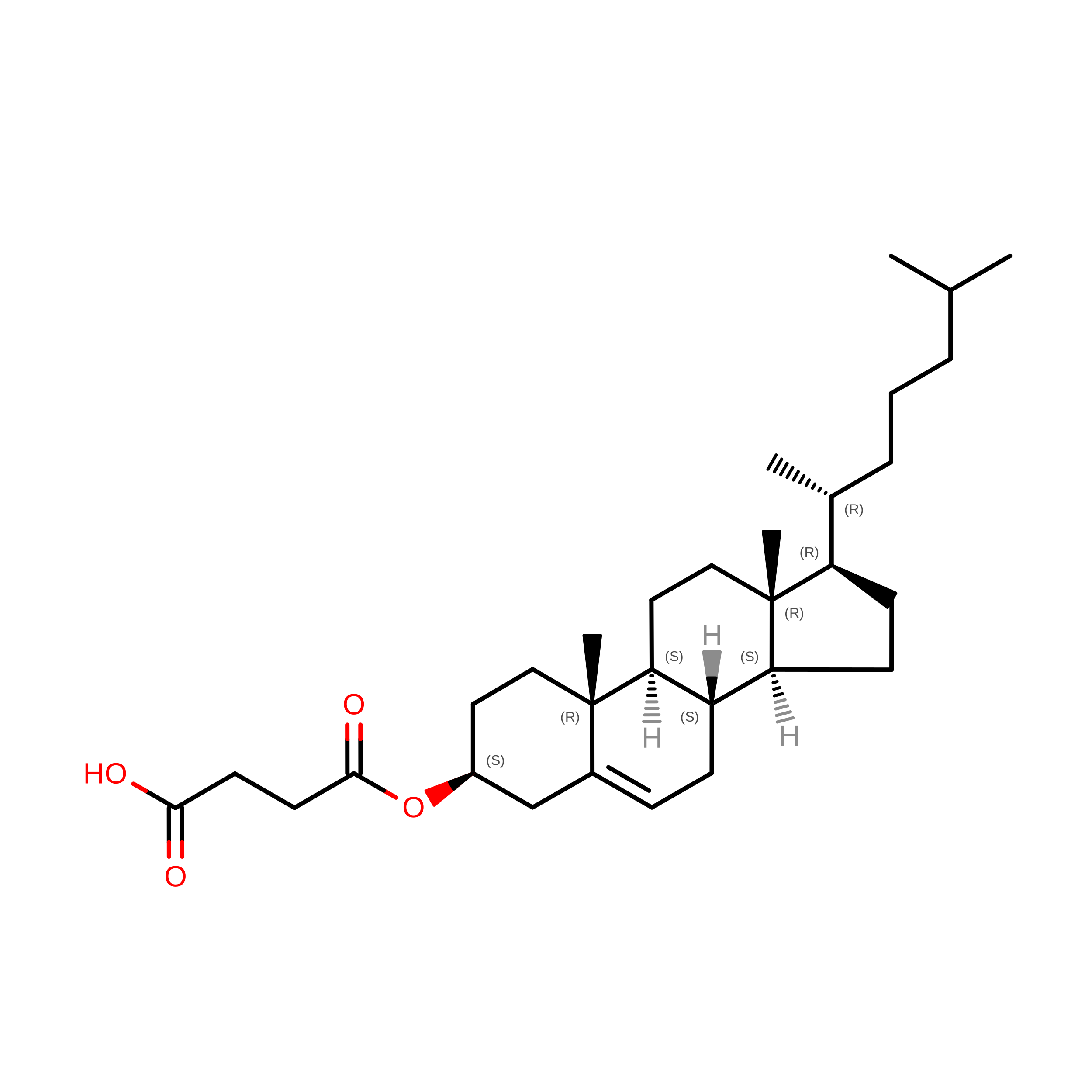
Y01

Query on Y01


Download:Ideal Coordinates CCD File
E [auth A]
G [auth A]
K [auth B]
M [auth B]
Q [auth C]
E [auth A],
G [auth A],
K [auth B],
M [auth B],
Q [auth C],
S [auth C],
W [auth D],
Y [auth D]
CHOLESTEROL HEMISUCCINATE
C31 H50 O4
WLNARFZDISHUGS-MIXBDBMTSA-N
UND

Query on UND


Download:Ideal Coordinates CCD File
H [auth A],
N [auth B],
T [auth C],
Z [auth D]
UNDECANE
C11 H24
RSJKGSCJYJTIGS-UHFFFAOYSA-N
NA

Query on NA


Download:Ideal Coordinates CCD File
AA [auth D]
BA [auth D]
I [auth A]
J [auth A]
O [auth B]
AA [auth D],
BA [auth D],
I [auth A],
J [auth A],
O [auth B],
P [auth B],
U [auth C],
V [auth C]
SODIUM ION
Na
FKNQFGJONOIPTF-UHFFFAOYSA-N

Experimental Data & Validation

Experimental Data

  • Method: ELECTRON MICROSCOPY
  • Resolution: 2.65 Å
  • Aggregation State: PARTICLE 
  • Reconstruction Method: SINGLE PARTICLE 
EM Software:
TaskSoftware PackageVersion
MODEL REFINEMENTPHENIX1.20
RECONSTRUCTIONcryoSPARC3.3.2

Structure Validation

View Full Validation Report


Entry History 

& Funding Information

Deposition Data


Funding OrganizationLocationGrant Number
Other governmentPoland--

Revision History  (Full details and data files)

  • Version 1.0: 2023-11-01
    Type: Initial release
  • Version 1.1: 2024-10-23
    Changes: Data collection, Structure summary