7YOX | pdb_00007yox

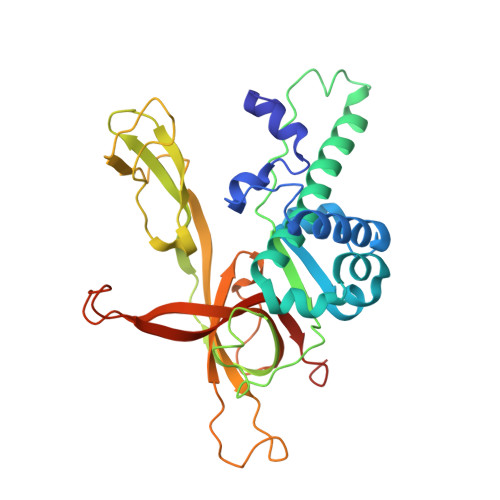
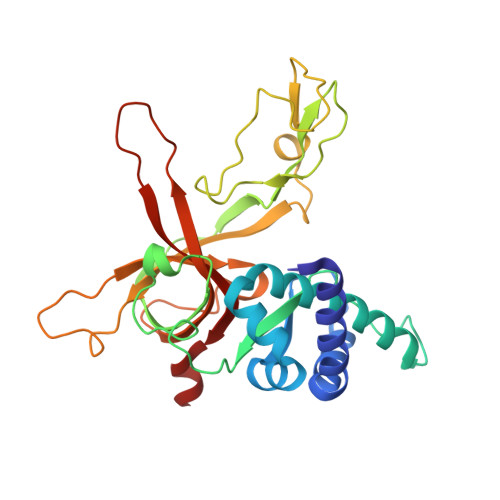
Cryo-EM structure of the N-terminal domain of hMCM8/9 and HROB


Experimental Data Snapshot

  • Method: ELECTRON MICROSCOPY
  • Resolution: 3.95 Å
  • Aggregation State: PARTICLE 
  • Reconstruction Method: SINGLE PARTICLE 

wwPDB Validation 3D Report Full Report

Validation slider image for 7YOX

This is version 1.2 of the entry. See complete history

Literature

Structural and mechanistic insights into the MCM8/9 helicase complex.

Weng, Z.Zheng, J.Zhou, Y.Lu, Z.Wu, Y.Xu, D.Li, H.Liang, H.Liu, Y.

(2023) Elife 12

  • DOI: https://doi.org/10.7554/eLife.87468
  • Primary Citation Related Structures: 
    7W7P, 7YOX

  • PubMed Abstract: 

    MCM8 and MCM9 form a functional helicase complex (MCM8/9) that plays an essential role in DNA homologous recombination repair for DNA double-strand break. However, the structural characterization of MCM8/9 for DNA binding/unwinding remains unclear. Here, we report structures of the MCM8/9 complex using cryo-electron microscopy single particle analysis. The structures reveal that MCM8/9 is arranged into a heterohexamer through a threefold symmetry axis, creating a central channel that accommodates DNA. Multiple characteristic hairpins from the N-terminal oligosaccharide/oligonucleotide (OB) domains of MCM8/9 protrude into the central channel and serve to unwind the duplex DNA. When activated by HROB, the structure of MCM8/9's N-tier ring converts its symmetry from C3 to C1 with a conformational change that expands the MCM8/9's trimer interface. Moreover, our structural dynamic analyses revealed that the flexible C-tier ring exhibited rotary motions relative to the N-tier ring, which is required for the unwinding ability of MCM8/9. In summary, our structural and biochemistry study provides a basis for understanding the DNA unwinding mechanism of MCM8/9 helicase in homologous recombination.


  • Organizational Affiliation
    • Shenzhen Key Laboratory for Systems Medicine in Inflammatory Diseases, School of Medicine, Shenzhen Campus of Sun Yat-sen University, Shenzhen, China.

Macromolecule Content 

  • Total Structure Weight: 201.16 kDa 
  • Atom Count: 13,878 
  • Modeled Residue Count: 1,749 
  • Deposited Residue Count: 1,776 
  • Unique protein chains: 2

Macromolecules

Find similar proteins by:|  3D Structure
Entity ID: 1
MoleculeChains  Sequence LengthOrganismDetailsImage
DNA helicase MCM8
A, C, F
316Homo sapiensMutation(s): 0 
Gene Names: MCM8C20orf154
EC: 3.6.4.12 (PDB Primary Data), 5.6.2.4 (UniProt)
UniProt & NIH Common Fund Data Resources
Find proteins for Q9UJA3 (Homo sapiens)
Explore Q9UJA3 
Go to UniProtKB:  Q9UJA3
PHAROS:  Q9UJA3
GTEx:  ENSG00000125885 
Entity Groups
Sequence Clusters30% Identity50% Identity70% Identity90% Identity95% Identity100% Identity
UniProt GroupQ9UJA3
Sequence Annotations
Expand
Reference Sequence
Find similar proteins by:|  3D Structure
Entity ID: 2
MoleculeChains  Sequence LengthOrganismDetailsImage
DNA helicase MCM9
B, D, E
276Homo sapiensMutation(s): 0 
Gene Names: MCM9C6orf61MCMDC1
EC: 3.6.4.12 (PDB Primary Data), 5.6.2.4 (UniProt)
UniProt & NIH Common Fund Data Resources
Find proteins for Q9NXL9 (Homo sapiens)
Explore Q9NXL9 
Go to UniProtKB:  Q9NXL9
PHAROS:  Q9NXL9
GTEx:  ENSG00000111877 
Entity Groups
Sequence Clusters30% Identity50% Identity70% Identity90% Identity95% Identity100% Identity
UniProt GroupQ9NXL9
Sequence Annotations
Expand
Reference Sequence

Experimental Data & Validation

Experimental Data

  • Method: ELECTRON MICROSCOPY
  • Resolution: 3.95 Å
  • Aggregation State: PARTICLE 
  • Reconstruction Method: SINGLE PARTICLE 

Structure Validation

View Full Validation Report


Entry History 

& Funding Information

Deposition Data


Funding OrganizationLocationGrant Number
National Natural Science Foundation of China (NSFC)China31530015

Revision History  (Full details and data files)

  • Version 1.0: 2023-08-09
    Type: Initial release
  • Version 1.1: 2023-12-06
    Changes: Data collection, Database references
  • Version 1.2: 2024-11-13
    Changes: Data collection, Structure summary