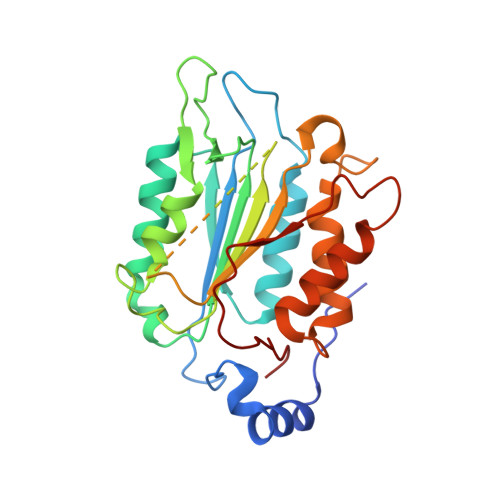
7WR0 | pdb_00007wr0

P32 of caspase-4 C258A mutant


Experimental Data Snapshot

  • Method: X-RAY DIFFRACTION
  • Resolution: 2.80 Å
  • R-Value Free: 
    0.266 (Depositor), 0.270 (DCC) 
  • R-Value Work: 
    0.238 (Depositor), 0.241 (DCC) 
  • R-Value Observed: 
    0.241 (Depositor) 

Starting Model: experimental
View more details

wwPDB Validation 3D Report Full Report

Validation slider image for 7WR0

This is version 1.3 of the entry. See complete history

Literature

Structural mechanisms of calmodulin activation of Shigella effector OspC3 to ADP-riboxanate caspase-4/11 and block pyroptosis.

Hou, Y.Zeng, H.Li, Z.Feng, N.Meng, F.Xu, Y.Li, L.Shao, F.Ding, J.

(2023) Nat Struct Mol Biol 30: 261-272

  • DOI: https://doi.org/10.1038/s41594-022-00888-3
  • Primary Citation Related Structures: 
    7WR0, 7WR1, 7WR2, 7WR3, 7WR4, 7WR5, 7WR6

  • PubMed Abstract: 

    The caspase-4/11-GSDMD pyroptosis axis recognizes cytosolic lipopolysaccharide for antibacterial defenses. Shigella flexneri employs an OspC3 effector to block pyroptosis by catalyzing NAD + -dependent arginine ADP-riboxanation of caspase-4/11. Here, we identify Ca 2+ -free calmodulin (CaM) that binds and stimulates OspC3 ADP-riboxanase activity. Crystal structures of OspC3-CaM and OspC3-caspase-4 binary complexes reveal unique CaM binding to an OspC3 N-terminal domain featuring an ADP-ribosyltransferase-like fold and specific recognition of caspase-4 by an OspC3 ankryin repeat domain, respectively. CaM-OspC3-caspase-4 ternary complex structures show that NAD + binding reorganizes the catalytic pocket, in which D231 and D177 activate the substrate arginine for initial ADP-ribosylation and ribosyl 2'-OH in the ADP-ribosylated arginine, respectively, for subsequent deamination. We also determine structures of unmodified and OspC3-ADP-riboxanated caspase-4. Mechanisms derived from this series of structures covering the entire process of OspC3 action are supported by biochemical analyses in vitro and functional validation in S. flexneri-infected mice.


  • Organizational Affiliation
    • National Laboratory of Biomacromolecules, CAS Center for Excellence in Biomacromolecules, Institute of Biophysics, Chinese Academy of Sciences, Beijing, China.

Macromolecule Content 

  • Total Structure Weight: 32.1 kDa 
  • Atom Count: 1,921 
  • Modeled Residue Count: 237 
  • Deposited Residue Count: 280 
  • Unique protein chains: 1

Macromolecules

Find similar proteins by:|  3D Structure
Entity ID: 1
MoleculeChains  Sequence LengthOrganismDetailsImage
Caspase-4280Homo sapiensMutation(s): 1 
Gene Names: CASP4
EC: 3.4.22.57
UniProt & NIH Common Fund Data Resources
Find proteins for P49662 (Homo sapiens)
Explore P49662 
Go to UniProtKB:  P49662
PHAROS:  P49662
GTEx:  ENSG00000196954 
Entity Groups
Sequence Clusters30% Identity50% Identity70% Identity90% Identity95% Identity100% Identity
UniProt GroupP49662
Sequence Annotations
Expand
Reference Sequence

Experimental Data & Validation

Experimental Data

  • Method: X-RAY DIFFRACTION
  • Resolution: 2.80 Å
  • R-Value Free:  0.266 (Depositor), 0.270 (DCC) 
  • R-Value Work:  0.238 (Depositor), 0.241 (DCC) 
  • R-Value Observed: 0.241 (Depositor) 
Space Group: P 32 2 1
Unit Cell:
Length ( Å )Angle ( ˚ )
a = 77.571α = 90
b = 77.571β = 90
c = 85.82γ = 120
Software Package:
Software NamePurpose
PHENIXrefinement
XDSdata reduction
XDSdata scaling
PHASERphasing

Structure Validation

View Full Validation Report


Entry History 

& Funding Information

Deposition Data


Funding OrganizationLocationGrant Number
Chinese Academy of SciencesChina--

Revision History  (Full details and data files)

  • Version 1.0: 2023-01-25
    Type: Initial release
  • Version 1.1: 2023-02-01
    Changes: Database references
  • Version 1.2: 2023-03-29
    Changes: Database references
  • Version 1.3: 2023-11-29
    Changes: Data collection, Refinement description