7U6P | pdb_00007u6p

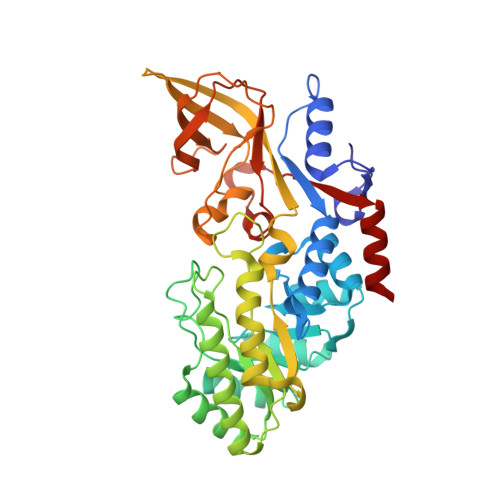
Structure of an intellectual disability-associated ornithine decarboxylase variant G84R


Experimental Data Snapshot

  • Method: X-RAY DIFFRACTION
  • Resolution: 2.35 Å
  • R-Value Free: 
    0.225 (Depositor), 0.226 (DCC) 
  • R-Value Work: 
    0.188 (Depositor), 0.189 (DCC) 
  • R-Value Observed: 
    0.191 (Depositor) 

Starting Model: experimental
View more details

wwPDB Validation 3D Report Full Report

Validation slider image for 7U6P

This is version 1.1 of the entry. See complete history

Literature

Structure and Enzymatic Activity of an Intellectual Disability-Associated Ornithine Decarboxylase Variant, G84R.

Zhou, X.E.Schultz, C.R.Suino Powell, K.Henrickson, A.Lamp, J.Brunzelle, J.S.Demeler, B.Vega, I.E.Bachmann, A.S.Melcher, K.

(2022) ACS Omega 7: 34665-34675

  • DOI: https://doi.org/10.1021/acsomega.2c04702
  • Primary Citation Related Structures: 
    7U6P, 7U6U

  • PubMed Abstract: 

    Ornithine decarboxylase (ODC) is a rate-limiting enzyme for the synthesis of polyamines (PAs). PAs are required for proliferation, and increased ODC activity is associated with cancer and neural over-proliferation. ODC levels and activity are therefore tightly regulated, including through the ODC-specific inhibitor, antizyme AZ1. Recently, ODC G84R has been reported as a partial loss-of-function variant that is associated with intellectual disability and seizures. However, G84 is distant from both the catalytic center and the ODC homodimerization interface. To understand how G84R modulates ODC activity, we have determined the crystal structure of ODC G84R in both the presence and the absence of the cofactor pyridoxal 5-phosphate. The structures show that the replacement of G84 by arginine leads to hydrogen bond formation of R84 with F420, the last residue of the ODC C-terminal helix, a structural element that is involved in the AZ1-mediated proteasomal degradation of ODC. In contrast, the catalytic center is essentially indistinguishable from that of wildtype ODC. We therefore reanalyzed the catalytic activity of ODC G84R and found that it is rescued when the protein is purified in the presence of a reducing agent to mimic the reducing environment of the cytoplasm. This suggests that R84 may exert its neurological effects not through reducing ODC catalytic activity but through misregulation of its AZ1-mediated proteasomal degradation.


  • Organizational Affiliation
    • Department of Structural Biology, Van Andel Institute, Grand Rapids, Michigan 49503, United States.

Macromolecule Content 

  • Total Structure Weight: 94.87 kDa 
  • Atom Count: 6,679 
  • Modeled Residue Count: 813 
  • Deposited Residue Count: 848 
  • Unique protein chains: 1

Macromolecules

Find similar proteins by:|  3D Structure
Entity ID: 1
MoleculeChains  Sequence LengthOrganismDetailsImage
Ornithine decarboxylase
A, B
424Homo sapiensMutation(s): 1 
Gene Names: ODC1
EC: 4.1.1.17
UniProt & NIH Common Fund Data Resources
Find proteins for P11926 (Homo sapiens)
Explore P11926 
Go to UniProtKB:  P11926
PHAROS:  P11926
GTEx:  ENSG00000115758 
Entity Groups
Sequence Clusters30% Identity50% Identity70% Identity90% Identity95% Identity100% Identity
UniProt GroupP11926
Sequence Annotations
Expand
Reference Sequence

Experimental Data & Validation

Experimental Data

  • Method: X-RAY DIFFRACTION
  • Resolution: 2.35 Å
  • R-Value Free:  0.225 (Depositor), 0.226 (DCC) 
  • R-Value Work:  0.188 (Depositor), 0.189 (DCC) 
  • R-Value Observed: 0.191 (Depositor) 
Space Group: P 21 21 21
Unit Cell:
Length ( Å )Angle ( ˚ )
a = 74.806α = 90
b = 85.879β = 90
c = 154.738γ = 90
Software Package:
Software NamePurpose
PHENIXrefinement
PDB_EXTRACTdata extraction
MOSFLMdata reduction
pointlessdata scaling
PHASERphasing

Structure Validation

View Full Validation Report


Entry History 

& Funding Information

Deposition Data


Funding OrganizationLocationGrant Number
National Institutes of Health/National Institute of General Medical Sciences (NIH/NIGMS)United StatesGM120600
Canada Research ChairsCanadaC150-2017-00015
Canada Foundation for InnovationCanadaCFI-37589

Revision History  (Full details and data files)

  • Version 1.0: 2022-10-19
    Type: Initial release
  • Version 1.1: 2023-10-18
    Changes: Data collection, Refinement description