7TFM | pdb_00007tfm

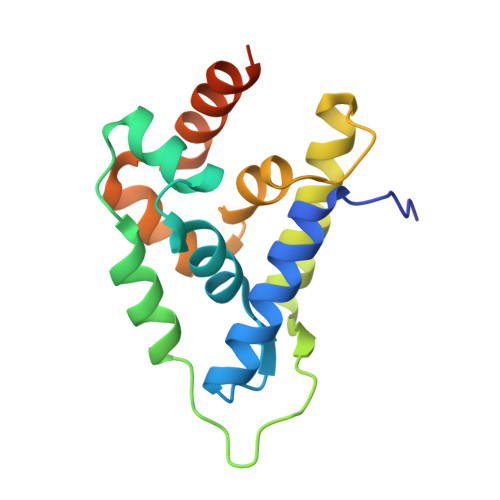
Atomic Structure of the Leishmania spp. Hsp100 N-Domain


Experimental Data Snapshot

  • Method: X-RAY DIFFRACTION
  • Resolution: 1.05 Å
  • R-Value Free: 
    0.153 (Depositor), 0.156 (DCC) 
  • R-Value Work: 
    0.134 (Depositor), 0.137 (DCC) 
  • R-Value Observed: 
    0.135 (Depositor) 

Starting Model: experimental
View more details

wwPDB Validation 3D Report Full Report

Validation slider image for 7TFM

This is version 1.2 of the entry. See complete history

Literature

Atomic structure of the Leishmania spp. Hsp100 N-domain.

Mercado, J.M.Lee, S.Chang, C.Sung, N.Soong, L.Catic, A.Tsai, F.T.F.

(2022) Proteins 90: 1242-1246

  • DOI: https://doi.org/10.1002/prot.26310
  • Primary Citation Related Structures: 
    7TFM

  • PubMed Abstract: 

    Hsp100 is an ATP-dependent unfoldase that promotes protein disaggregation or facilitates the unfolding of aggregation-prone polypeptides marked for degradation. Recently, new Hsp100 functions are emerging. In Plasmodium, an Hsp100 drives malaria protein export, presenting a novel drug target. Whether Hsp100 has a similar function in other protists is unknown. We present the 1.06 Å resolution crystal structure of the Hsp100 N-domain from Leishmania spp., the causative agent of leishmaniasis in humans. Our structure reveals a network of methionines and aromatic amino acids that define the putative substrate-binding site and likely evolved to protect Hsp100 from oxidative damage in host immune cells.


  • Organizational Affiliation
    • Department of Molecular and Cellular Biology, Baylor College of Medicine, Houston, Texas, USA.

Macromolecule Content 

  • Total Structure Weight: 17.52 kDa 
  • Atom Count: 1,349 
  • Modeled Residue Count: 142 
  • Deposited Residue Count: 158 
  • Unique protein chains: 1

Macromolecules

Find similar proteins by:|  3D Structure
Entity ID: 1
MoleculeChains  Sequence LengthOrganismDetailsImage
ATP-dependent Clp protease subunit, heat shock protein 100 (HSP100)158Leishmania mexicana MHOM/GT/2001/U1103Mutation(s): 0 
Gene Names: LMXM_08_29_1270
UniProt
Find proteins for E9ALU6 (Leishmania mexicana (strain MHOM/GT/2001/U1103))
Explore E9ALU6 
Go to UniProtKB:  E9ALU6
Entity Groups
Sequence Clusters30% Identity50% Identity70% Identity90% Identity95% Identity100% Identity
UniProt GroupE9ALU6
Sequence Annotations
Expand
Reference Sequence

Small Molecules

Ligands 1 Unique
IDChains Name / Formula / InChI Key2D Diagram3D Interactions
GOL

Query on GOL


Download:Ideal Coordinates CCD File
B [auth A]GLYCEROL
C3 H8 O3
PEDCQBHIVMGVHV-UHFFFAOYSA-N

Experimental Data & Validation

Experimental Data

  • Method: X-RAY DIFFRACTION
  • Resolution: 1.05 Å
  • R-Value Free:  0.153 (Depositor), 0.156 (DCC) 
  • R-Value Work:  0.134 (Depositor), 0.137 (DCC) 
  • R-Value Observed: 0.135 (Depositor) 
Space Group: P 41 21 2
Unit Cell:
Length ( Å )Angle ( ˚ )
a = 60.971α = 90
b = 60.971β = 90
c = 71.807γ = 90
Software Package:
Software NamePurpose
PHENIXrefinement
PDB_EXTRACTdata extraction
HKL-3000data reduction
HKL-3000data scaling
PHASERphasing

Structure Validation

View Full Validation Report


Entry History 

& Funding Information

Deposition Data


Funding OrganizationLocationGrant Number
National Institutes of Health/National Institute of General Medical Sciences (NIH/NIGMS)United StatesR01-GM104980
National Institutes of Health/National Institute of General Medical Sciences (NIH/NIGMS)United StatesR01-GM142143
National Institutes of Health/National Institute of Diabetes and Digestive and Kidney Disease (NIH/NIDDK)United StatesR01-DK115454
Cancer Prevention and Research Institute of Texas (CPRIT)United StatesRR140038
National Institutes of Health/National Institute of General Medical Sciences (NIH/NIGMS)United StatesS10-OD030246
Welch FoundationUnited StatesQ-1530-20190330
Department of Energy (DOE, United States)United StatesDE-AC02-06CH11357
National Institutes of Health/National Institute of General Medical Sciences (NIH/NIGMS)United StatesT32-GM008289

Revision History  (Full details and data files)

  • Version 1.0: 2022-02-16
    Type: Initial release
  • Version 1.1: 2022-04-27
    Changes: Database references
  • Version 1.2: 2023-10-18
    Changes: Data collection, Refinement description