7RRW | pdb_00007rrw

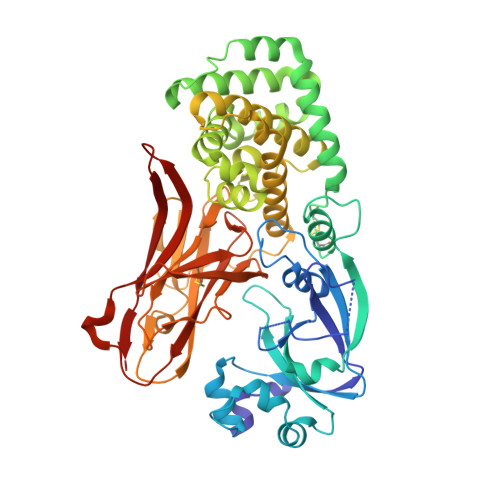
Monomeric CRM197 expressed in E. coli


Experimental Data Snapshot

  • Method: X-RAY DIFFRACTION
  • Resolution: 2.00 Å
  • R-Value Free: 
    0.217 (Depositor), 0.217 (DCC) 
  • R-Value Work: 
    0.178 (Depositor), 0.179 (DCC) 
  • R-Value Observed: 
    0.180 (Depositor) 

Starting Model: experimental
View more details

wwPDB Validation 3D Report Full Report

Validation slider image for 7RRW

This is version 1.3 of the entry. See complete history

Literature

Monomeric crystal structure of the vaccine carrier protein CRM 197 and implications for vaccine development.

Gallagher, D.T.Oganesyan, N.Lees, A.

(2023) Acta Crystallogr F Struct Biol Commun 79: 82-86

  • DOI: https://doi.org/10.1107/S2053230X23002364
  • Primary Citation Related Structures: 
    7RRW

  • PubMed Abstract: 

    CRM 197 is a genetically detoxified mutant of diphtheria toxin (DT) that is widely used as a carrier protein in conjugate vaccines. Protective immune responses to several bacterial diseases are obtained by coupling CRM 197 to glycans from these pathogens. Wild-type DT has been described in two oligomeric forms: a monomer and a domain-swapped dimer. Their proportions depend on the chemical conditions and especially the pH, with a large kinetic barrier to interconversion. A similar situation occurs in CRM 197 , where the monomer is preferred for vaccine synthesis. Despite 30 years of research and the increasing application of CRM 197 in conjugate vaccines, until now all of its available crystal structures have been dimeric. Here, CRM 197 was expressed as a soluble, intracellular protein in an Escherichia coli strain engineered to have an oxidative cytoplasm. The purified product, called EcoCRM, remained monomeric throughout crystallization. The structure of monomeric EcoCRM is reported at 2.0 Å resolution with the domain-swapping hinge loop (residues 379-387) in an extended, exposed conformation, similar to monomeric wild-type DT. The structure enables comparisons across expression systems and across oligomeric states, with implications for monomer-dimer interconversion and for the optimization of conjugation.


  • Organizational Affiliation
    • National Institute of Standards and Technology, 9600 Gudelsky Drive, Rockville, MD 20850, USA.

Macromolecule Content 

  • Total Structure Weight: 58.61 kDa 
  • Atom Count: 4,316 
  • Modeled Residue Count: 506 
  • Deposited Residue Count: 535 
  • Unique protein chains: 1

Macromolecules

Find similar proteins by:|  3D Structure
Entity ID: 1
MoleculeChains  Sequence LengthOrganismDetailsImage
Diphtheria toxin535Corynebacterium diphtheriaeMutation(s): 1 
EC: 2.4.2.36
UniProt
Find proteins for Q6NK15 (Corynebacterium diphtheriae (strain ATCC 700971 / NCTC 13129 / Biotype gravis))
Explore Q6NK15 
Go to UniProtKB:  Q6NK15
Entity Groups
Sequence Clusters30% Identity50% Identity70% Identity90% Identity95% Identity100% Identity
UniProt GroupQ6NK15
Sequence Annotations
Expand
Reference Sequence

Small Molecules

Ligands 1 Unique
IDChains Name / Formula / InChI Key2D Diagram3D Interactions
TRS

Query on TRS


Download:Ideal Coordinates CCD File
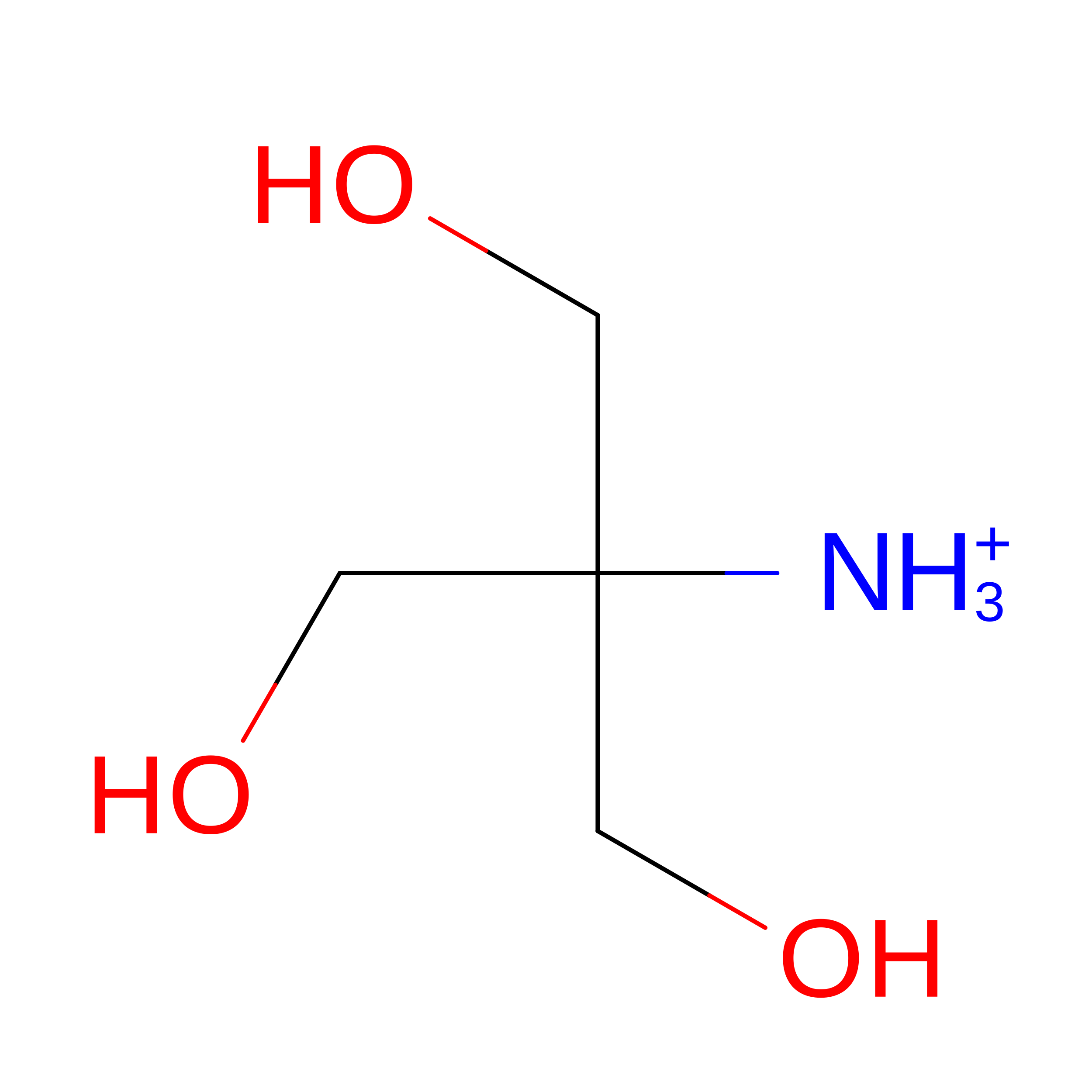
B [auth A]2-AMINO-2-HYDROXYMETHYL-PROPANE-1,3-DIOL
C4 H12 N O3
LENZDBCJOHFCAS-UHFFFAOYSA-O

Experimental Data & Validation

Experimental Data

  • Method: X-RAY DIFFRACTION
  • Resolution: 2.00 Å
  • R-Value Free:  0.217 (Depositor), 0.217 (DCC) 
  • R-Value Work:  0.178 (Depositor), 0.179 (DCC) 
  • R-Value Observed: 0.180 (Depositor) 
Space Group: P 1 21 1
Unit Cell:
Length ( Å )Angle ( ˚ )
a = 59.024α = 90
b = 81.671β = 110.87
c = 71.758γ = 90
Software Package:
Software NamePurpose
REFMACrefinement
PDB_EXTRACTdata extraction
XDSdata reduction
X-GENdata scaling
PHASERphasing

Structure Validation

View Full Validation Report


Entry History 

& Funding Information

Deposition Data


Funding OrganizationLocationGrant Number
Other governmentUnited States--

Revision History  (Full details and data files)

  • Version 1.0: 2022-11-09
    Type: Initial release
  • Version 1.1: 2023-05-31
    Changes: Database references
  • Version 1.2: 2023-10-25
    Changes: Data collection, Refinement description
  • Version 1.3: 2024-10-23
    Changes: Structure summary