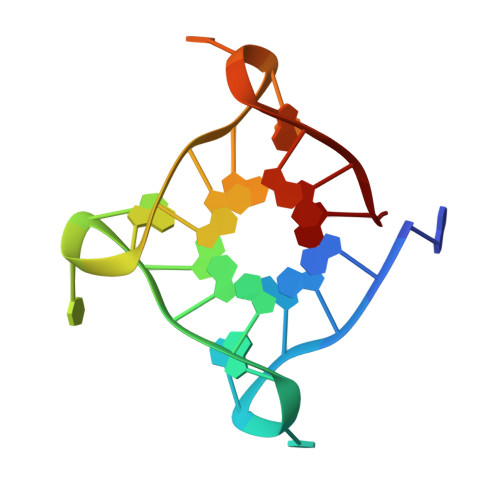
7PNL | pdb_00007pnl

Complex between monomolecular human telomeric G-quadruplex and a sulfonamide derivative of the natural alkaloid Berberine


Experimental Data Snapshot

  • Method: X-RAY DIFFRACTION
  • Resolution: 1.83 Å
  • R-Value Free: 
    0.321 (Depositor) 
  • R-Value Work: 
    0.204 (Depositor) 
  • R-Value Observed: 
    0.209 (Depositor) 

Starting Model: experimental
View more details

wwPDB Validation 3D Report Full Report

Currently 7PNL does not have a validation slider image.


This is version 1.2 of the entry. See complete history. 

Literature

Development of a multi-targeted chemotherapeutic approach based on G-quadruplex stabilisation and carbonic anhydrase inhibition.

Nocentini, A., Di Porzio, A., Bonardi, A., Bazzicalupi, C., Petreni, A., Biver, T., Bua, S., Marzano, S., Amato, J., Pagano, B., Iaccarino, N., De Tito, S., Amente, S., Supuran, C.T., Randazzo, A., Gratteri, P.

(2024) J Enzyme Inhib Med Chem 39: 2366236-2366236

  • DOI: https://doi.org/10.1080/14756366.2024.2366236
  • Primary Citation Related Structures: 
    7PNL

  • PubMed Abstract: 

    A novel class of compounds designed to hit two anti-tumour targets, G-quadruplex structures and human carbonic anhydrases (hCAs) IX and XII is proposed. The induction/stabilisation of G-quadruplex structures by small molecules has emerged as an anticancer strategy, disrupting telomere maintenance and reducing oncogene expression. hCAs IX and XII are well-established anti-tumour targets, upregulated in many hypoxic tumours and contributing to metastasis. The ligands reported feature a berberine G-quadruplex stabiliser scaffold connected to a moiety inhibiting hCAs IX and XII. In vitro experiments showed that our compounds selectively stabilise G-quadruplex structures and inhibit hCAs IX and XII. The crystal structure of a telomeric G-quadruplex in complex with one of these ligands was obtained, shedding light on the ligand/target interaction mode. The most promising ligands showed significant cytotoxicity against CA IX-positive HeLa cancer cells in hypoxia, and the ability to stabilise G-quadruplexes within tumour cells.


  • Organizational Affiliation: 
    • NEUROFARBA Department, Pharmaceutical and Nutraceutical Section and Laboratory of Molecular Modeling Cheminformatics & QSAR, University of Florence, Sesto Fiorentino, Florence, Italy.

Macromolecule Content 

  • Total Structure Weight: 8.64 kDa 
  • Atom Count: 598 
  • Modeled Residue Count: 23 
  • Deposited Residue Count: 23 
  • Unique nucleic acid chains: 1

Macromolecules

Find similar nucleic acids by:  Sequence
Entity ID: 1
MoleculeChains LengthOrganismImage
G-guadruplex DNA (23-mer)23Homo sapiens
Sequence Annotations
Expand
Reference Sequence

Small Molecules

Ligands 2 Unique
IDChains Name / Formula / InChI Key2D Diagram3D Interactions
7VE
(Subject of Investigation/LOI)

Query on 7VE


Download:Ideal Coordinates CCD File
E [auth A],
F [auth A]
4-[[1-[3-[(17-methoxy-5,7-dioxa-13-azoniapentacyclo[11.8.0.0^{2,10}.0^{4,8}.0^{15,20}]henicosa-1(21),2(10),3,8,13,15,17,19-octaen-16-yl)oxy]propyl]triazol-4-yl]methoxy]benzenesulfonamide
C31 H30 N5 O7 S
ZPZQYKHNQSCVCG-UHFFFAOYSA-N
K

Query on K


Download:Ideal Coordinates CCD File
B [auth A],
C [auth A],
D [auth A]
POTASSIUM ION
K
NPYPAHLBTDXSSS-UHFFFAOYSA-N

Experimental Data & Validation

Experimental Data

  • Method: X-RAY DIFFRACTION
  • Resolution: 1.83 Å
  • R-Value Free:  0.321 (Depositor) 
  • R-Value Work:  0.204 (Depositor) 
  • R-Value Observed: 0.209 (Depositor) 
Space Group: C 1 2 1
Unit Cell:
Length ( Å )Angle ( ˚ )
a = 36.842α = 90
b = 72.717β = 90.1
c = 27.028γ = 90
Software Package:
Software NamePurpose
REFMACrefinement
PDB_EXTRACTdata extraction
XDSdata reduction
XSCALEdata scaling
MOLREPphasing

Structure Validation

View Full Validation Report

Currently 7PNL does not have a validation slider image.


Entry History 

& Funding Information

Deposition Data


Funding OrganizationLocationGrant Number
Other governmentFFARB2018
Other governmentCARLABAZZICALUPIRICATEN2020

Revision History  (Full details and data files)

  • Version 1.0: 2022-09-21
    Type: Initial release
  • Version 1.1: 2024-01-31
    Changes: Data collection, Refinement description
  • Version 1.2: 2024-07-24
    Changes: Database references