Download Mendeley
A conserved isoleucine in the binding pocket of RIG-I controls immune tolerance to mitochondrial RNA.
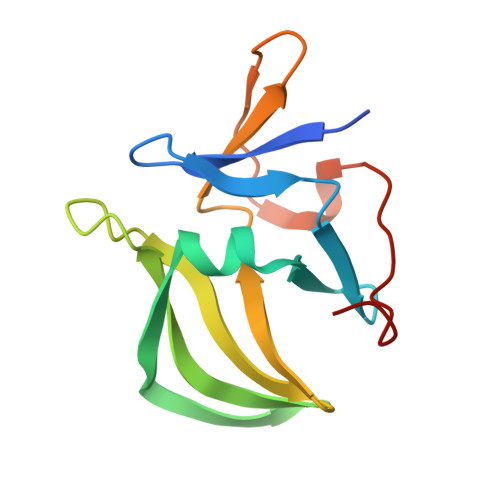
de Regt, A.K., Anand, K., Ciupka, K., Bender, F., Gatterdam, K., Putschli, B., Fussholler, D., Hilbig, D., Kirchhoff, A., Hunkler, C., Wolter, S., Grunewald, A., Wallerath, C., Schuberth-Wagner, C., Ludwig, J., Paeschke, K., Bartok, E., Hagelueken, G., Hartmann, G., Zillinger, T., Geyer, M., Schlee, M.(2023) Nucleic Acids Res 51: 11893-11910
- PubMed: 37831086 Search on PubMedSearch on PubMed Central
- DOI: https://doi.org/10.1093/nar/gkad835
- Primary Citation Related Structures:
7BAH, 7BAI - PubMed Abstract:
RIG-I is a cytosolic receptor of viral RNA essential for the immune response to numerous RNA viruses. Accordingly, RIG-I must sensitively detect viral RNA yet tolerate abundant self-RNA species. The basic binding cleft and an aromatic amino acid of the RIG-I C-terminal domain(CTD) mediate high-affinity recognition of 5'triphosphorylated and 5'base-paired RNA(dsRNA). Here, we found that, while 5'unmodified hydroxyl(OH)-dsRNA demonstrated residual activation potential, 5'-monophosphate(5'p)-termini, present on most cellular RNAs, prevented RIG-I activation. Determination of CTD/dsRNA co-crystal structures and mutant activation studies revealed that the evolutionarily conserved I875 within the CTD sterically inhibits 5'p-dsRNA binding. RIG-I(I875A) was activated by both synthetic 5'p-dsRNA and endogenous long dsRNA within the polyA-rich fraction of total cellular RNA. RIG-I(I875A) specifically interacted with long, polyA-bearing, mitochondrial(mt) RNA, and depletion of mtRNA from total RNA abolished its activation. Altogether, our study demonstrates that avoidance of 5'p-RNA recognition is crucial to prevent mtRNA-triggered RIG-I-mediated autoinflammation.
- Department of Clinical Chemistry and Clinical Pharmacology, University Hospital Bonn, Bonn, Germany.
Organizational Affiliation: