7ZS2 | pdb_00007zs2

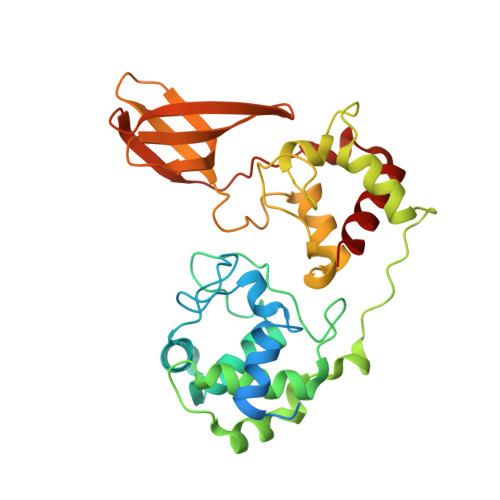
Diheme cytochrome c Kustd1711 from Kuenenia stuttgartiensis, M292H mutant


Experimental Data Snapshot

  • Method: X-RAY DIFFRACTION
  • Resolution: 1.12 Å
  • R-Value Free: 
    0.143 (Depositor), 0.143 (DCC) 
  • R-Value Work: 
    0.125 (Depositor), 0.126 (DCC) 
  • R-Value Observed: 
    0.126 (Depositor) 

Starting Model: experimental
View more details

wwPDB Validation 3D Report Full Report

Validation slider image for 7ZS2

Ligand Structure Quality Assessment 


This is version 2.3 of the entry. See complete history

Literature

Redox potential tuning by calcium ions in a novel c-type cytochrome from an anammox organism.

Akram, M.Hauser, D.Dietl, A.Steigleder, M.Ullmann, G.M.Barends, T.R.M.

(2024) J Biological Chem : 108082-108082

  • DOI: https://doi.org/10.1016/j.jbc.2024.108082
  • Primary Citation Related Structures: 
    7ZS0, 7ZS1, 7ZS2, 9FBK

  • PubMed Abstract: 

    The electrochemical potentials of redox-active proteins need to be tuned accurately to the correct values for proper biological function. Here we describe a diheme cytochrome c with high heme redox potentials of about +350 mV, despite having a large overall negative charge which typically reduces redox potentials. High resolution crystal structures, spectroelectrochemical measurements and high-end computational methods show how this is achieved: each heme iron has a calcium cation positioned next to it at a distance of only 6.9 Å, raising their redox potentials by several hundred mV through electrostatic interaction. We suggest that this has evolved to provide the protein with a high redox potential despite its large negative surface charge, which it likely requires for interactions with redox partners.


  • Organizational Affiliation
    • Department of Biomolecular Mechanisms, Max Planck Institute for Medical Research, Jahnstrasse 29, D-69120 Heidelberg, Germany.

Macromolecule Content 

  • Total Structure Weight: 35.77 kDa 
  • Atom Count: 2,808 
  • Modeled Residue Count: 278 
  • Deposited Residue Count: 316 
  • Unique protein chains: 1

Macromolecules

Find similar proteins by:|  3D Structure
Entity ID: 1
MoleculeChains  Sequence LengthOrganismDetailsImage
Hypothetical (Diheme) protein316Candidatus KueneniaMutation(s): 1 
Gene Names: KsCSTR_07890KSMBR1_1466kustd1711
UniProt
Find proteins for Q1PZE6 (Kuenenia stuttgartiensis)
Explore Q1PZE6 
Go to UniProtKB:  Q1PZE6
Entity Groups
Sequence Clusters30% Identity50% Identity70% Identity90% Identity95% Identity100% Identity
UniProt GroupQ1PZE6
Sequence Annotations
Expand
Reference Sequence

Small Molecules

Ligands 3 Unique
IDChains Name / Formula / InChI Key2D Diagram3D Interactions
HEC
(Subject of Investigation/LOI)

Query on HEC


Download:Ideal Coordinates CCD File
F [auth A],
G [auth A]
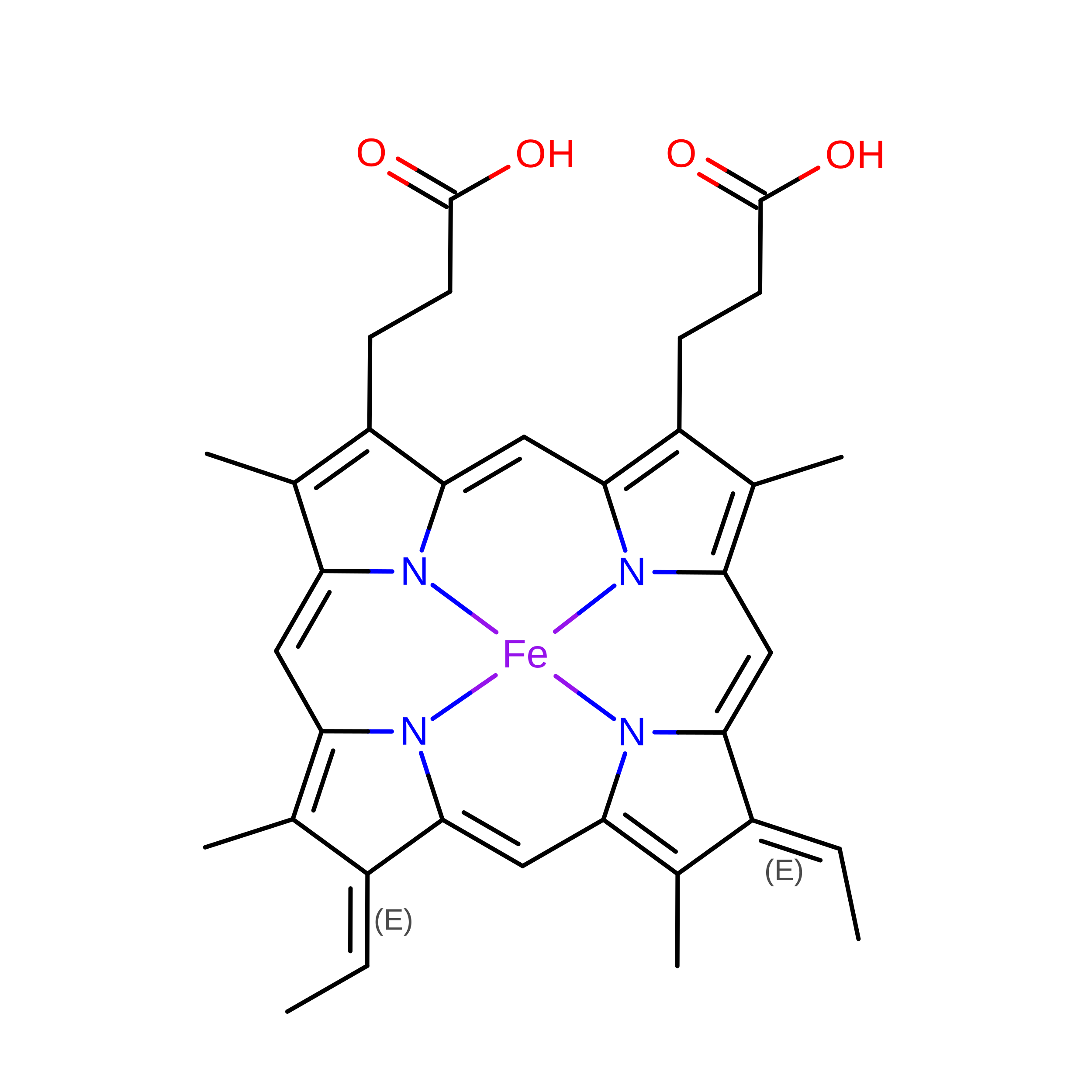
HEME C
C34 H34 Fe N4 O4
HXQIYSLZKNYNMH-LJNAALQVSA-N
IMD

Query on IMD


Download:Ideal Coordinates CCD File
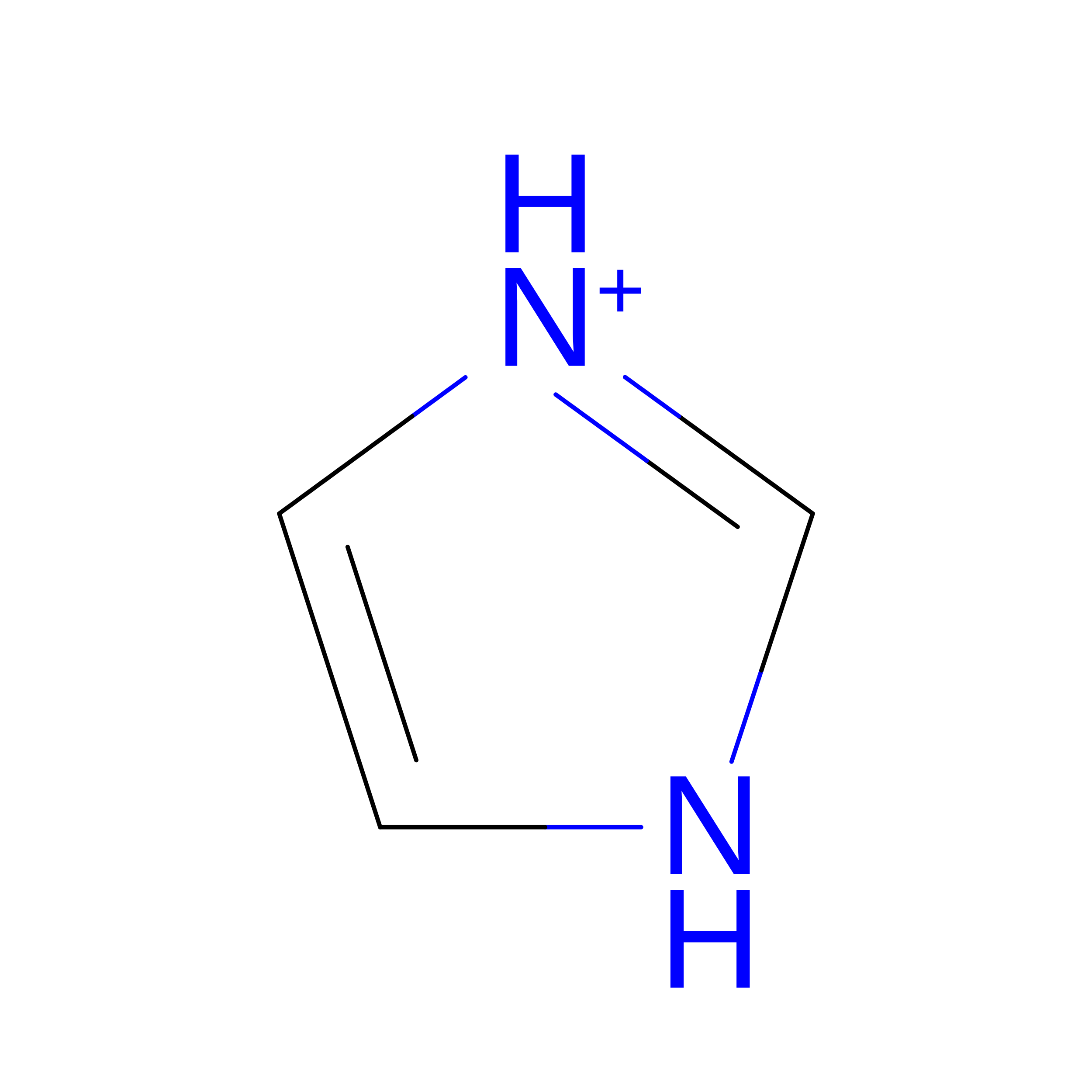
H [auth A]IMIDAZOLE
C3 H5 N2
RAXXELZNTBOGNW-UHFFFAOYSA-O
CA
(Subject of Investigation/LOI)

Query on CA


Download:Ideal Coordinates CCD File
B [auth A],
C [auth A],
D [auth A],
E [auth A]
CALCIUM ION
Ca
BHPQYMZQTOCNFJ-UHFFFAOYSA-N

Experimental Data & Validation

Experimental Data

  • Method: X-RAY DIFFRACTION
  • Resolution: 1.12 Å
  • R-Value Free:  0.143 (Depositor), 0.143 (DCC) 
  • R-Value Work:  0.125 (Depositor), 0.126 (DCC) 
  • R-Value Observed: 0.126 (Depositor) 
Space Group: P 21 21 2
Unit Cell:
Length ( Å )Angle ( ˚ )
a = 62.65α = 90
b = 92.71β = 90
c = 55.23γ = 90
Software Package:
Software NamePurpose
PHENIXrefinement
XDSdata reduction
XSCALEdata scaling
PHASERphasing

Structure Validation

View Full Validation Report


Ligand Structure Quality Assessment 


Entry History 

& Funding Information

Deposition Data


Funding OrganizationLocationGrant Number
Max Planck SocietyGermany--

Revision History  (Full details and data files)

  • Version 1.0: 2023-05-17
    Type: Initial release
  • Version 1.1: 2024-05-01
    Changes: Data collection, Refinement description
  • Version 2.0: 2024-09-04
    Type: Coordinate replacement
    Reason: Atomic clashes
    Changes: Advisory, Atomic model, Author supporting evidence, Data collection, Derived calculations, Non-polymer description, Refinement description, Structure summary
  • Version 2.1: 2024-10-23
    Changes: Structure summary
  • Version 2.2: 2024-12-25
    Changes: Database references
  • Version 2.3: 2025-01-22
    Changes: Database references