Download Mendeley
Disulfide-Directed Multicyclic Peptide Libraries for the Discovery of Peptide Ligands and Drugs.
Lu, S., Fan, S., Xiao, S., Li, J., Zhang, S., Wu, Y., Kong, C., Zhuang, J., Liu, H., Zhao, Y., Wu, C.(2023) J Am Chem Soc 145: 1964-1972
- PubMed: 36633218 Search on PubMed
- DOI: https://doi.org/10.1021/jacs.2c12462
- Primary Citation Related Structures:
7YRV, 7YRW, 7YRX - PubMed Abstract:
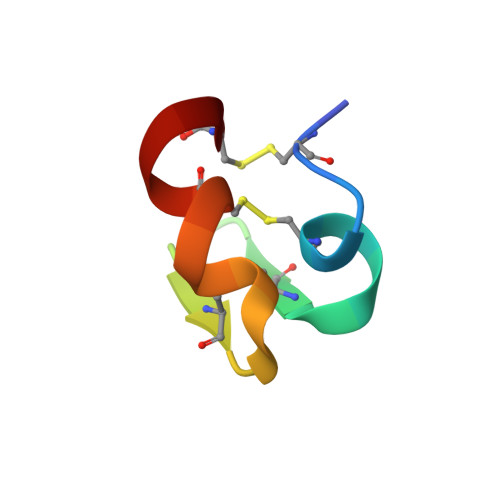
Multicyclic peptides with stable 3D structures are a kind of novel and promising peptide formats for drug design and discovery as they have the potential to combine the best characteristics of small molecules and proteins. However, the development of multicyclic peptides is largely limited to naturally occurring products. It remains a big challenge to develop multicyclic peptides with new structures and functions without recourse to the existing natural scaffolds. Here, we report a general and robust method relying on the utility of new disulfide-directing motifs for designing and discovering diverse multicyclic peptides with potent protein-binding capability. These peptides, referred to as disulfide-directed multicyclic peptides (DDMPs), are tolerant to extensive sequence manipulations and variations of disulfide-pairing frameworks, enabling the development of de novo DDMP libraries useful for ligand and drug discovery. This study opens a new avenue for creating a new generation of multicyclic peptides in sequence and structure space inaccessible by natural scaffolds, thus would greatly benefit the field of peptide drug discovery.
- Department of Chemistry, College of Chemistry and Chemical Engineering, The MOE Key Laboratory of Spectrochemical Analysis and Instrumentation, State Key Laboratory of Physical Chemistry of Solid Surfaces, Xiamen University, Xiamen 361005, P. R. China.
Organizational Affiliation: