7YOJ | pdb_00007yoj

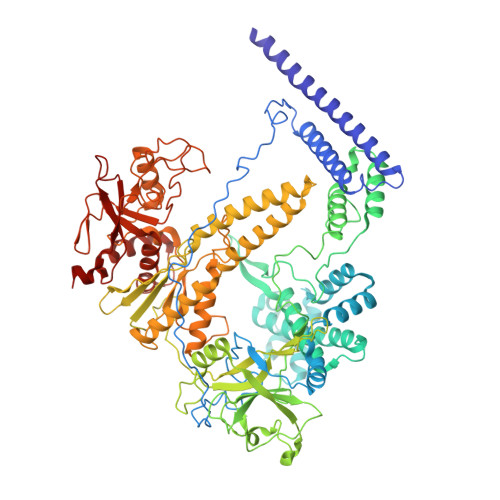
Structure of CasPi with guide RNA and target DNA


Experimental Data Snapshot

  • Method: ELECTRON MICROSCOPY
  • Resolution: 3.36 Å
  • Resolution: 3.36 Å
  • Aggregation State: PARTICLE 
  • Reconstruction Method: SINGLE PARTICLE 

wwPDB Validation 3D Report Full Report

Validation slider image for 7YOJ

This is version 2.2 of the entry. See complete history

Literature

The compact Cas pi (Cas12l) 'bracelet' provides a unique structural platform for DNA manipulation.

Sun, A.Li, C.P.Chen, Z.Zhang, S.Li, D.Y.Yang, Y.Li, L.Q.Zhao, Y.Wang, K.Li, Z.Liu, J.Liu, S.Wang, J.Liu, J.G.

(2023) Cell Res 33: 229-244

  • DOI: https://doi.org/10.1038/s41422-022-00771-2
  • Primary Citation Related Structures: 
    7YOJ

  • PubMed Abstract: 

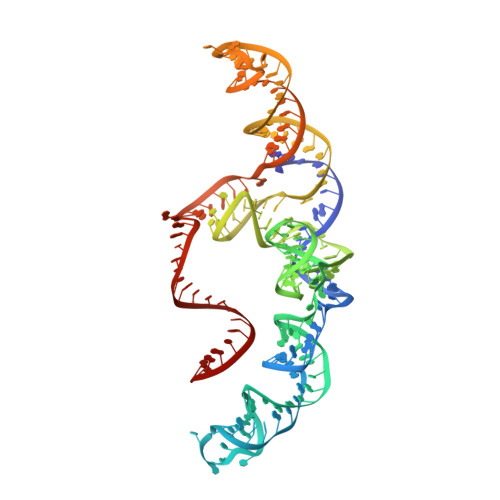
    CRISPR-Cas modules serve as the adaptive nucleic acid immune systems for prokaryotes, and provide versatile tools for nucleic acid manipulation in various organisms. Here, we discovered a new miniature type V system, CRISPR-Casπ (Cas12l) (~860 aa), from the environmental metagenome. Complexed with a large guide RNA (~170 nt) comprising the tracrRNA and crRNA, Casπ (Cas12l) recognizes a unique 5' C-rich PAM for DNA cleavage under a broad range of biochemical conditions, and generates gene editing in mammalian cells. Cryo-EM study reveals a 'bracelet' architecture of Casπ effector encircling the DNA target at 3.4 Å resolution, substantially different from the canonical 'two-lobe' architectures of Cas12 and Cas9 nucleases. The large guide RNA serves as a 'two-arm' scaffold for effector assembly. Our study expands the knowledge of DNA targeting mechanisms by CRISPR effectors, and offers an efficient but compact platform for DNA manipulation.


  • Organizational Affiliation
    • Beijing Advanced Innovation Center for Structural Biology & Frontier Research Center for Biological Structure, School of Life Sciences, Tsinghua University, Beijing, China.

Macromolecule Content 

  • Total Structure Weight: 168.02 kDa 
  • Atom Count: 11,545 
  • Modeled Residue Count: 1,083 
  • Deposited Residue Count: 1,083 
  • Unique protein chains: 1
  • Unique nucleic acid chains: 3

Macromolecules


Find similar proteins by:|  3D Structure
Entity ID: 1
MoleculeChains  Sequence LengthOrganismDetailsImage
CasPi867Armatimonadota bacteriumMutation(s): 2 
Gene Names: DCC45_12200EDM73_08925
UniProt
Find proteins for A0ACD6B9Z5 (Armatimonadota bacterium)
Explore A0ACD6B9Z5 
Go to UniProtKB:  A0ACD6B9Z5
Entity Groups
Sequence Clusters30% Identity50% Identity70% Identity90% Identity95% Identity100% Identity
UniProt GroupA0ACD6B9Z5
Sequence Annotations
Expand
Reference Sequence
Find similar nucleic acids by:  Sequence
Entity ID: 2
MoleculeChains LengthOrganismImage
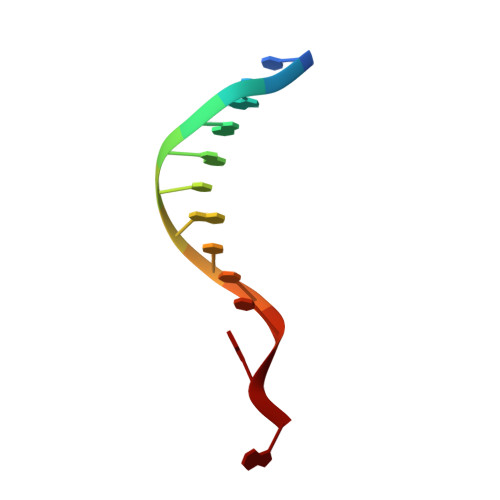
DNA (5'-D(P*CP*GP*GP*GP*AP*TP*GP*CP*CP*CP*AP*G)-3')B [auth C]12Armatimonadota bacterium
Sequence Annotations
Expand
Reference Sequence
Find similar nucleic acids by:  (by identity cutoff) 
Entity ID: 3
MoleculeChains LengthOrganismImage
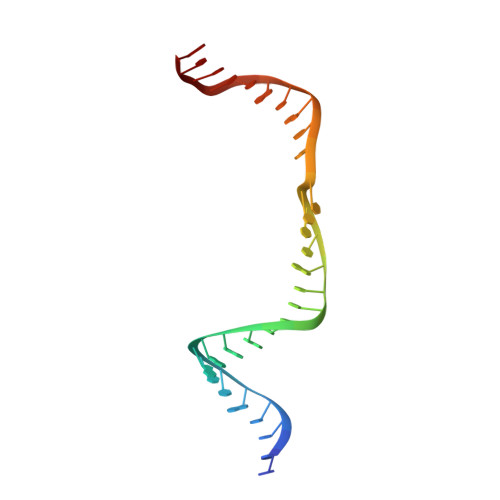
DNA (30-MER)C [auth D]30Armatimonadota bacterium
Sequence Annotations
Expand
Reference Sequence
Find similar nucleic acids by:  (by identity cutoff) 
Entity ID: 4
MoleculeChains LengthOrganismImage
RNA (174-MER)D [auth B]174Armatimonadota bacterium
Sequence Annotations
Expand
Reference Sequence

Experimental Data & Validation

Experimental Data

  • Method: ELECTRON MICROSCOPY
  • Resolution: 3.36 Å
  • Resolution: 3.36 Å
  • Aggregation State: PARTICLE 
  • Reconstruction Method: SINGLE PARTICLE 

Structure Validation

View Full Validation Report


Entry History 

& Funding Information

Deposition Data


Funding OrganizationLocationGrant Number
National Natural Science Foundation of China (NSFC)China--

Revision History  (Full details and data files)

  • Version 1.0: 2023-02-15
    Type: Initial release
  • Version 2.0: 2023-03-22
    Type: Coordinate replacement
    Reason: Sequence discrepancy
    Changes: Advisory, Atomic model, Author supporting evidence, Data collection, Data processing, Database references, Derived calculations, Polymer sequence, Refinement description, Source and taxonomy, Structure summary
  • Version 2.1: 2023-03-29
    Changes: Database references
  • Version 2.2: 2024-07-03
    Changes: Data collection