Find PDB structures and Computed Structure Models (CSM) by combining queries from tools in this suite: Attribute Search, Sequence Similarity, Sequence Motif, 3D Similarity, and 3D Motif with 'AND' logic.
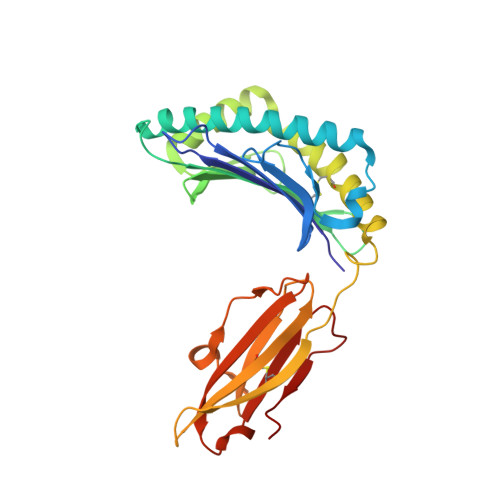
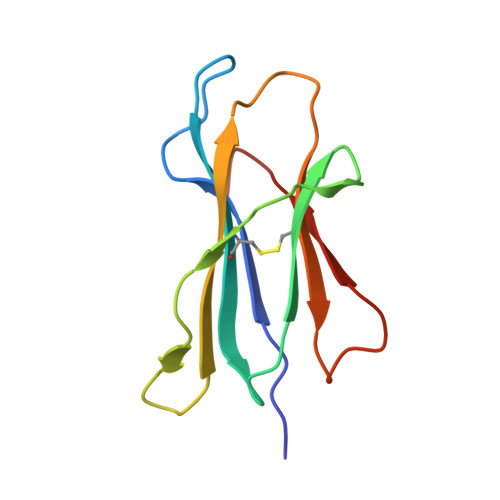
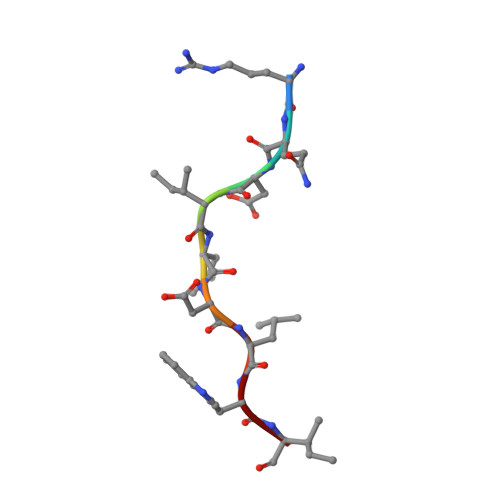
Severe cutaneous adverse drug reactions (SCARs) are a group of serious clinical conditions caused by immune reaction to certain drugs. The allelic variance of human leukocyte antigens of HLA-B*13:01 has been strongly associated with hypersensitivities induced by dapsone (DDS). T-cell receptor mediated activation of cytotoxic T lymphocytes (CTLs) has also been suggested to play an essential role in pathogenesis of SCARs. However, HLA-B*13:01-DDS-TCR immune synapse that plays role in drug-induced hypersensitivity syndrome (DIHS) associated T cells activation remains uncharacterized. To investigate the molecular mechanisms for HLA-B*13:01 in the pathogenesis of Dapsone-induced drug hypersensitivity (DDS-DIHS), we performed crystallization and expanded drug-specific CTLs to analyze the pathological role of DDS-DIHS. Results showed the crystal structure of HLA-B*13:01-beta-2-microglobulin (β2M) complex at 1.5 Å resolution and performed mutation assays demonstrating that I118 or I119, and R121 of HLA-B*13:01 were the key residues that mediate the binding of DDS. Subsequent single-cell TCR and RNA sequencing indicated that TCRs composed of paired TRAV12-3/TRBV28 clonotype with shared CDR3 region specifically recognize HLA-B*13:01-DDS complex to trigger inflammatory cytokines associated with DDS-DIHS. Our study identified the novel p-i-HLA/TCR as the model of interaction between HLA-B*13:01, DDS and the clonotype-specific TCR in DDS-DIHS.
Organizational Affiliation:
Department of Mycobacterium, Jiangsu Key Laboratory of Molecular Biology for Skin Diseases and STIs, Institute of Dermatology & Hospital for Skin Diseases, Chinese Academy of Medical Sciences & Peking Union Medical College, Nanjing, China.
Centre for Global Health, School of Public Health, Nanjing Medical University, Nanjing, China.
Department of Dermatology, Drug Hypersensitivity Clinical and Research Center, Cancer Vaccine and Immune Cell Therapy Core Laboratory, Chang Gung Memorial Hospital, Taipei and Keelung, Linkou, Taiwan.
Chang Gung Immunology Consortium, Chang Gung Memorial Hospital and Chang Gung University, Taoyuan, Taiwan.
Department of Dermatology, Xiamen Chang Gung Hospital, Xiamen, China.
The Key Laboratory of Innate Immune Biology of Fujian Province, Biomedical Research Center of South China, Key Laboratory of OptoElectronic Science and Technology for Medicine of Ministry of Education, College of Life Sciences, Fujian Normal University, Fujian, China.
National Institute of Occupational Health and Poison Control, Chinese Center for Disease Control and Prevention, Beijing, China.
National Laboratory of BiomacromoleculesInstitute of Biophysics, Chinese Academy of Sciences, Beijing, China.
Department of Biotechnology, Ming Chuan University, Taoyuan, Taiwan.
College of Life Sciences, Sichuan University, Chengdu, China.
Department of Dermatology, Drug Hypersensitivity Clinical and Research Center, Cancer Vaccine and Immune Cell Therapy Core Laboratory, Chang Gung Memorial Hospital, Taipei and Keelung, Linkou, Taiwan. wenhungchung@yahoo.com.
Chang Gung Immunology Consortium, Chang Gung Memorial Hospital and Chang Gung University, Taoyuan, Taiwan. wenhungchung@yahoo.com.
Department of Dermatology, Xiamen Chang Gung Hospital, Xiamen, China. wenhungchung@yahoo.com.
College of Medicine, Chang Gung University, Taoyuan, Taiwan. wenhungchung@yahoo.com.
Immune-Oncology Center of Excellence, Chang Gung Memorial Hospital, Linkou, Taiwan. wenhungchung@yahoo.com.
Department of Dermatology, Beijing Tsinghua Chang Gung Hospital, School of Clinical Medicine, Tsinghua University, Beijing, China. wenhungchung@yahoo.com.
School of Medicine, Shanghai Jiao Tong University, Shanghai, China. wenhungchung@yahoo.com.
Genomic Medicine Core Laboratory, Chang Gung Memorial Hospital, Linkou, Taiwan. wenhungchung@yahoo.com.
The Key Laboratory of Innate Immune Biology of Fujian Province, Biomedical Research Center of South China, Key Laboratory of OptoElectronic Science and Technology for Medicine of Ministry of Education, College of Life Sciences, Fujian Normal University, Fujian, China. ouyangsy@fjnu.edu.cn.
Department of Mycobacterium, Jiangsu Key Laboratory of Molecular Biology for Skin Diseases and STIs, Institute of Dermatology & Hospital for Skin Diseases, Chinese Academy of Medical Sciences & Peking Union Medical College, Nanjing, China. whs33@vip.sina.com.
Centre for Global Health, School of Public Health, Nanjing Medical University, Nanjing, China. whs33@vip.sina.com.

 Download Mendeley