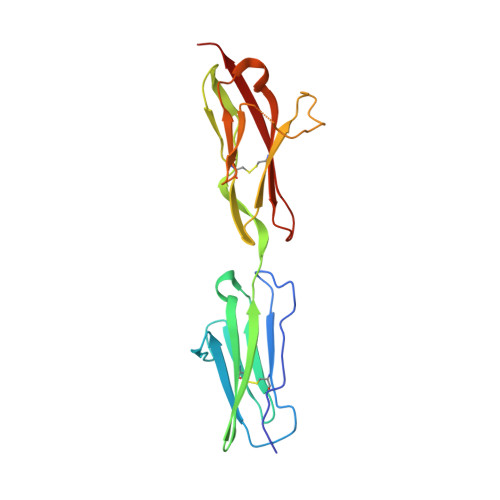
7Y9A | pdb_00007y9a

Crystal structure of sDscam Ig1-2 domains, isoform beta2v6


Experimental Data Snapshot

  • Method: X-RAY DIFFRACTION
  • Resolution: 2.51 Å
  • R-Value Free: 
    0.279 (Depositor), 0.280 (DCC) 
  • R-Value Work: 
    0.241 (Depositor), 0.240 (DCC) 
  • R-Value Observed: 
    0.243 (Depositor) 

Starting Model: experimental
View more details

wwPDB Validation   3D Report Full Report


This is version 1.2 of the entry. See complete history


Literature

Structural basis for the self-recognition of sDSCAM in Chelicerata.

Cheng, J.Yu, Y.Wang, X.Zheng, X.Liu, T.Hu, D.Jin, Y.Lai, Y.Fu, T.M.Chen, Q.

(2023) Nat Commun 14: 2522-2522

  • DOI: https://doi.org/10.1038/s41467-023-38205-1
  • Primary Citation of Related Structures:  
    7Y4X, 7Y54, 7Y5J, 7Y5R, 7Y6E, 7Y6O, 7Y73, 7Y8H, 7Y8I, 7Y8S, 7Y95, 7Y9A

  • PubMed Abstract: 

    To create a functional neural circuit, neurons develop a molecular identity to discriminate self from non-self. The invertebrate Dscam family and vertebrate Pcdh family are implicated in determining synaptic specificity. Recently identified in Chelicerata, a shortened Dscam (sDscam) has been shown to resemble the isoform-generating characters of both Dscam and Pcdh and represent an evolutionary transition. Here we presented the molecular details of sDscam self-recognition via both trans and cis interactions using X-ray crystallographic data and functional assays. Based on our results, we proposed a molecular zipper model for the assemblies of sDscam to mediate cell-cell recognition. In this model, sDscam utilized FNIII domain to form side-by-side interactions with neighboring molecules in the same cell while established hand-in-hand interactions via Ig1 domain with molecules from another cell around. Together, our study provided a framework for understanding the assembly, recognition, and evolution of sDscam.


  • Organizational Affiliation
    • National Clinical Research Center for Geriatrics, West China Hospital, State Key Laboratory of Biotherapy and Collaborative Innovation Center of Biotherapy, Sichuan University, 610041, Chengdu, China.

Macromolecules
Find similar proteins by:  (by identity cutoff)  |  3D Structure
Entity ID: 1
MoleculeChains Sequence LengthOrganismDetailsImage
Down Syndrome Cell Adhesion Molecules196ChelicerataMutation(s): 0 
Entity Groups  
Sequence Clusters30% Identity50% Identity70% Identity90% Identity95% Identity100% Identity
Glycosylation
Glycosylation Sites: 2
Sequence Annotations
Expand
  • Reference Sequence
Oligosaccharides

Help

Entity ID: 2
MoleculeChains Length2D Diagram Glycosylation3D Interactions
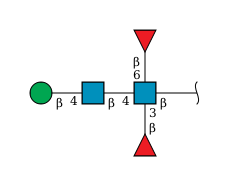
beta-D-mannopyranose-(1-4)-2-acetamido-2-deoxy-beta-D-glucopyranose-(1-4)-[beta-L-fucopyranose-(1-3)][beta-L-fucopyranose-(1-6)]2-acetamido-2-deoxy-beta-D-glucopyranose
B, C
5N-Glycosylation
Glycosylation Resources
GlyTouCan:  G17345YW
GlyCosmos:  G17345YW
Experimental Data & Validation

Experimental Data

  • Method: X-RAY DIFFRACTION
  • Resolution: 2.51 Å
  • R-Value Free:  0.279 (Depositor), 0.280 (DCC) 
  • R-Value Work:  0.241 (Depositor), 0.240 (DCC) 
  • R-Value Observed: 0.243 (Depositor) 
Space Group: I 1 2 1
Unit Cell:
Length ( Å )Angle ( ˚ )
a = 63.256α = 90
b = 49.018β = 104.663
c = 82.024γ = 90
Software Package:
Software NamePurpose
PHENIXrefinement
HKL-3000data scaling
PDB_EXTRACTdata extraction
HKL-3000data reduction
PHASERphasing

Structure Validation

View Full Validation Report


Entry History & Funding Information

Deposition Data


Funding OrganizationLocationGrant Number
National Natural Science Foundation of China (NSFC)China--

Revision History  (Full details and data files)

  • Version 1.0: 2023-05-24
    Type: Initial release
  • Version 1.1: 2023-09-06
    Changes: Data collection, Refinement description
  • Version 1.2: 2024-10-09
    Changes: Structure summary