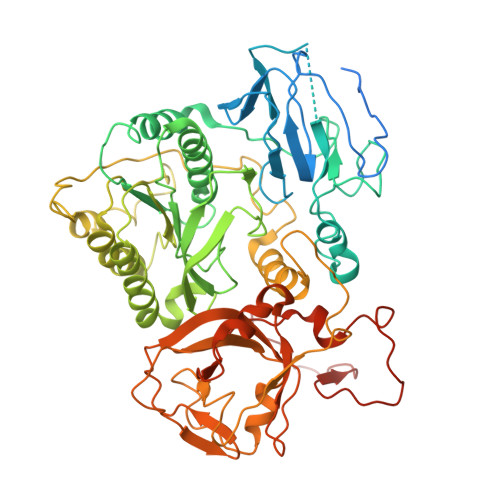
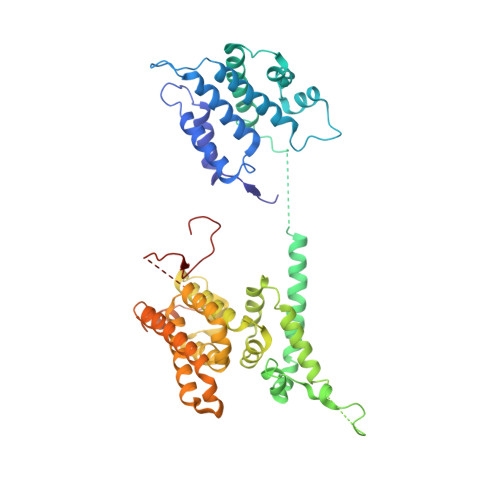
7Y18 | pdb_00007y18

Crystal structure of ribosomal ITS2 pre-rRNA processing complex from Saccharomyces cerevisiae


Experimental Data Snapshot

  • Method: X-RAY DIFFRACTION
  • Resolution: 3.69 Å
  • R-Value Free: 
    0.318 (Depositor), 0.320 (DCC) 
  • R-Value Work: 
    0.278 (Depositor), 0.280 (DCC) 
  • R-Value Observed: 
    0.280 (Depositor) 

Starting Model: experimental
View more details

wwPDB Validation   3D Report Full Report


This is version 1.2 of the entry. See complete history


Literature

Structural and mechanistic insights into ribosomal ITS2 RNA processing by nuclease-kinase machinery.

Chen, J.Chen, H.Li, S.Lin, X.Hu, R.Zhang, K.Liu, L.

(2024) Elife 12

  • DOI: https://doi.org/10.7554/eLife.86847
  • Primary Citation of Related Structures:  
    7Y16, 7Y17, 7Y18, 8J5Y, 8J60

  • PubMed Abstract: 

    Precursor ribosomal RNA (pre-rRNA) processing is a key step in ribosome biosynthesis and involves numerous RNases. A HEPN (higher eukaryote and prokaryote nucleotide binding) nuclease Las1 and a polynucleotide kinase Grc3 assemble into a tetramerase responsible for rRNA maturation. Here, we report the structures of full-length Saccharomyces cerevisiae and Cyberlindnera jadinii Las1-Grc3 complexes, and C. jadinii Las1. The Las1-Grc3 structures show that the central coiled-coil domain of Las1 facilitates pre-rRNA binding and cleavage, while the Grc3 C-terminal loop motif directly binds to the HEPN active center of Las1 and regulates pre-rRNA cleavage. Structural comparison between Las1 and Las1-Grc3 complex exhibits that Grc3 binding induces conformational rearrangements of catalytic residues associated with HEPN nuclease activation. Biochemical assays identify that Las1 processes pre-rRNA at the two specific sites (C2 and C2'), which greatly facilitates rRNA maturation. Our structures and specific pre-rRNA cleavage findings provide crucial insights into the mechanism and pathway of pre-rRNA processing in ribosome biosynthesis.


  • Organizational Affiliation
    • State Key Laboratory of Cellular Stress Biology, School of Life Sciences, Faculty of Medicine and Life Sciences, Xiamen University, Xiamen, China.

Macromolecules
Find similar proteins by:  (by identity cutoff)  |  3D Structure
Entity ID: 1
MoleculeChains Sequence LengthOrganismDetailsImage
Polynucleotide 5'-hydroxyl-kinase GRC3A,
D [auth B],
E
632Saccharomyces cerevisiae S288CMutation(s): 0 
Gene Names: GRC3YLL035W
EC: 2.7.1
UniProt
Find proteins for Q07845 (Saccharomyces cerevisiae (strain ATCC 204508 / S288c))
Explore Q07845 
Go to UniProtKB:  Q07845
Entity Groups  
Sequence Clusters30% Identity50% Identity70% Identity90% Identity95% Identity100% Identity
UniProt GroupQ07845
Sequence Annotations
Expand
  • Reference Sequence
Find similar proteins by:  (by identity cutoff)  |  3D Structure
Entity ID: 2
MoleculeChains Sequence LengthOrganismDetailsImage
Protein LAS1B [auth C],
C [auth D],
F
502Saccharomyces cerevisiae S288CMutation(s): 0 
Gene Names: LAS1YKR063C
UniProt
Find proteins for P36146 (Saccharomyces cerevisiae (strain ATCC 204508 / S288c))
Explore P36146 
Go to UniProtKB:  P36146
Entity Groups  
Sequence Clusters30% Identity50% Identity70% Identity90% Identity95% Identity100% Identity
UniProt GroupP36146
Sequence Annotations
Expand
  • Reference Sequence
Experimental Data & Validation

Experimental Data

  • Method: X-RAY DIFFRACTION
  • Resolution: 3.69 Å
  • R-Value Free:  0.318 (Depositor), 0.320 (DCC) 
  • R-Value Work:  0.278 (Depositor), 0.280 (DCC) 
  • R-Value Observed: 0.280 (Depositor) 
Space Group: C 1 2 1
Unit Cell:
Length ( Å )Angle ( ˚ )
a = 233.556α = 90
b = 116.142β = 96.406
c = 159.311γ = 90
Software Package:
Software NamePurpose
PHENIXrefinement
HKL-3000data scaling
HKL-3000data reduction
Cootmodel building
PHENIXphasing

Structure Validation

View Full Validation Report


Entry History & Funding Information

Deposition Data


Funding OrganizationLocationGrant Number
National Natural Science Foundation of China (NSFC)China32171286

Revision History  (Full details and data files)

  • Version 1.0: 2023-06-14
    Type: Initial release
  • Version 1.1: 2023-11-29
    Changes: Data collection, Refinement description
  • Version 1.2: 2024-01-17
    Changes: Database references