7XTN | pdb_00007xtn

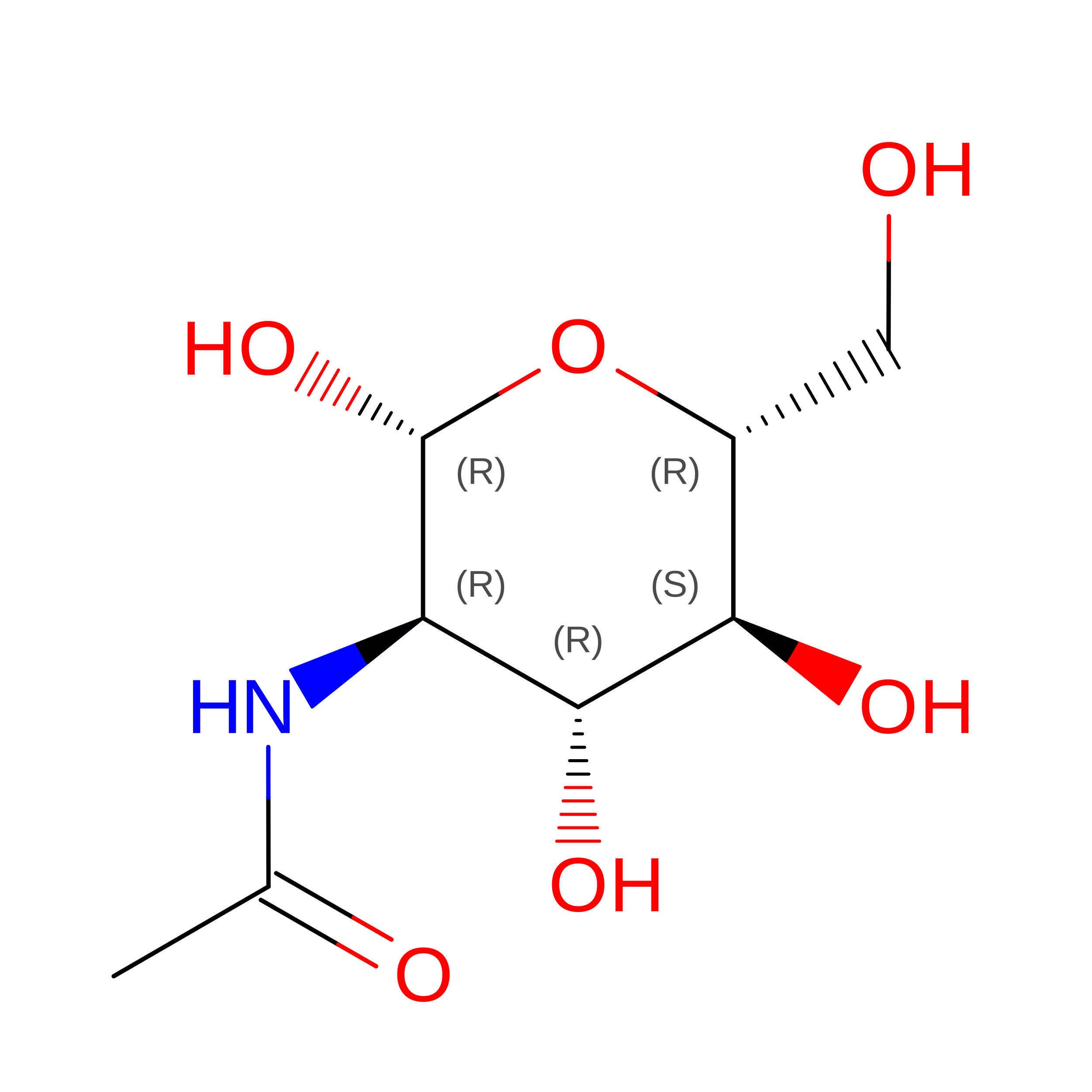
Crystal structure of the C-terminal domain of Bombyx mori N-acetylglucosaminyltransferase IV in complex with N-acetylglucosamine


Experimental Data Snapshot

  • Method: X-RAY DIFFRACTION
  • Resolution: 1.15 Å
  • R-Value Free: 
    0.209 (Depositor), 0.219 (DCC) 
  • R-Value Work: 
    0.193 (Depositor), 0.202 (DCC) 

Starting Model: in silico
View more details

wwPDB Validation 3D Report Full Report

Validation slider image for 7XTN

Ligand Structure Quality Assessment 


This is version 1.3 of the entry. See complete history

Literature

Crystal structure and sugar-binding ability of the C-terminal domain of N-acetylglucosaminyltransferase IV establish a new carbohydrate-binding module family.

Oka, N.Mori, S.Ikegaya, M.Park, E.Y.Miyazaki, T.

(2022) Glycobiology 32: 1153-1163

  • DOI: https://doi.org/10.1093/glycob/cwac058
  • Primary Citation Related Structures: 
    7XTL, 7XTM, 7XTN

  • PubMed Abstract: 

    N-glycans are modified by glycosyltransferases in the endoplasmic reticulum and Golgi apparatus. N-acetylglucosaminyltransferase IV (GnT-IV) is a Golgi-localized glycosyltransferase that synthesizes complex-type N-glycans in vertebrates. This enzyme attaches N-acetylglucosamine (GlcNAc) to the α-1,3-linked mannose branch of the N-glycan core structure via a β-1,4 linkage. Deficiency of this enzyme is known to cause abnormal cellular functions, making it a vital enzyme for living organisms. However, there has been no report on its 3-dimensional structure to date. Here, we demonstrated that the C-terminal regions (named CBML) of human GnT-IVa and Bombyx mori ortholog have the ability to bind β-N-acetylglucosamine. In addition, we determined the crystal structures of human CBML, B. mori CBML, and its complex with β-GlcNAc at 1.97, 1.47, and 1.15 Å resolutions, respectively, and showed that they adopt a β-sandwich fold, similar to carbohydrate-binding module family 32 (CBM32) proteins. The regions homologous to CBML (≥24% identity) were found in GnT-IV isozymes, GnT-IVb, and GnT-IVc (known as GnT-VI), and the structure of B. mori CBML in complex with β-GlcNAc indicated that the GlcNAc-binding residues were highly conserved among these isozymes. These residues are also conserved with the GlcNAc-binding CBM32 domain of β-N-acetylhexosaminidase NagH from Clostridium perfringens despite the low sequence identity (<20%). Taken together with the phylogenetic analysis, these findings indicate that these CBMLs may be novel CBM family proteins with GlcNAc-binding ability.


  • Organizational Affiliation
    • Department of Agriculture, Graduate School of Integrated Science and Technology, Shizuoka University, 836 Ohya, Suruga-ku, Shizuoka 422-8529, Japan.

Macromolecule Content 

  • Total Structure Weight: 38.77 kDa 
  • Atom Count: 2,786 
  • Modeled Residue Count: 301 
  • Deposited Residue Count: 328 
  • Unique protein chains: 1

Macromolecules

Find similar proteins by:|  3D Structure
Entity ID: 1
MoleculeChains  Sequence LengthOrganismDetailsImage
N-acetylglucosaminyltransferase IV
A, B
164Bombyx mandarinaMutation(s): 0 
Gene Names: MGAT4
UniProt
Find proteins for A0A6J2K041 (Bombyx mandarina)
Explore A0A6J2K041 
Go to UniProtKB:  A0A6J2K041
Entity Groups
Sequence Clusters30% Identity50% Identity70% Identity90% Identity95% Identity100% Identity
UniProt GroupA0A6J2K041
Sequence Annotations
Expand
Reference Sequence

Experimental Data & Validation

Experimental Data

  • Method: X-RAY DIFFRACTION
  • Resolution: 1.15 Å
  • R-Value Free:  0.209 (Depositor), 0.219 (DCC) 
  • R-Value Work:  0.193 (Depositor), 0.202 (DCC) 
Space Group: P 1 21 1
Unit Cell:
Length ( Å )Angle ( ˚ )
a = 32.697α = 90
b = 64.098β = 95.891
c = 79.148γ = 90
Software Package:
Software NamePurpose
REFMACrefinement
XDSdata reduction
SCALAdata scaling
MOLREPphasing
Cootmodel building

Structure Validation

View Full Validation Report


Ligand Structure Quality Assessment 


Entry History 

& Funding Information

Deposition Data


Funding OrganizationLocationGrant Number
Japan Society for the Promotion of Science (JSPS)Japan19K15748

Revision History  (Full details and data files)

  • Version 1.0: 2022-09-28
    Type: Initial release
  • Version 1.1: 2022-11-30
    Changes: Database references, Source and taxonomy, Structure summary
  • Version 1.2: 2022-12-07
    Changes: Database references
  • Version 1.3: 2024-04-03
    Changes: Data collection, Refinement description