7X54 | pdb_00007x54

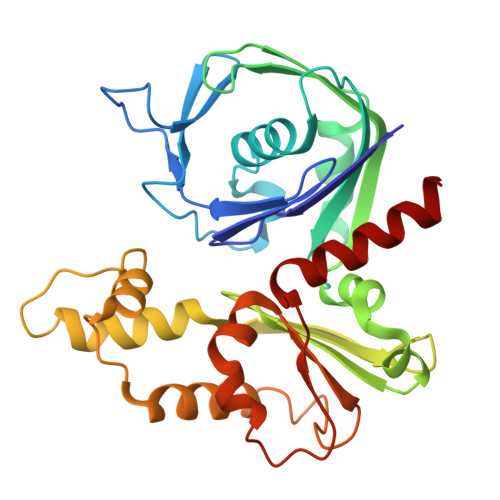
A Cbc-ParM filament with ADP


Experimental Data Snapshot

  • Method: ELECTRON MICROSCOPY
  • Resolution: 3.90 Å
  • Aggregation State: FILAMENT 
  • Reconstruction Method: HELICAL 

wwPDB Validation   3D Report Full Report


This is version 1.2 of the entry. See complete history


Literature

Bacterial genome-encoded ParMs.

Ali, S.Koh, A.Popp, D.Tanaka, K.Kitaoku, Y.Miyazaki, N.Iwasaki, K.Mitsuoka, K.Robinson, R.C.Narita, A.

(2025) J Biological Chem 301: 110351-110351

  • DOI: https://doi.org/10.1016/j.jbc.2025.110351
  • Primary Citation of Related Structures:  
    7X54, 7X55, 7X56, 7X59, 8X1I

  • PubMed Abstract: 

    ParMs generally exist on low-copy number plasmids where they contribute to plasmid segregation and stable inheritance. We carried out bioinformatics analysis, which indicated that ParM genes are not only confined to plasmids but are also occasionally found on genomes. Here we report the discovery and characterization of two chromosome-encoded ParMs (cParMs) from the genomes of Desulfitobacterium hafniense (Dh-cParM1) and Clostridium botulinum (Cb-cParM). Both cParMs form filaments, exhibit nucleotide hydrolysis, and possess characteristic ParM subunit structures. Dh-cParM1 forms single and tightly coupled double filaments and is highly conserved on the chromosomes of five of six Desulfitobacterium species. Interestingly, these bacteria have not been reported to harbor plasmids. Cb-cParM possesses unique properties. Its filaments were stable after nucleotide hydrolysis and Pi release, and its ParR (Cb-cParR) did not affect the initial phase of Cb-cParM polymerization but displayed properties of a depolymerization factor for mature filaments. These results indicate functional, polymerizing ParMs can be encoded on genomes, suggesting that ParM roles may extend to other functions beyond plasmid segregation.


  • Organizational Affiliation
    • Research Institute for Interdisciplinary Science, Okayama University, Okayama, Japan; Institute of Molecular and Cell Biology, A∗STAR (Agency for Science, Technology and Research), Biopolis, Singapore.

Macromolecules
Find similar proteins by:  (by identity cutoff)  |  3D Structure
Entity ID: 1
MoleculeChains Sequence LengthOrganismDetailsImage
ParM/StbA family protein
A, B, C, D, E
285Clostridium botulinum BfMutation(s): 0 
Gene Names: EXN02_10840
UniProt
Find proteins for A0A9Y2YAC8 (Clostridium botulinum Bf)
Explore A0A9Y2YAC8 
Go to UniProtKB:  A0A9Y2YAC8
Entity Groups  
Sequence Clusters30% Identity50% Identity70% Identity90% Identity95% Identity100% Identity
UniProt GroupA0A9Y2YAC8
Sequence Annotations
Expand
  • Reference Sequence
Small Molecules
Ligands 2 Unique
IDChains Name / Formula / InChI Key2D Diagram3D Interactions
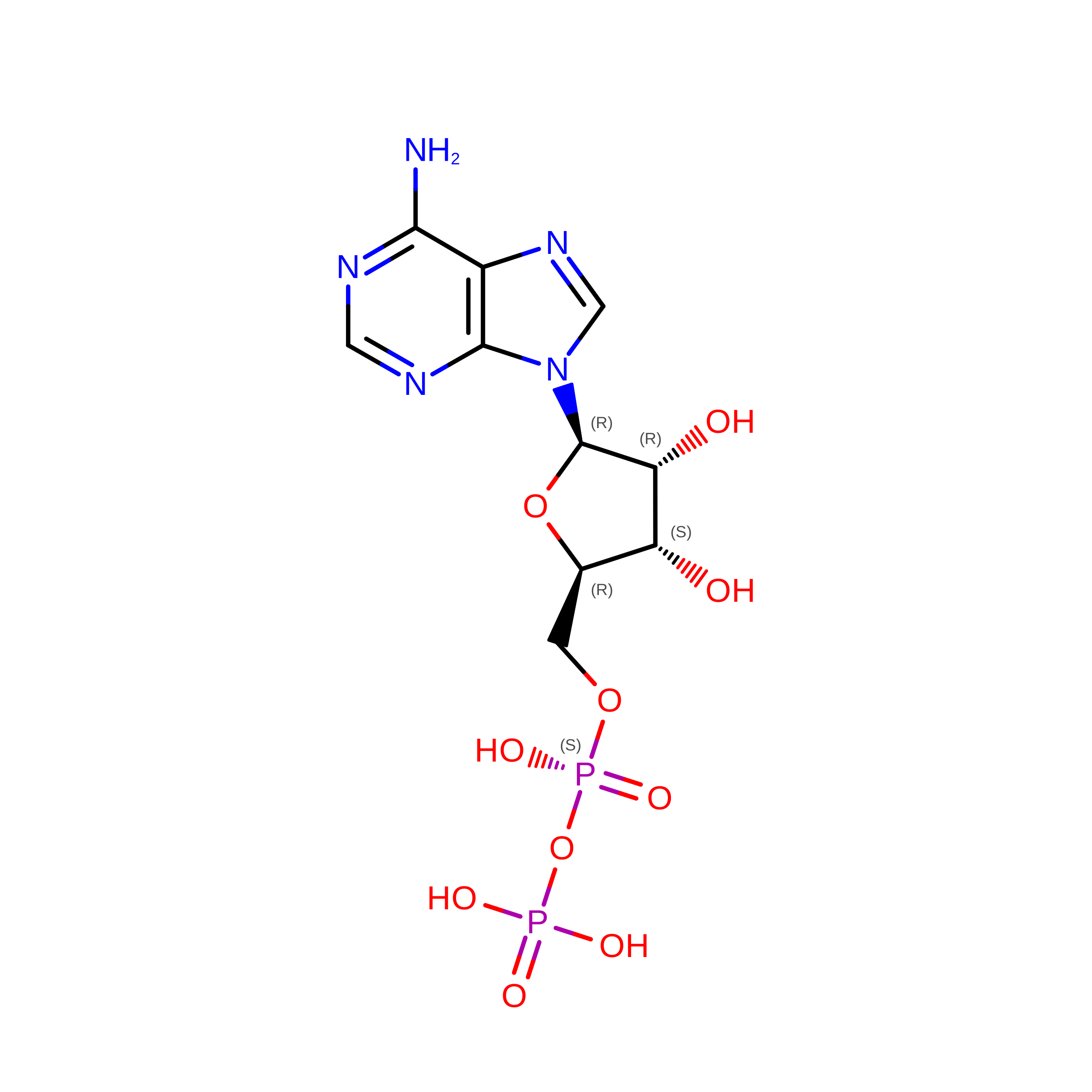
ADP (Subject of Investigation/LOI)
Query on ADP

Download Ideal Coordinates CCD File 
F [auth A],
H [auth B],
J [auth C],
L [auth D],
N [auth E]
ADENOSINE-5'-DIPHOSPHATE
C10 H15 N5 O10 P2
XTWYTFMLZFPYCI-KQYNXXCUSA-N
MG (Subject of Investigation/LOI)
Query on MG

Download Ideal Coordinates CCD File 
G [auth A],
I [auth B],
K [auth C],
M [auth D],
O [auth E]
MAGNESIUM ION
Mg
JLVVSXFLKOJNIY-UHFFFAOYSA-N
Experimental Data & Validation

Experimental Data

  • Method: ELECTRON MICROSCOPY
  • Resolution: 3.90 Å
  • Aggregation State: FILAMENT 
  • Reconstruction Method: HELICAL 
EM Software:
TaskSoftware PackageVersion
RECONSTRUCTIONRELION3.1

Structure Validation

View Full Validation Report


Entry History & Funding Information

Deposition Data


Funding OrganizationLocationGrant Number
Japan Society for the Promotion of Science (JSPS)Japan18H02410
Japan Science and TechnologyJapanJPMJCR19S5

Revision History  (Full details and data files)

  • Version 1.0: 2023-03-08
    Type: Initial release
  • Version 1.1: 2024-06-26
    Changes: Data collection
  • Version 1.2: 2025-07-16
    Changes: Data collection, Database references, Structure summary