7WRM | pdb_00007wrm

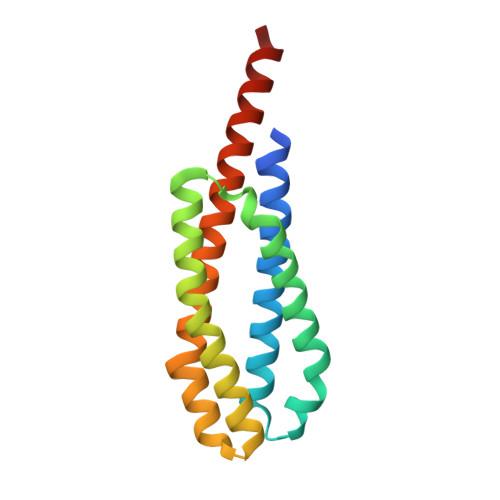
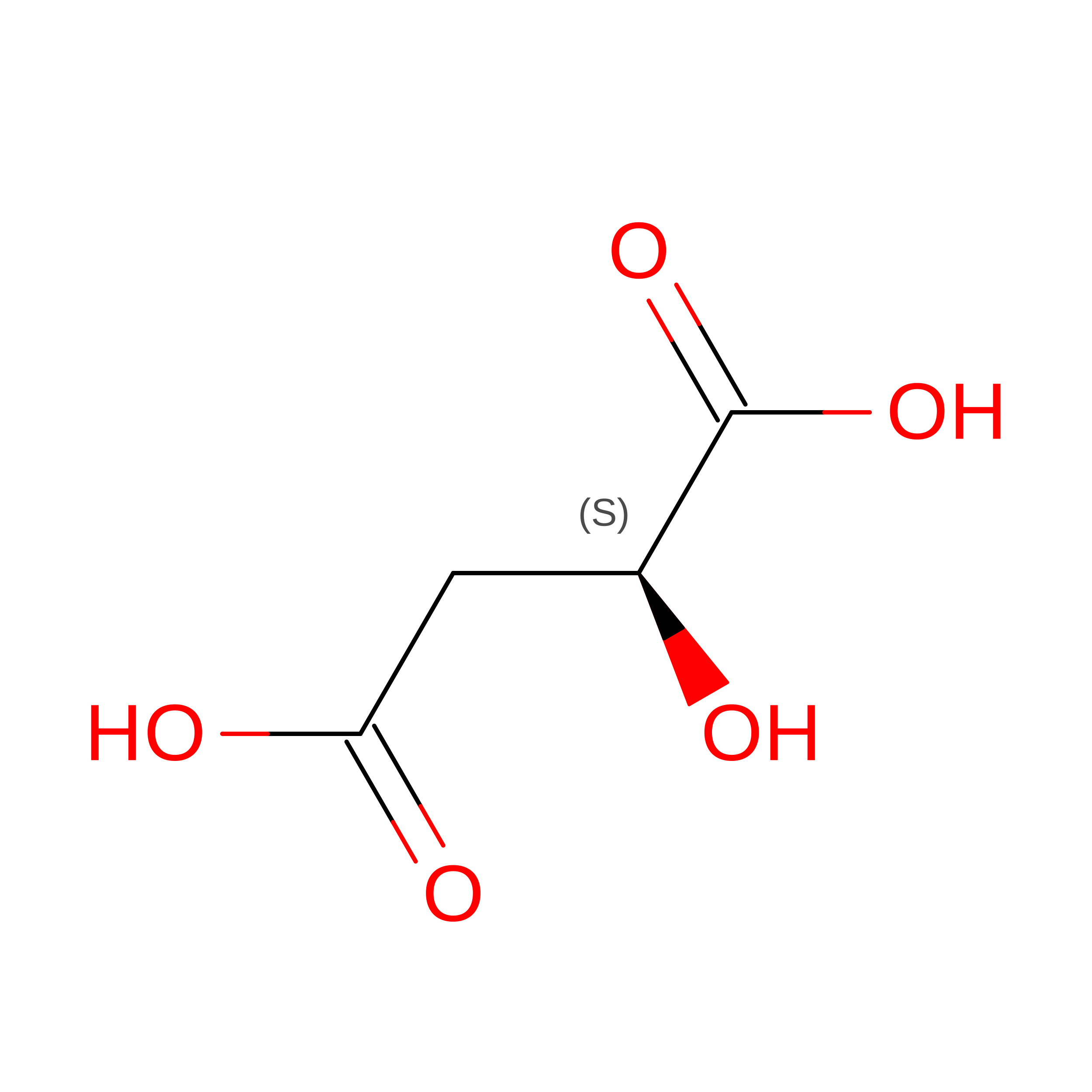
The malate-bound dimer of chemoreceptor MCP2201 ligand binding domain


Experimental Data Snapshot

  • Method: X-RAY DIFFRACTION
  • Resolution: 1.80 Å
  • R-Value Free: 
    0.208 (Depositor), 0.210 (DCC) 
  • R-Value Work: 
    0.180 (Depositor), 0.180 (DCC) 
  • R-Value Observed: 
    0.182 (Depositor) 

Starting Model: experimental
View more details

wwPDB Validation   3D Report Full Report


This is version 1.2 of the entry. See complete history


Literature

Attractant and repellent induce opposing changes in the four-helix bundle ligand-binding domain of a bacterial chemoreceptor.

Guo, L.Wang, Y.H.Cui, R.Huang, Z.Hong, Y.Qian, J.W.Ni, B.Xu, A.M.Jiang, C.Y.Zhulin, I.B.Liu, S.J.Li, D.F.

(2023) PLoS Biol 21: e3002429-e3002429

  • DOI: https://doi.org/10.1371/journal.pbio.3002429
  • Primary Citation of Related Structures:  
    7WRM

  • PubMed Abstract: 

    Motile bacteria navigate toward favorable conditions and away from unfavorable environments using chemotaxis. Mechanisms of sensing attractants are well understood; however, molecular aspects of how bacteria sense repellents have not been established. Here, we identified malate as a repellent recognized by the MCP2201 chemoreceptor in a bacterium Comamonas testosteroni and showed that it binds to the same site as an attractant citrate. Binding determinants for a repellent and an attractant had only minor differences, and a single amino acid substitution in the binding site inverted the response to malate from a repellent to an attractant. We found that malate and citrate affect the oligomerization state of the ligand-binding domain in opposing way. We also observed opposing effects of repellent and attractant binding on the orientation of an alpha helix connecting the sensory domain to the transmembrane helix. We propose a model to illustrate how positive and negative signals might be generated.


  • Organizational Affiliation
    • State Key Laboratory of Microbial Resources, Institute of Microbiology, Chinese Academy of Sciences, Beijing, China.

Macromolecules
Find similar proteins by:  (by identity cutoff)  |  3D Structure
Entity ID: 1
MoleculeChains Sequence LengthOrganismDetailsImage
Methyl-accepting chemotaxis sensory transducer
A, B
154Comamonas testosteroni CNB-2Mutation(s): 0 
Gene Names: CtCNB1_2201
Entity Groups  
Sequence Clusters30% Identity50% Identity70% Identity90% Identity95% Identity100% Identity
Sequence Annotations
Expand
  • Reference Sequence
Experimental Data & Validation

Experimental Data

  • Method: X-RAY DIFFRACTION
  • Resolution: 1.80 Å
  • R-Value Free:  0.208 (Depositor), 0.210 (DCC) 
  • R-Value Work:  0.180 (Depositor), 0.180 (DCC) 
  • R-Value Observed: 0.182 (Depositor) 
Space Group: P 21 21 21
Unit Cell:
Length ( Å )Angle ( ˚ )
a = 47.42α = 90
b = 59.84β = 90
c = 98.06γ = 90
Software Package:
Software NamePurpose
XDSdata scaling
PHENIXphasing
PHENIXrefinement

Structure Validation

View Full Validation Report


Entry History & Funding Information

Deposition Data


Funding OrganizationLocationGrant Number
National Natural Science Foundation of China (NSFC)China92051101

Revision History  (Full details and data files)

  • Version 1.0: 2023-01-04
    Type: Initial release
  • Version 1.1: 2023-11-29
    Changes: Data collection, Refinement description
  • Version 1.2: 2024-07-17
    Changes: Database references