Download Mendeley
Pseudo-Isolated alpha-Helix Platform for the Recognition of Deep and Narrow Targets.
Kim, D.I., Han, S.H., Park, H., Choi, S., Kaur, M., Hwang, E., Han, S.J., Ryu, J.Y., Cheong, H.K., Barnwal, R.P., Lim, Y.B.(2022) J Am Chem Soc 144: 15519-15528
- PubMed: 35972994 Search on PubMed
- DOI: https://doi.org/10.1021/jacs.2c03858
- Primary Citation Related Structures:
7WBN - PubMed Abstract:
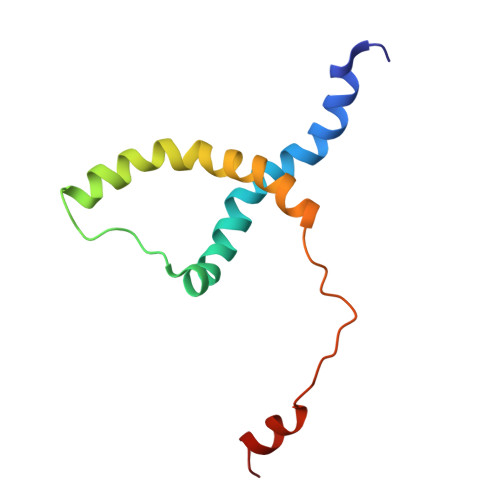
Although interest in stabilized α-helical peptides as next-generation therapeutics for modulating biomolecular interfaces is increasing, peptides have limited functionality and stability due to their small size. In comparison, α-helical ligands based on proteins can make steric clash with targets due to their large size. Here, we report the design of a monomeric pseudo-isolated α-helix (mPIH) system in which proteins behave as if they are peptides. The designed proteins contain α-helix ligands that do not require any covalent chemical modification, do not have frayed ends, and importantly can make sterically favorable interactions similar to isolated peptides. An optimal mPIH showed a more than 100-fold increase in target selectivity, which might be related to the advantages in conformational selection due to the absence of frayed ends. The α-helical ligand in the mPIH displayed high thermal stability well above human body temperature and showed reversible and rapid folding/unfolding transitions. Thus, mPIH can become a promising protein-based platform for developing stabilized α-helix pharmaceuticals.
- Department of Materials Science and Engineering, Yonsei University, Seoul 03722, Republic of Korea.
Organizational Affiliation: