Download Mendeley
Allosteric Determinants in High Temperature Requirement A Enzymes Are Conserved and Regulate the Population of Active Conformations.
Gupta, A.K., Singh, K., Patidar, Y., Sharma, R., Sardesai, A.A., Reddy, G., Gopal, B.(2023) ACS Chem Biol 18: 1487-1499
- PubMed: 37319329 Search on PubMed
- DOI: https://doi.org/10.1021/acschembio.2c00921
- Primary Citation Related Structures:
7VYZ, 7VZ0, 7W21, 7W22, 7W23, 7W24, 7W25, 7W4R, 7W4S, 7W4T, 7W4U, 7W4V, 7W4W - PubMed Abstract:
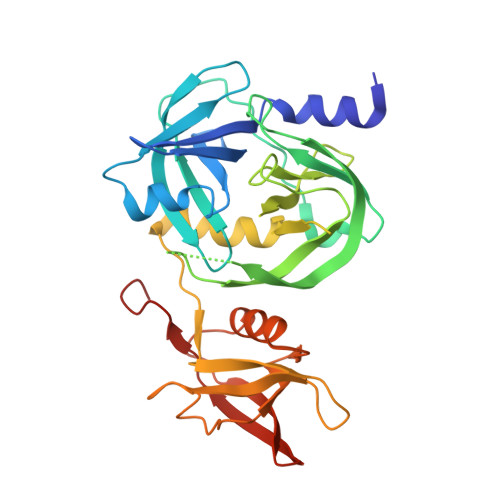
High temperature requirement A (HtrA) are allosterically regulated enzymes wherein effector binding to the PDZ domain triggers proteolytic activity. Yet, it remains unclear if the inter-residue network governing allostery is conserved across HtrA enzymes. Here, we investigated and identified the inter-residue interaction networks by molecular dynamics simulations on representative HtrA proteases, Escherichia coli DegS and Mycobacterium tuberculosis PepD, in effector-bound and free forms. This information was used to engineer mutations that could potentially perturb allostery and conformational sampling in a different homologue, M. tuberculosis HtrA. Mutations in HtrA perturbed allosteric regulation─a finding consistent with the hypothesis that the inter-residue interaction network is conserved across HtrA enzymes. Electron density from data collected on cryo-protected HtrA crystals revealed that mutations altered the topology of the active site. Ensemble models fitted into electron density calculated from room-temperature diffraction data showed that only a fraction of these models had a catalytically competent active site conformation alongside a functional oxyanion hole thus providing experimental evidence that these mutations influenced conformational sampling. Mutations at analogous positions in the catalytic domain of DegS perturbed the coupling between effector binding and proteolytic activity, thus confirming the role of these residues in the allosteric response. The finding that a perturbation in the conserved inter-residue network alters conformational sampling and the allosteric response suggests that an ensemble allosteric model best describes regulated proteolysis in HtrA enzymes.
- Molecular Biophysics Unit, Indian Institute of Science, Bangalore 560012, India.
Organizational Affiliation: