Download Mendeley
Structure-based classification of bacterial chitooligosaccharide-specific outer membrane porins (ChiPs).
Amornloetwattana, R., Bunkum, P., Soysa, H.S.M., Basle, A., Aunkham, A., Robinson, R.C., van den Berg, B., Suginta, W.(2026) J Biol Chem : 113441-113441
- PubMed: 42586430 Search on PubMed
- DOI: https://doi.org/10.1016/j.jbc.2026.113441
- Primary Citation Related Structures:
7VTZ, 7VU0, 7VU1, 7VU2, 7VU3 - PubMed Abstract:
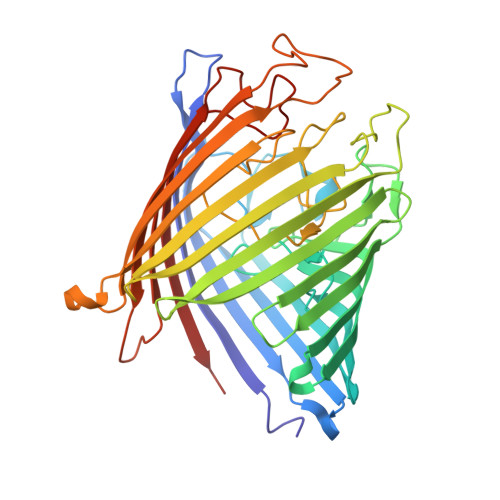
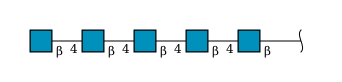
Chitoporins (ChiPs) are chitooligosaccharide-specific outer membrane porins found in various Gram-negative bacteria and are critical for marine species that use chitin as a carbon and nitrogen source. Vibrio spp. ChiPs, exemplified by VhChiP from V. harveyi, are trimeric OmpC-like 16-stranded β-barrels with a long pore-confining loop L3 that interacts exclusively with long chain chitooligosaccharides. Here, using crystallography and electrophysiology, we show that two atypical ChiPs, Escherichia coli ChiP (EcChiP) and Serratia marcescens ChiP (SmChiP), are monomeric 18-stranded β-barrels with shorter L3 loops, which display weaker and less selective substrate interactions compared with their Vibrio counterparts. Structure-based phylogenetic analysis of bacterial ChiPs resolves three clades: monomeric ChiPs; clade A, trimeric ChiPs with an N-plug; and clade B, trimeric ChiPs lacking the characterized helical N-plug. These architectural differences likely reflect environmental selection. Marine Vibrio spp., living in chitin-rich environments, possess trimeric ChiPs that enable rapid chitin uptake, whereas soil-borne S. marcescens and multi-habitat E. coli encode monomeric ChiPs that we speculate are more suited to variable substrate availability.
- School of Biomolecular Science and Engineering (BSE), Vidyasirimedhi Institute of Science and Technology, (VISTEC), Wangchan Valley 555 Moo 1 Payupnai, Rayong 21210, Thailand.
Organizational Affiliation: