Download Mendeley
Ca2+/CaM dependent protein kinase II (CaMKII) alpha and CaMKII beta hub domains adopt distinct oligomeric states and stabilities.
Ozden, C., MacManus, S., Adafia, R., Samkutty, A., Torres-Ocampo, A.P., Garman, S.C., Stratton, M.M.(2024) Protein Sci 33: e4960-e4960
- PubMed: 38501502 Search on PubMedSearch on PubMed Central
- DOI: https://doi.org/10.1002/pro.4960
- Primary Citation Related Structures:
7URW, 7URZ - PubMed Abstract:
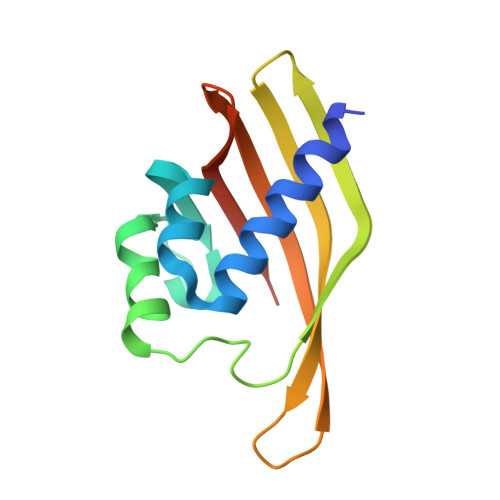
Ca 2+ /calmodulin-dependent protein kinase II (CaMKII) is a multidomain serine/threonine kinase that plays important roles in the brain, heart, muscle tissue, and eggs/sperm. The N-terminal kinase and regulatory domain is connected by a flexible linker to the C-terminal hub domain. The hub domain drives the oligomeric organization of CaMKII, assembling the kinase domains into high local concentration. Previous structural studies have shown multiple stoichiometries of the holoenzyme as well as the hub domain alone. Here, we report a comprehensive study of the hub domain stoichiometry and stability in solution. We solved two crystal structures of the CaMKIIβ hub domain that show 14-mer (3.1 Å) and 16-mer (3.4 Å) assemblies. Both crystal structures were determined from crystals grown in the same drop, which suggests that CaMKII oligomers with different stoichiometries likely coexist. To further interrogate hub stability, we employed mass photometry and temperature denaturation studies of CaMKIIβ and CaMKIIα hubs, which highlight major differences between these highly similar domains. We created a dimeric CaMKIIβ hub unit using rational mutagenesis, which is significantly less stable than the oligomer. Both hub domains populate an intermediate during unfolding. We found that multiple CaMKIIβ hub stoichiometries are present in solution and that larger oligomers are more stable. CaMKIIα had a narrower distribution of molecular weight and was distinctly more stable than CaMKIIβ.
- Department of Biochemistry and Molecular Biology, University of Massachusetts, Amherst, Massachusetts, USA.
Organizational Affiliation: