7UJL | pdb_00007ujl

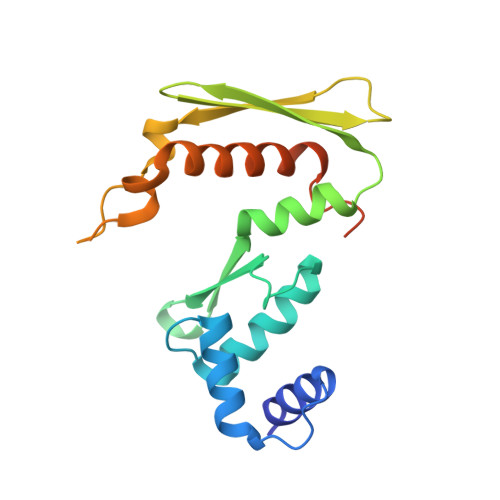
Bacteriophage Lambda Red-Beta N-terminal domain helical assembly in complex with dsDNA


Experimental Data Snapshot

  • Method: ELECTRON MICROSCOPY
  • Resolution: 3.30 Å
  • Aggregation State: HELICAL ARRAY 
  • Reconstruction Method: HELICAL 

wwPDB Validation 3D Report Full Report

Validation slider image for 7UJL

This is version 1.3 of the entry. See complete history

Literature

Red beta 177 annealase structure reveals details of oligomerization and lambda Red-mediated homologous DNA recombination

Newing, T.P.Brewster, J.L.Fitschen, L.J.Bouwer, J.C.Johnston, N.P.Yu, H.Tolun, G.

(2022) Nat Commun 13: 5649

  • DOI: https://doi.org/10.1038/s41467-022-33090-6
  • Primary Citation Related Structures: 
    7UJL

  • PubMed Abstract: 

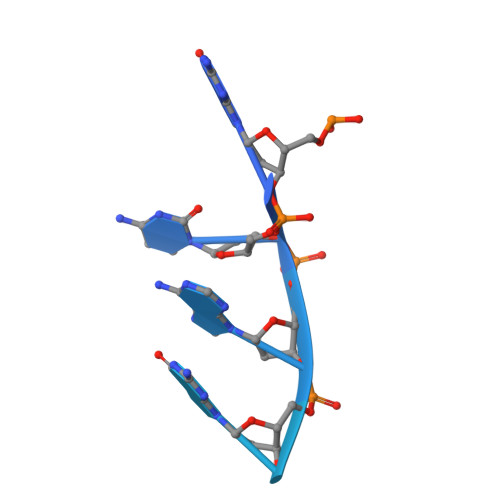
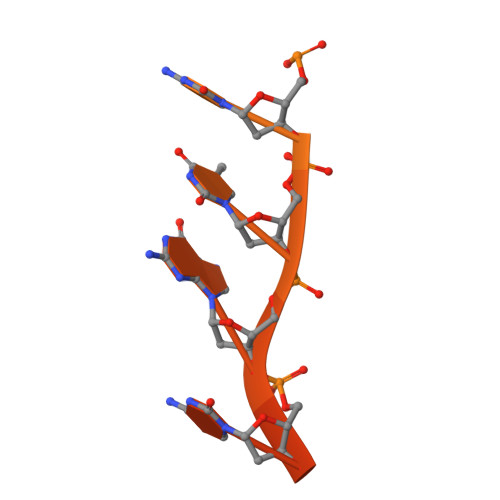
    The Redβ protein of the bacteriophage λ red recombination system is a model annealase which catalyzes single-strand annealing homologous DNA recombination. Here we present the structure of a helical oligomeric annealing intermediate of Redβ, consisting of N-terminal residues 1-177 bound to two complementary 27mer oligonucleotides, determined via cryogenic electron microscopy (cryo-EM) to a final resolution of 3.3 Å. The structure reveals a continuous binding groove which positions and stabilizes complementary DNA strands in a planar orientation to facilitate base pairing via a network of hydrogen bonding. Definition of the inter-subunit interface provides a structural basis for the propensity of Redβ to oligomerize into functionally significant long helical filaments, a trait shared by most annealases. Our cryo-EM structure and molecular dynamics simulations suggest that residues 133-138 form a flexible loop which modulates access to the binding groove. More than half a century after its discovery, this combination of structural and computational observations has allowed us to propose molecular mechanisms for the actions of the model annealase Redβ, a defining member of the Redβ/RecT protein family.


  • Organizational Affiliation
    • School of Chemistry and Molecular Bioscience, and Molecular Horizons, University of Wollongong, Wollongong, NSW, Australia.

Macromolecule Content 

  • Total Structure Weight: 37.87 kDa 
  • Atom Count: 1,447 
  • Modeled Residue Count: 169 
  • Deposited Residue Count: 239 
  • Unique protein chains: 1
  • Unique nucleic acid chains: 2

Macromolecules


Find similar proteins by:|  3D Structure
Entity ID: 1
MoleculeChains  Sequence LengthOrganismDetailsImage
Recombination protein bet185Lambdavirus lambdaMutation(s): 0 
Gene Names: betbetAred-betaredB
UniProt
Find proteins for P03698 (Escherichia phage lambda)
Explore P03698 
Go to UniProtKB:  P03698
Entity Groups
Sequence Clusters30% Identity50% Identity70% Identity90% Identity95% Identity100% Identity
UniProt GroupP03698
Sequence Annotations
Expand
Reference Sequence
Find similar nucleic acids by:  (by identity cutoff) 
Entity ID: 2
MoleculeChains LengthOrganismImage
Template DNA27Escherichia coli
Sequence Annotations
Expand
Reference Sequence
Find similar nucleic acids by:  (by identity cutoff) 
Entity ID: 3
MoleculeChains LengthOrganismImage
Complementary DNA27Escherichia coli
Sequence Annotations
Expand
Reference Sequence

Experimental Data & Validation

Experimental Data

  • Method: ELECTRON MICROSCOPY
  • Resolution: 3.30 Å
  • Aggregation State: HELICAL ARRAY 
  • Reconstruction Method: HELICAL 
EM Software:
TaskSoftware PackageVersion
MODEL REFINEMENTPHENIX
RECONSTRUCTIONcryoSPARC3.0

Structure Validation

View Full Validation Report


Entry History 

& Funding Information

Deposition Data


Funding OrganizationLocationGrant Number
National Health and Medical Research Council (NHMRC, Australia)AustraliaGNT1184012

Revision History  (Full details and data files)

  • Version 1.0: 2022-10-05
    Type: Initial release
  • Version 1.1: 2023-01-11
    Changes: Structure summary
  • Version 1.2: 2024-06-12
    Changes: Data collection
  • Version 1.3: 2024-11-06
    Changes: Data collection, Source and taxonomy, Structure summary