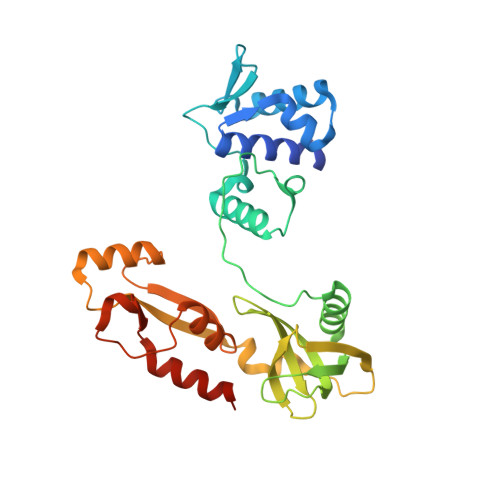
7TB6 | pdb_00007tb6

Structure of S. maltophilia CapW


Experimental Data Snapshot

  • Method: X-RAY DIFFRACTION
  • Resolution: 1.89 Å
  • R-Value Free: 
    0.214 (Depositor), 0.214 (DCC) 
  • R-Value Work: 
    0.196 (Depositor), 0.196 (DCC) 
  • R-Value Observed: 
    0.197 (Depositor) 

Starting Model: experimental
View more details

wwPDB Validation 3D Report Full Report

Validation slider image for 7TB6

This is version 1.3 of the entry. See complete history

Literature

Control of bacterial immune signaling by a WYL domain transcription factor.

Blankenchip, C.L.Nguyen, J.V.Lau, R.K.Ye, Q.Gu, Y.Corbett, K.D.

(2022) Nucleic Acids Res 50: 5239-5250

  • DOI: https://doi.org/10.1093/nar/gkac343
  • Primary Citation Related Structures: 
    7TB5, 7TB6

  • PubMed Abstract: 

    Bacteria use diverse immune systems to defend themselves from ubiquitous viruses termed bacteriophages (phages). Many anti-phage systems function by abortive infection to kill a phage-infected cell, raising the question of how they are regulated to avoid cell killing outside the context of infection. Here, we identify a transcription factor associated with the widespread CBASS bacterial immune system, that we term CapW. CapW forms a homodimer and binds a palindromic DNA sequence in the CBASS promoter region. Two crystal structures of CapW suggest that the protein switches from an unliganded, DNA binding-competent state to a ligand-bound state unable to bind DNA. We show that CapW strongly represses CBASS gene expression in uninfected cells, and that phage infection causes increased CBASS expression in a CapW-dependent manner. Unexpectedly, this CapW-dependent increase in CBASS expression is not required for robust anti-phage activity, suggesting that CapW may mediate CBASS activation and cell death in response to a signal other than phage infection. Our results parallel concurrent reports on the structure and activity of BrxR, a transcription factor associated with the BREX anti-phage system, suggesting that CapW and BrxR are members of a family of universal defense signaling proteins.


  • Organizational Affiliation
    • Biomedical Sciences Graduate Program, University of California, San Diego, La Jolla, CA, USA.

Macromolecule Content 

  • Total Structure Weight: 34.66 kDa 
  • Atom Count: 2,552 
  • Modeled Residue Count: 285 
  • Deposited Residue Count: 299 
  • Unique protein chains: 1

Macromolecules

Find similar proteins by:|  3D Structure
Entity ID: 1
MoleculeChains  Sequence LengthOrganismDetailsImage
S. maltophilia CapW299Stenotrophomonas maltophiliaMutation(s): 0 
UniProt
Find proteins for A0A8X6EH27 (Stenotrophomonas maltophilia)
Explore A0A8X6EH27 
Go to UniProtKB:  A0A8X6EH27
Entity Groups
Sequence Clusters30% Identity50% Identity70% Identity90% Identity95% Identity100% Identity
UniProt GroupA0A8X6EH27
Sequence Annotations
Expand
Reference Sequence

Experimental Data & Validation

Experimental Data

  • Method: X-RAY DIFFRACTION
  • Resolution: 1.89 Å
  • R-Value Free:  0.214 (Depositor), 0.214 (DCC) 
  • R-Value Work:  0.196 (Depositor), 0.196 (DCC) 
  • R-Value Observed: 0.197 (Depositor) 
Space Group: P 65 2 2
Unit Cell:
Length ( Å )Angle ( ˚ )
a = 113.033α = 90
b = 113.033β = 90
c = 188.22γ = 120
Software Package:
Software NamePurpose
PHENIXrefinement
DIALSdata reduction
Aimlessdata scaling
PHASERphasing

Structure Validation

View Full Validation Report


Entry History 

& Funding Information

Deposition Data


Funding OrganizationLocationGrant Number
National Institutes of Health/National Institute Of Allergy and Infectious Diseases (NIH/NIAID)United StatesR21 AI148814

Revision History  (Full details and data files)

  • Version 1.0: 2022-01-19
    Type: Initial release
  • Version 1.1: 2022-05-25
    Changes: Database references
  • Version 1.2: 2022-06-01
    Changes: Database references
  • Version 1.3: 2023-10-18
    Changes: Data collection, Database references, Refinement description