7SQ8 | pdb_00007sq8

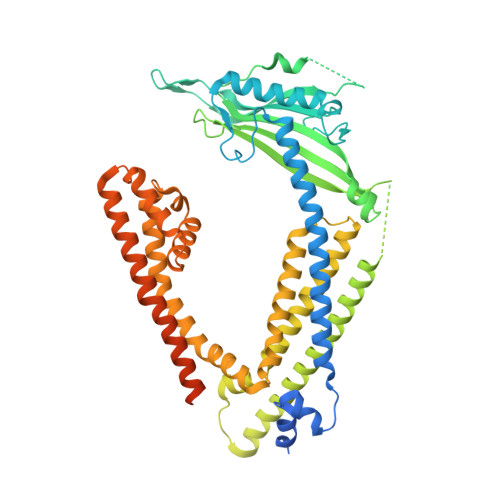
Cryo-EM structure of mouse apo TRPML1 channel at 2.598 Angstrom resolution


Experimental Data Snapshot

  • Method: ELECTRON MICROSCOPY
  • Resolution: 2.60 Å
  • Aggregation State: PARTICLE 
  • Reconstruction Method: SINGLE PARTICLE 

wwPDB Validation 3D Report Full Report

Validation slider image for 7SQ8

This is version 1.3 of the entry. See complete history

Literature

Structural mechanism of allosteric activation of TRPML1 by PI(3,5)P 2 and rapamycin.

Gan, N.Han, Y.Zeng, W.Wang, Y.Xue, J.Jiang, Y.

(2022) Proc Natl Acad Sci U S A 119

  • DOI: https://doi.org/10.1073/pnas.2120404119
  • Primary Citation Related Structures: 
    7SQ6, 7SQ7, 7SQ8, 7SQ9

  • PubMed Abstract: 

    Transient receptor potential mucolipin 1 (TRPML1) is a Ca 2+ -permeable, nonselective cation channel ubiquitously expressed in the endolysosomes of mammalian cells and its loss-of-function mutations are the direct cause of type IV mucolipidosis (MLIV), an autosomal recessive lysosomal storage disease. TRPML1 is a ligand-gated channel that can be activated by phosphatidylinositol 3,5-bisphosphate [PI(3,5)P 2 ] as well as some synthetic small-molecule agonists. Recently, rapamycin has also been shown to directly bind and activate TRPML1. Interestingly, both PI(3,5)P 2 and rapamycin have low efficacy in channel activation individually but together they work cooperatively and activate the channel with high potency. To reveal the structural basis underlying the synergistic activation of TRPML1 by PI(3,5)P 2 and rapamycin, we determined the high-resolution cryoelectron microscopy (cryo-EM) structures of the mouse TRPML1 channel in various states, including apo closed, PI(3,5)P 2 -bound closed, and PI(3,5)P 2 /temsirolimus (a rapamycin analog)-bound open states. These structures, combined with electrophysiology, elucidate the molecular details of ligand binding and provide structural insight into how the TRPML1 channel integrates two distantly bound ligand stimuli and facilitates channel opening.


  • Organizational Affiliation
    • HHMI, University of Texas Southwestern Medical Center, Dallas, TX 75390-9040.

Macromolecule Content 

  • Total Structure Weight: 264.02 kDa 
  • Atom Count: 15,117 
  • Modeled Residue Count: 1,852 
  • Deposited Residue Count: 2,320 
  • Unique protein chains: 1

Macromolecules

Find similar proteins by:|  3D Structure
Entity ID: 1
MoleculeChains  Sequence LengthOrganismDetailsImage
Mucolipin-1
A, B, C, D
580Mus musculusMutation(s): 0 
Gene Names: Mcoln1Trpml1
Membrane Entity: Yes 
UniProt
Find proteins for Q99J21 (Mus musculus)
Explore Q99J21 
Go to UniProtKB:  Q99J21
Entity Groups
Sequence Clusters30% Identity50% Identity70% Identity90% Identity95% Identity100% Identity
UniProt GroupQ99J21
Glycosylation
Glycosylation Sites: 1Go to GlyGen: Q99J21-1
Sequence Annotations
Expand
Reference Sequence

Oligosaccharides

Help  
Entity ID: 2
MoleculeChains Length2D Diagram GlycosylationD Interactions
2-acetamido-2-deoxy-beta-D-glucopyranose-(1-4)-2-acetamido-2-deoxy-beta-D-glucopyranose
E, F, G, H
2N-Glycosylation
Glycosylation Resources
GlyTouCan: G42666HT
GlyCosmos: G42666HT
GlyGen: G42666HT

Small Molecules

Ligands 1 Unique
IDChains Name / Formula / InChI Key2D Diagram3D Interactions
NA

Query on NA


Download:Ideal Coordinates CCD File
I [auth C]SODIUM ION
Na
FKNQFGJONOIPTF-UHFFFAOYSA-N

Experimental Data & Validation

Experimental Data

  • Method: ELECTRON MICROSCOPY
  • Resolution: 2.60 Å
  • Aggregation State: PARTICLE 
  • Reconstruction Method: SINGLE PARTICLE 

Structure Validation

View Full Validation Report


Entry History 

& Funding Information

Deposition Data


Funding OrganizationLocationGrant Number
National Institutes of Health/National Institute of General Medical Sciences (NIH/NIGMS)R35GM140892
Welch FoundationUnited StatesI-1578

Revision History  (Full details and data files)

  • Version 1.0: 2022-02-02
    Type: Initial release
  • Version 1.1: 2022-02-16
    Changes: Data collection, Database references
  • Version 1.2: 2022-02-23
    Changes: Database references
  • Version 1.3: 2024-11-06
    Changes: Data collection, Structure summary