7SG5 | pdb_00007sg5

Structure of PfCSP peptide 21 with antibody CIS43_Var2


Experimental Data Snapshot

  • Method: X-RAY DIFFRACTION
  • Resolution: 1.40 Å
  • R-Value Free: 
    0.218 (Depositor), 0.219 (DCC) 
  • R-Value Work: 
    0.185 (Depositor), 0.189 (DCC) 
  • R-Value Observed: 
    0.187 (Depositor) 

Starting Model: experimental
View more details

wwPDB Validation 3D Report Full Report

Validation slider image for 7SG5

This is version 1.3 of the entry. See complete history

Literature

Highly protective antimalarial antibodies via precision library generation and yeast display screening.

Banach, B.B.Tripathi, P.Da Silva Pereira, L.Gorman, J.Nguyen, T.D.Dillon, M.Fahad, A.S.Kiyuka, P.K.Madan, B.Wolfe, J.R.Bonilla, B.Flynn, B.Francica, J.R.Hurlburt, N.K.Kisalu, N.K.Liu, T.Ou, L.Rawi, R.Schon, A.Shen, C.H.Teng, I.T.Zhang, B.Pancera, M.Idris, A.H.Seder, R.A.Kwong, P.D.DeKosky, B.J.

(2022) J Exp Medicine 219

  • DOI: https://doi.org/10.1084/jem.20220323
  • Primary Citation Related Structures: 
    7SG5, 7SG6

  • PubMed Abstract: 

    The monoclonal antibody CIS43 targets the Plasmodium falciparum circumsporozoite protein (PfCSP) and prevents malaria infection in humans for up to 9 mo following a single intravenous administration. To enhance the potency and clinical utility of CIS43, we used iterative site-saturation mutagenesis and DNA shuffling to screen precise gene-variant yeast display libraries for improved PfCSP antigen recognition. We identified several mutations that improved recognition, predominately in framework regions, and combined these to produce a panel of antibody variants. The most improved antibody, CIS43_Var10, had three mutations and showed approximately sixfold enhanced protective potency in vivo compared to CIS43. Co-crystal and cryo-electron microscopy structures of CIS43_Var10 with the peptide epitope or with PfCSP, respectively, revealed functional roles for each of these mutations. The unbiased site-directed mutagenesis and screening pipeline described here represent a powerful approach to enhance protective potency and to enable broader clinical use of antimalarial antibodies.


  • Organizational Affiliation
    • Bioengineering Graduate Program, The University of Kansas, Lawrence, KS.

Macromolecule Content 

  • Total Structure Weight: 50.59 kDa 
  • Atom Count: 3,854 
  • Modeled Residue Count: 451 
  • Deposited Residue Count: 461 
  • Unique protein chains: 3

Macromolecules

Find similar proteins by:|  3D Structure
Entity ID: 1
MoleculeChains  Sequence LengthOrganismDetailsImage
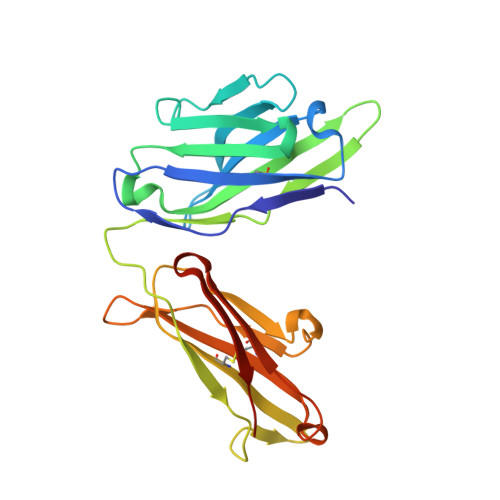
CIS43_Var2 Fab Heavy chainA [auth H]226Homo sapiensMutation(s): 0 
Find similar proteins by:|  3D Structure
Entity ID: 2
MoleculeChains  Sequence LengthOrganismDetailsImage
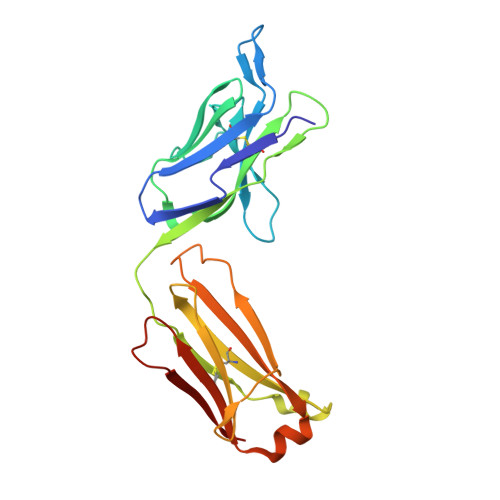
CIS43_Var2 Fab Light chainB [auth L]220Homo sapiensMutation(s): 0 
Find similar proteins by:  Sequence   |   3D Structure  
Entity ID: 3
MoleculeChains  Sequence LengthOrganismDetailsImage
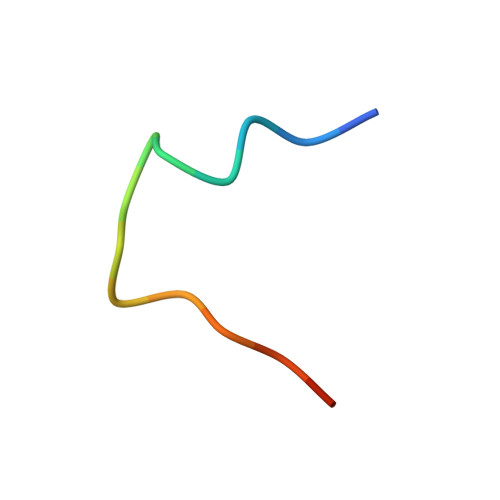
PfCSP peptide 21C [auth A]15synthetic constructMutation(s): 0 
UniProt
Find proteins for Q7K740 (Plasmodium falciparum (isolate 3D7))
Explore Q7K740 
Go to UniProtKB:  Q7K740
Entity Groups
Sequence Clusters30% Identity50% Identity70% Identity90% Identity95% Identity100% Identity
UniProt GroupQ7K740
Sequence Annotations
Expand
Reference Sequence

Experimental Data & Validation

Experimental Data

  • Method: X-RAY DIFFRACTION
  • Resolution: 1.40 Å
  • R-Value Free:  0.218 (Depositor), 0.219 (DCC) 
  • R-Value Work:  0.185 (Depositor), 0.189 (DCC) 
  • R-Value Observed: 0.187 (Depositor) 
Space Group: C 1 2 1
Unit Cell:
Length ( Å )Angle ( ˚ )
a = 94.77α = 90
b = 61.137β = 106.56
c = 75.313γ = 90
Software Package:
Software NamePurpose
PHENIXrefinement
PDB_EXTRACTdata extraction
XDSdata reduction
Aimlessdata scaling
PHASERphasing

Structure Validation

View Full Validation Report


Entry History 

& Funding Information

Deposition Data


Funding OrganizationLocationGrant Number
National Institutes of Health/National Institute Of Allergy and Infectious Diseases (NIH/NIAID)United States--

Revision History  (Full details and data files)

  • Version 1.0: 2022-06-22
    Type: Initial release
  • Version 1.1: 2023-07-05
    Changes: Database references
  • Version 1.2: 2023-10-25
    Changes: Data collection, Refinement description
  • Version 1.3: 2024-10-30
    Changes: Structure summary