7S8W | pdb_00007s8w

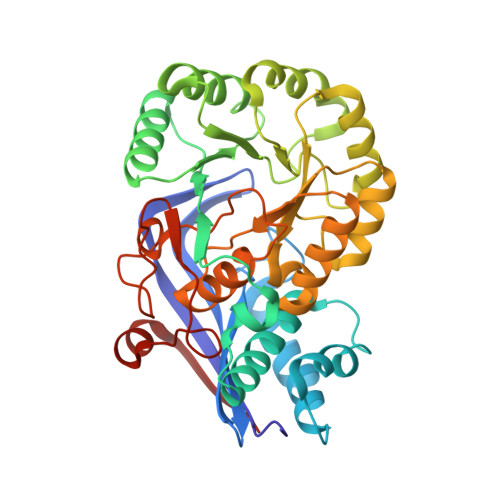
Amycolatopsis sp. T-1-60 N-succinylamino acid racemase/o-succinylbenzoate synthase R266Q mutant in complex with N-succinylphenylglycine


Experimental Data Snapshot

  • Method: X-RAY DIFFRACTION
  • Resolution: 2.90 Å
  • R-Value Free: 
    0.215 (Depositor), 0.216 (DCC) 
  • R-Value Work: 
    0.170 (Depositor), 0.175 (DCC) 
  • R-Value Observed: 
    0.172 (Depositor) 

Starting Model: experimental
View more details

wwPDB Validation 3D Report Full Report

Validation slider image for 7S8W

Ligand Structure Quality Assessment 


This is version 1.3 of the entry. See complete history

Literature

Second-Shell Amino Acid R266 Helps Determine N -Succinylamino Acid Racemase Reaction Specificity in Promiscuous N -Succinylamino Acid Racemase/ o -Succinylbenzoate Synthase Enzymes.

Truong, D.P.Rousseau, S.Machala, B.W.Huddleston, J.P.Zhu, M.Hull, K.G.Romo, D.Raushel, F.M.Sacchettini, J.C.Glasner, M.E.

(2021) Biochemistry 60: 3829-3840

  • DOI: https://doi.org/10.1021/acs.biochem.1c00627
  • Primary Citation Related Structures: 
    7S8W

  • PubMed Abstract: 

    Catalytic promiscuity is the coincidental ability to catalyze nonbiological reactions in the same active site as the native biological reaction. Several lines of evidence show that catalytic promiscuity plays a role in the evolution of new enzyme functions. Thus, studying catalytic promiscuity can help identify structural features that predispose an enzyme to evolve new functions. This study identifies a potentially preadaptive residue in a promiscuous N -succinylamino acid racemase/ o -succinylbenzoate synthase (NSAR/OSBS) enzyme from Amycolatopsis sp. T-1-60. This enzyme belongs to a branch of the OSBS family which includes many catalytically promiscuous NSAR/OSBS enzymes. R266 is conserved in all members of the NSAR/OSBS subfamily. However, the homologous position is usually hydrophobic in other OSBS subfamilies, whose enzymes lack NSAR activity. The second-shell amino acid R266 is close to the catalytic acid/base K263, but it does not contact the substrate, suggesting that R266 could affect the catalytic mechanism. Mutating R266 to glutamine in Amycolatopsis NSAR/OSBS profoundly reduces NSAR activity but moderately reduces OSBS activity. This is due to a 1000-fold decrease in the rate of proton exchange between the substrate and the general acid/base catalyst K263. This mutation is less deleterious for the OSBS reaction because K263 forms a cation-π interaction with the OSBS substrate and/or the intermediate, rather than acting as a general acid/base catalyst. Together, the data explain how R266 contributes to NSAR reaction specificity and was likely an essential preadaptation for the evolution of NSAR activity.


  • Organizational Affiliation
    • Department of Biochemistry and Biophysics, Texas A&M University, 2128 TAMU, College Station, Texas 77843-2128, United States.

Macromolecule Content 

  • Total Structure Weight: 159.02 kDa 
  • Atom Count: 11,278 
  • Modeled Residue Count: 1,469 
  • Deposited Residue Count: 1,472 
  • Unique protein chains: 1

Macromolecules

Find similar proteins by:|  3D Structure
Entity ID: 1
MoleculeChains  Sequence LengthOrganismDetailsImage
N-succinylamino acid racemase/O-succinylbenzoate synthase
A, B, C, D
368Amycolatopsis sp.Mutation(s): 1 
Gene Names: AaarmenC
EC: 4.2.1.113 (PDB Primary Data), 5.1.1 (UniProt)
UniProt
Find proteins for Q44244 (Amycolatopsis sp)
Explore Q44244 
Go to UniProtKB:  Q44244
Entity Groups
Sequence Clusters30% Identity50% Identity70% Identity90% Identity95% Identity100% Identity
UniProt GroupQ44244
Sequence Annotations
Expand
Reference Sequence

Small Molecules

Ligands 3 Unique
IDChains Name / Formula / InChI Key2D Diagram3D Interactions
8JI
(Subject of Investigation/LOI)

Query on 8JI


Download:Ideal Coordinates CCD File
E [auth A],
G [auth B],
J [auth C],
L [auth D]
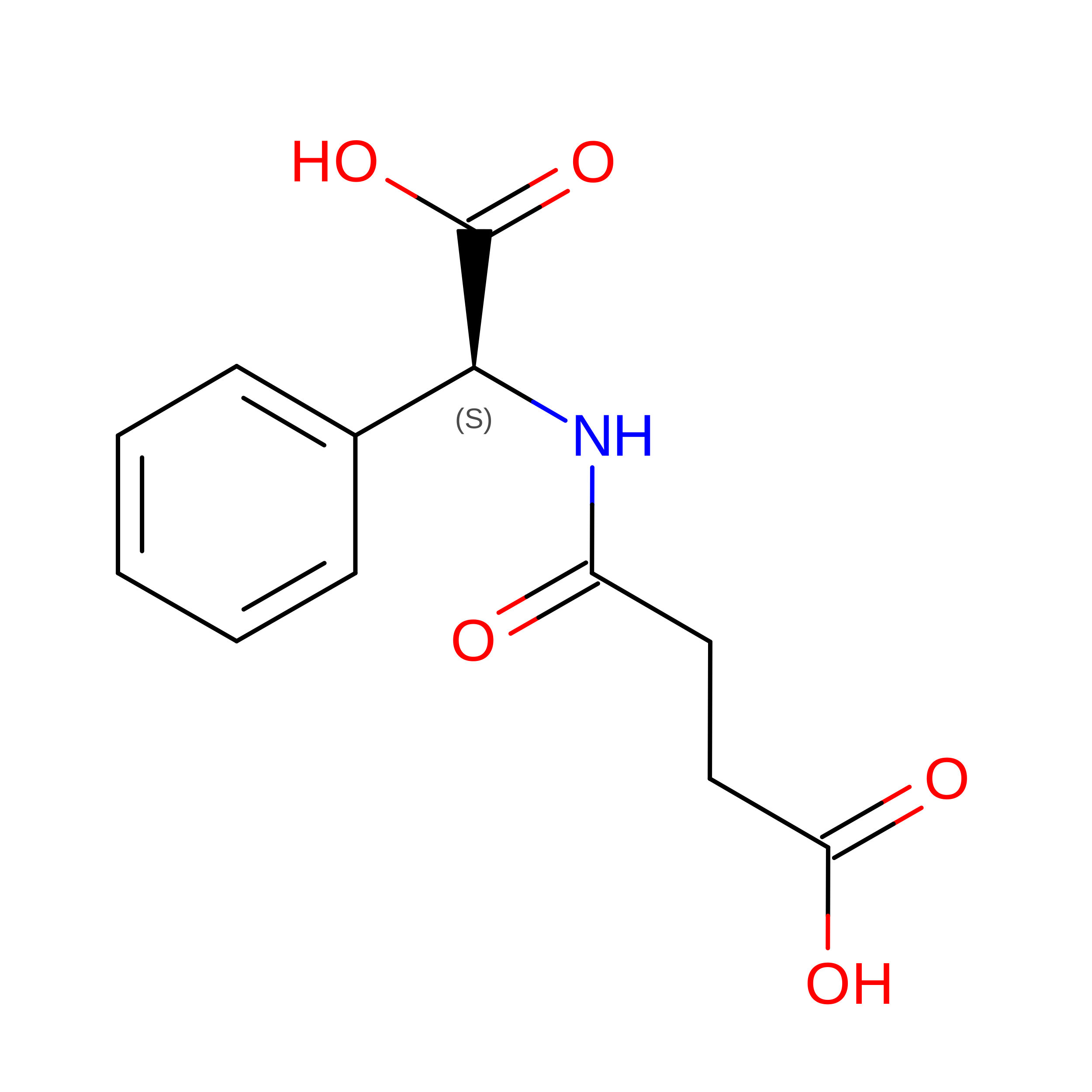
N-succinyl-L-phenylglycine
C12 H13 N O5
GQFHIYFXQQEWME-NSHDSACASA-N
1PE

Query on 1PE


Download:Ideal Coordinates CCD File
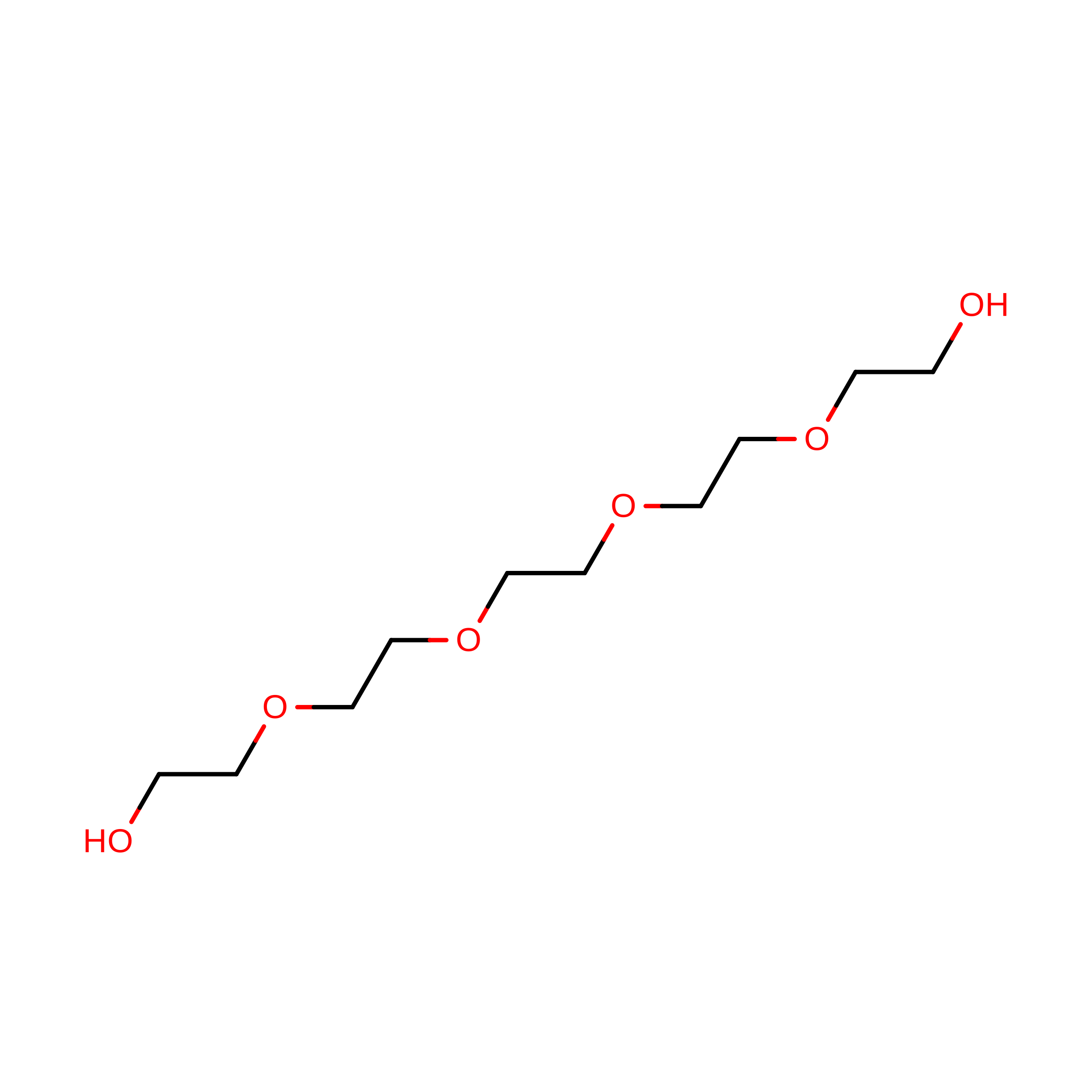
I [auth C]PENTAETHYLENE GLYCOL
C10 H22 O6
JLFNLZLINWHATN-UHFFFAOYSA-N
MG
(Subject of Investigation/LOI)

Query on MG


Download:Ideal Coordinates CCD File
F [auth A],
H [auth B],
K [auth C],
M [auth D]
MAGNESIUM ION
Mg
JLVVSXFLKOJNIY-UHFFFAOYSA-N

Experimental Data & Validation

Experimental Data

  • Method: X-RAY DIFFRACTION
  • Resolution: 2.90 Å
  • R-Value Free:  0.215 (Depositor), 0.216 (DCC) 
  • R-Value Work:  0.170 (Depositor), 0.175 (DCC) 
  • R-Value Observed: 0.172 (Depositor) 
Space Group: H 3 2
Unit Cell:
Length ( Å )Angle ( ˚ )
a = 213.742α = 90
b = 213.742β = 90
c = 253.077γ = 120
Software Package:
Software NamePurpose
PHENIXrefinement
SBC-Collectdata collection
HKL-3000data reduction
HKL-3000data scaling
PHASERphasing

Structure Validation

View Full Validation Report


Ligand Structure Quality Assessment 


Entry History 

& Funding Information

Deposition Data


Funding OrganizationLocationGrant Number
National Science Foundation (NSF, United States)United States1253975
National Institutes of Health/National Institute of General Medical Sciences (NIH/NIGMS)United StatesR01-GM124409
Welch FoundationUnited StatesA-1991-20190330
Welch FoundationUnited StatesA-0015

Revision History  (Full details and data files)

  • Version 1.0: 2021-10-06
    Type: Initial release
  • Version 1.1: 2021-12-15
    Changes: Database references
  • Version 1.2: 2021-12-29
    Changes: Database references
  • Version 1.3: 2023-10-18
    Changes: Data collection, Refinement description