7S7K | pdb_00007s7k

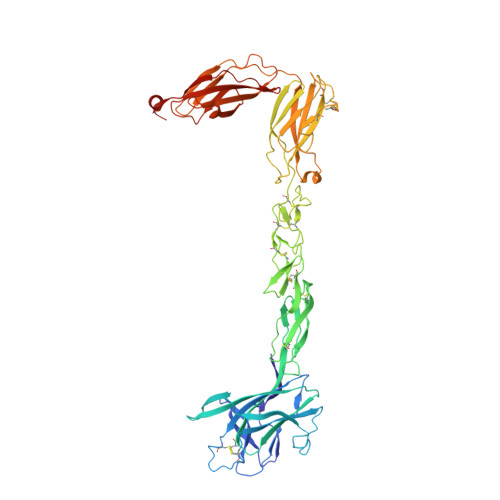
Crystal structure of the EphB2 extracellular domain


Experimental Data Snapshot

  • Method: X-RAY DIFFRACTION
  • Resolution: 3.15 Å
  • R-Value Free: 
    0.248 (Depositor), 0.244 (DCC) 
  • R-Value Work: 
    0.214 (Depositor), 0.214 (DCC) 
  • R-Value Observed: 
    0.215 (Depositor) 

Starting Model: experimental
View more details

wwPDB Validation 3D Report Full Report

Validation slider image for 7S7K

Ligand Structure Quality Assessment 


This is version 1.2 of the entry. See complete history

Literature

The Ephb2 Receptor Uses Homotypic, Head-to-Tail Interactions within Its Ectodomain as an Autoinhibitory Control Mechanism.

Xu, Y.Robev, D.Saha, N.Wang, B.Dalva, M.B.Xu, K.Himanen, J.P.Nikolov, D.B.

(2021) Int J Mol Sci 22

  • DOI: https://doi.org/10.3390/ijms221910473
  • Primary Citation Related Structures: 
    7S7K

  • PubMed Abstract: 

    The Eph receptor tyrosine kinases and their ephrin ligands direct axon pathfinding and neuronal cell migration, as well as mediate many other cell-cell communication events. Their dysfunctional signaling has been shown to lead to various diseases, including cancer. The Ephs and ephrins both localize to the plasma membrane and, upon cell-cell contact, form extensive signaling assemblies at the contact sites. The Ephs and the ephrins are divided into A and B subclasses based on their sequence conservation and affinities for each other. The molecular details of Eph-ephrin recognition have been previously revealed and it has been documented that ephrin binding induces higher-order Eph assemblies, which are essential for full biological activity, via multiple, distinct Eph-Eph interfaces. One Eph-Eph interface type is characterized by a homotypic, head-to-tail interaction between the ligand-binding and the fibronectin domains of two adjacent Eph molecules. While the previous Eph ectodomain structural studies were focused on A class receptors, we now report the crystal structure of the full ectodomain of EphB2, revealing distinct and unique head-to-tail receptor-receptor interactions. The EphB2 structure and structure-based mutagenesis document that EphB2 uses the head-to-tail interactions as a novel autoinhibitory control mechanism for regulating downstream signaling and that these interactions can be modulated by posttranslational modifications.


  • Organizational Affiliation
    • Department of Veterinary Biosciences, College of Veterinary Medicine, The Ohio State University, Columbus, OH 43210, USA.

Macromolecule Content 

  • Total Structure Weight: 59.67 kDa 
  • Atom Count: 4,167 
  • Modeled Residue Count: 525 
  • Deposited Residue Count: 525 
  • Unique protein chains: 1

Macromolecules

Find similar proteins by:|  3D Structure
Entity ID: 1
MoleculeChains  Sequence LengthOrganismDetailsImage
Ephrin type-B receptor 2525Mus musculusMutation(s): 0 
Gene Names: Ephb2Epth3NukSek3
EC: 2.7.10.1
UniProt & NIH Common Fund Data Resources
Find proteins for P54763 (Mus musculus)
Explore P54763 
Go to UniProtKB:  P54763
IMPC:  MGI:99611
Entity Groups
Sequence Clusters30% Identity50% Identity70% Identity90% Identity95% Identity100% Identity
UniProt GroupP54763
Glycosylation
Glycosylation Sites: 4Go to GlyGen: P54763-3
Sequence Annotations
Expand
Reference Sequence

Oligosaccharides

Help  
Entity ID: 2
MoleculeChains Length2D Diagram GlycosylationD Interactions
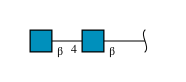
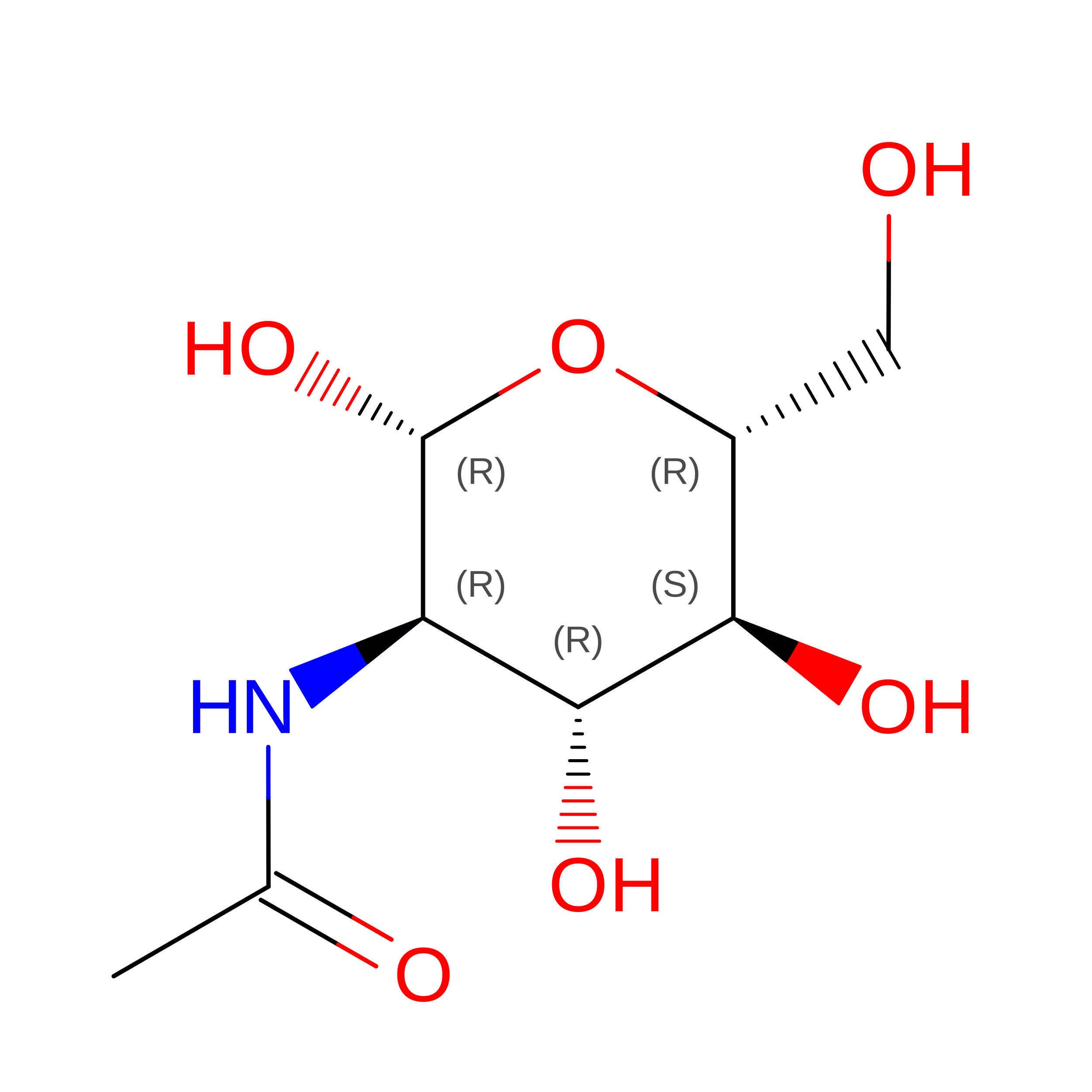
2-acetamido-2-deoxy-beta-D-glucopyranose-(1-4)-2-acetamido-2-deoxy-beta-D-glucopyranose
B
2N-Glycosylation
Glycosylation Resources
GlyTouCan: G42666HT
GlyCosmos: G42666HT
GlyGen: G42666HT
Entity ID: 3
MoleculeChains Length2D Diagram GlycosylationD Interactions
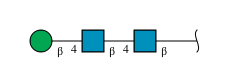
beta-D-mannopyranose-(1-4)-2-acetamido-2-deoxy-beta-D-glucopyranose-(1-4)-2-acetamido-2-deoxy-beta-D-glucopyranose
C
3N-Glycosylation
Glycosylation Resources
GlyTouCan: G15407YE
GlyCosmos: G15407YE
GlyGen: G15407YE

Experimental Data & Validation

Experimental Data

  • Method: X-RAY DIFFRACTION
  • Resolution: 3.15 Å
  • R-Value Free:  0.248 (Depositor), 0.244 (DCC) 
  • R-Value Work:  0.214 (Depositor), 0.214 (DCC) 
  • R-Value Observed: 0.215 (Depositor) 
Space Group: P 21 21 21
Unit Cell:
Length ( Å )Angle ( ˚ )
a = 73.843α = 90
b = 111.142β = 90
c = 156.877γ = 90
Software Package:
Software NamePurpose
PHENIXrefinement
SCALAdata scaling
PDB_EXTRACTdata extraction
XDSdata reduction
PHASERphasing

Structure Validation

View Full Validation Report


Ligand Structure Quality Assessment 


Entry History 

& Funding Information

Deposition Data


Funding OrganizationLocationGrant Number
National Institutes of Health/National Cancer Institute (NIH/NCI)United States--

Revision History  (Full details and data files)

  • Version 1.0: 2021-10-27
    Type: Initial release
  • Version 1.1: 2023-10-18
    Changes: Data collection, Refinement description
  • Version 1.2: 2024-11-13
    Changes: Structure summary