7ROA | pdb_00007roa

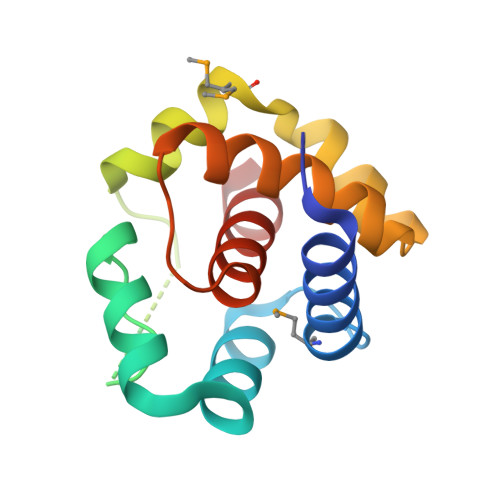
Crystal structure of EntV136 from Enterococcus faecalis


Experimental Data Snapshot

  • Method: X-RAY DIFFRACTION
  • Resolution: 1.82 Å
  • R-Value Free: 
    0.217 (Depositor), 0.219 (DCC) 
  • R-Value Work: 
    0.175 (Depositor), 0.175 (DCC) 
  • R-Value Observed: 
    0.177 (Depositor) 

wwPDB Validation 3D Report Full Report

Validation slider image for 7ROA

This is version 1.3 of the entry. See complete history

Literature

Structural and functional analysis of EntV reveals a 12 amino acid fragment protective against fungal infections.

Cruz, M.R.Cristy, S.Guha, S.De Cesare, G.B.Evdokimova, E.Sanchez, H.Borek, D.Miramon, P.Yano, J.Fidel Jr., P.L.Savchenko, A.Andes, D.R.Stogios, P.J.Lorenz, M.C.Garsin, D.A.

(2022) Nat Commun 13: 6047-6047

  • DOI: https://doi.org/10.1038/s41467-022-33613-1
  • Primary Citation Related Structures: 
    7ROA

  • PubMed Abstract: 

    Fungal pathogens are a continuing challenge due to few effective antifungals and a rise in resistance. In previous work, we described the inhibition of Candida albicans virulence following exposure to the 68 amino acid bacteriocin, EntV, secreted by Enterococcus faecalis. Here, to optimize EntV as a potential therapeutic and better understand its antifungal features, an X-ray structure is obtained. The structure consists of six alpha helices enclosing a seventh 16 amino acid helix (α7). The individual helices are tested for antifungal activity using in vitro and nematode infection assays. Interestingly, α7 retains antifungal, but not antibacterial activity and is also effective against Candida auris and Cryptococcus neoformans. Further reduction of α7 to 12 amino acids retains full antifungal activity, and excellent efficacy is observed in rodent models of C. albicans oropharyngeal, systemic, and venous catheter infections. Together, these results showcase EntV-derived peptides as promising candidates for antifungal therapeutic development.


  • Organizational Affiliation
    • Department of Microbiology and Molecular Genetics, The University of Texas Health Science Center at Houston, Houston, TX, 77030, USA.

Macromolecule Content 

  • Total Structure Weight: 14.94 kDa 
  • Atom Count: 991 
  • Modeled Residue Count: 117 
  • Deposited Residue Count: 136 
  • Unique protein chains: 1

Macromolecules

Find similar proteins by:|  3D Structure
Entity ID: 1
MoleculeChains  Sequence LengthOrganismDetailsImage
EntV136Enterococcus faecalis OG1RFMutation(s): 0 
UniProt
Find proteins for Q836L4 (Enterococcus faecalis (strain ATCC 700802 / V583))
Explore Q836L4 
Go to UniProtKB:  Q836L4
Entity Groups
Sequence Clusters30% Identity50% Identity70% Identity90% Identity95% Identity100% Identity
UniProt GroupQ836L4
Sequence Annotations
Expand
Reference Sequence

Small Molecules

Modified Residues  1 Unique
IDChains TypeFormula2D DiagramParent
MSE
Query on MSE
A
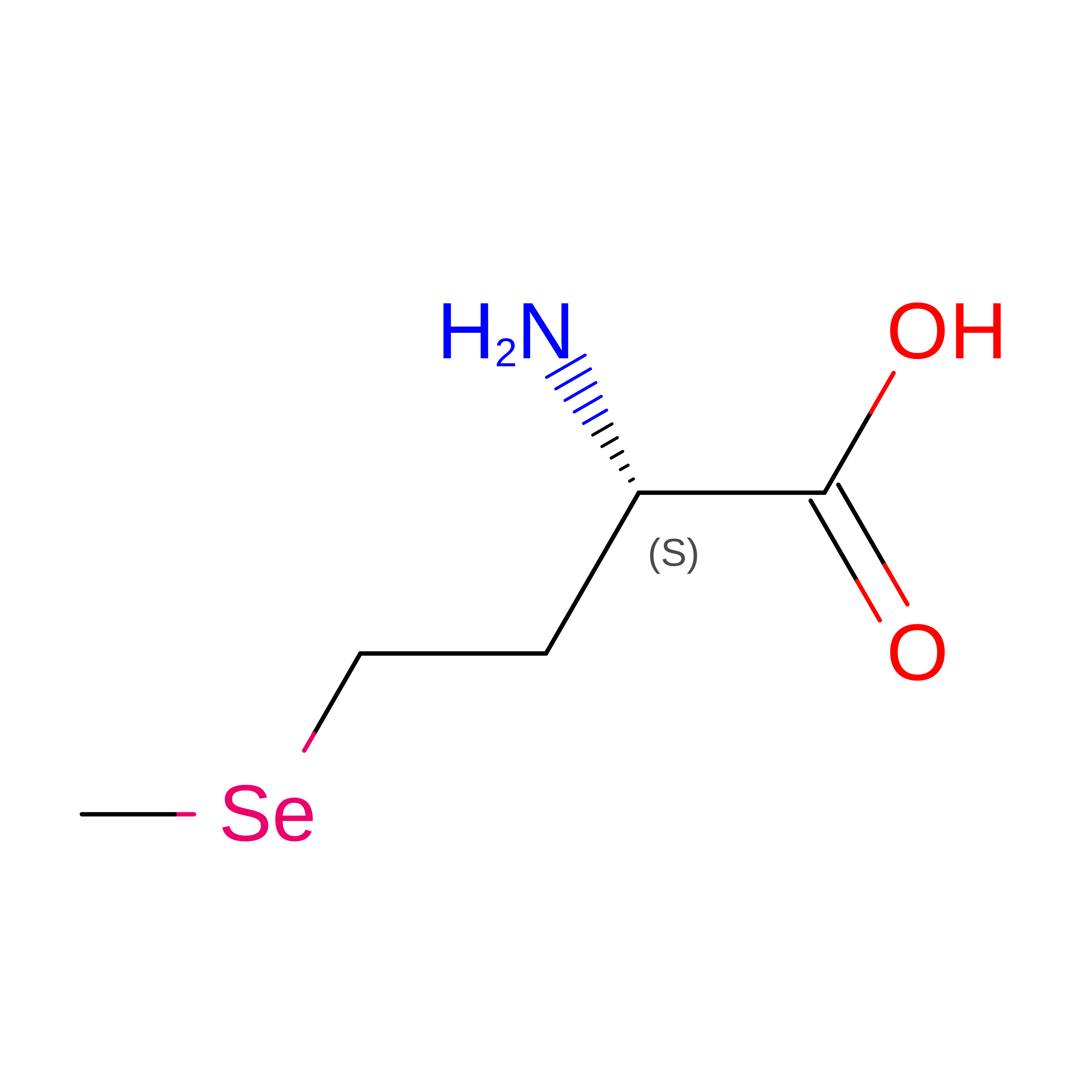
L-PEPTIDE LINKINGC5 H11 N O2 SeMET

Experimental Data & Validation

Experimental Data

  • Method: X-RAY DIFFRACTION
  • Resolution: 1.82 Å
  • R-Value Free:  0.217 (Depositor), 0.219 (DCC) 
  • R-Value Work:  0.175 (Depositor), 0.175 (DCC) 
  • R-Value Observed: 0.177 (Depositor) 
Space Group: C 1 2 1
Unit Cell:
Length ( Å )Angle ( ˚ )
a = 62.394α = 90
b = 32.064β = 90.86
c = 49.992γ = 90
Software Package:
Software NamePurpose
PHENIXrefinement
HKL-3000data reduction
HKL-3000data scaling
SHELXDEphasing
MLPHAREphasing
BUCCANEERmodel building
Cootmodel building
DMphasing

Structure Validation

View Full Validation Report


Entry History 

& Funding Information

Deposition Data


Funding OrganizationLocationGrant Number
National Institutes of Health/National Institute Of Allergy and Infectious Diseases (NIH/NIAID)United StatesHHSN272201700060C

Revision History  (Full details and data files)

  • Version 1.0: 2022-10-12
    Type: Initial release
  • Version 1.1: 2022-11-23
    Changes: Database references
  • Version 1.2: 2023-01-25
    Changes: Structure summary
  • Version 1.3: 2024-11-20
    Changes: Data collection, Structure summary