Download Mendeley
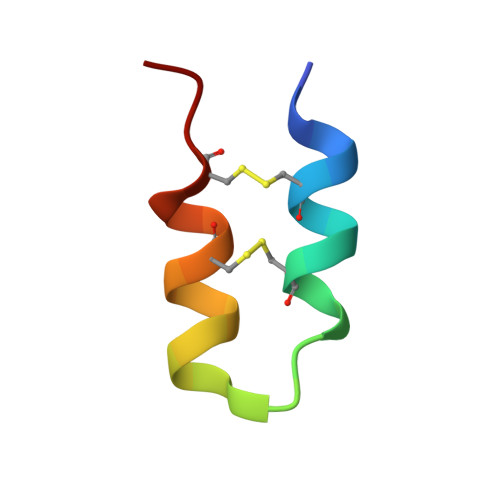
Artificial pore blocker acts specifically on voltage-gated potassium channel isoform K V 1.6.
Gigolaev, A.M., Lushpa, V.A., Pinheiro-Junior, E.L., Tabakmakher, V.M., Peigneur, S., Ignatova, A.A., Feofanov, A.V., Efremov, R.G., Mineev, K.S., Tytgat, J., Vassilevski, A.A.(2022) J Biol Chem 298: 102467-102467
- PubMed: 36087839 Search on PubMedSearch on PubMed Central
- DOI: https://doi.org/10.1016/j.jbc.2022.102467
- Primary Citation Related Structures:
7QXJ - PubMed Abstract:
Among voltage-gated potassium channel (K V ) isoforms, K V 1.6 is one of the most widespread in the nervous system. However, there are little data concerning its physiological significance, in part due to the scarcity of specific ligands. The known high-affinity ligands of K V 1.6 lack selectivity, and conversely, its selective ligands show low affinity. Here, we present a designer peptide with both high affinity and selectivity to K V 1.6. Previously, we have demonstrated that K V isoform-selective peptides can be constructed based on the simplistic α-hairpinin scaffold, and we obtained a number of artificial Tk-hefu peptides showing selective blockage of K V 1.3 in the submicromolar range. We have now proposed amino acid substitutions to enhance their activity. As a result, we have been able to produce Tk-hefu-11 that shows an EC 50 of ≈70 nM against K V 1.3. Quite surprisingly, Tk-hefu-11 turns out to block K V 1.6 with even higher potency, presenting an EC 50 of ≈10 nM. Furthermore, we have solved the peptide structure and used molecular dynamics to investigate the determinants of selective interactions between artificial α-hairpinins and K V channels to explain the dramatic increase in K V 1.6 affinity. Since K V 1.3 is not highly expressed in the nervous system, we hope that Tk-hefu-11 will be useful in studies of K V 1.6 and its functions.
- Shemyakin-Ovchinnikov Institute of Bioorganic Chemistry, Russian Academy of Sciences, Moscow, Russia.
Organizational Affiliation: