Download Mendeley
Triosephosphate isomerase from Fasciola hepatica: high-resolution crystal structure as a drug target.
Kontellas, G., Studholme, D.J., van der Giezen, M., Timson, D.J., Littlechild, J.A., Isupov, M.N.(2025) Acta Crystallogr F Struct Biol Commun 81: 381-387
- PubMed: 40832834 Search on PubMedSearch on PubMed Central
- DOI: https://doi.org/10.1107/S2053230X25006454
- Primary Citation Related Structures:
7QON - PubMed Abstract:
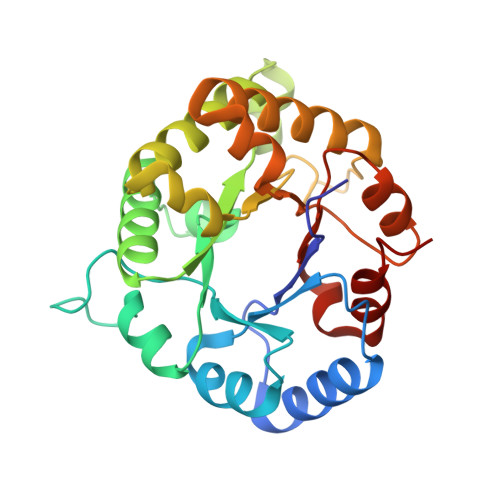
The trematode liver fluke Fasciola hepatica causes the neglected tropical disease fascioliasis in humans and is associated with significant losses in agricultural industry due to reduced animal productivity. Triosephosphate isomerase (TPI) is a glycolytic enzyme that has been researched as a drug target for various parasites, including F. hepatica. The high-resolution crystal structure of F. hepatica TPI (FhTPI) has been solved at 1.51 Å resolution in its monoclinic form. The structure has been used to perform molecular-docking studies with the most successful fasciolocide triclabendazole (TCBZ), which has recently been suggested to target FhTPI. Two FhTPI residues, Lys50 and Asp51, are located at the dimer interface and are found in close proximity to the docked TCBZ. These residues are not conserved in mammalian hosts.
- Henry Wellcome Building for Biocatalysis, Biosciences, Faculty of Health and Life Sciences, University of Exeter, Exeter EX4 4QD, United Kingdom.
Organizational Affiliation: