Download Mendeley
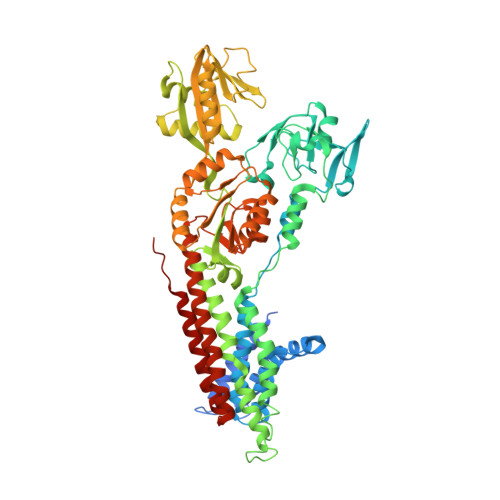
Structure and ion-release mechanism of P IB-4 -type ATPases.
Gronberg, C., Hu, Q., Mahato, D.R., Longhin, E., Salustros, N., Duelli, A., Lyu, P., Bagenholm, V., Eriksson, J., Rao, K.U., Henderson, D.I., Meloni, G., Andersson, M., Croll, T., Godaly, G., Wang, K., Gourdon, P.(2021) Elife 10
- PubMed: 34951590 Search on PubMedSearch on PubMed Central
- DOI: https://doi.org/10.7554/eLife.73124
- Primary Citation Related Structures:
7QBZ, 7QC0 - PubMed Abstract:
Transition metals, such as zinc, are essential micronutrients in all organisms, but also highly toxic in excessive amounts. Heavy-metal transporting P-type (P IB ) ATPases are crucial for homeostasis, conferring cellular detoxification and redistribution through transport of these ions across cellular membranes. No structural information is available for the P IB-4 -ATPases, the subclass with the broadest cargo scope, and hence even their topology remains elusive. Here, we present structures and complementary functional analyses of an archetypal P IB-4 -ATPase, sCoaT from Sulfitobacter sp. NAS14-1. The data disclose the architecture, devoid of classical so-called heavy-metal-binding domains (HMBDs), and provide fundamentally new insights into the mechanism and diversity of heavy-metal transporters. We reveal several novel P-type ATPase features, including a dual role in heavy-metal release and as an internal counter ion of an invariant histidine. We also establish that the turnover of P IB -ATPases is potassium independent, contrasting to many other P-type ATPases. Combined with new inhibitory compounds, our results open up for efforts in for example drug discovery, since P IB-4 -ATPases function as virulence factors in many pathogens.
- Department of Biomedical Sciences, University of Copenhagen, Copenhagen, Denmark.
Organizational Affiliation: