7Q3J | pdb_00007q3j

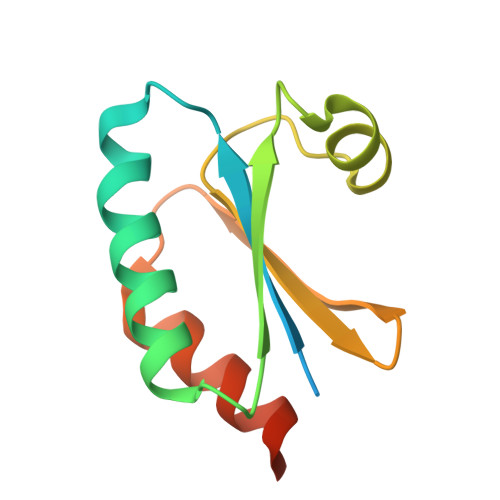
Computationally designed thioredoxin subjected to stability optimizing mutations.


Experimental Data Snapshot

  • Method: X-RAY DIFFRACTION
  • Resolution: 1.90 Å
  • R-Value Free: 
    0.239 (Depositor), 0.240 (DCC) 
  • R-Value Work: 
    0.192 (Depositor), 0.190 (DCC) 
  • R-Value Observed: 
    0.195 (Depositor) 

Starting Model: experimental
View more details

wwPDB Validation   3D Report Full Report


This is version 1.2 of the entry. See complete history


Literature

Increasing protein stability by inferring substitution effects from high-throughput experiments.

Norrild, R.K.Johansson, K.E.O'Shea, C.Morth, J.P.Lindorff-Larsen, K.Winther, J.R.

(2022) Cell Rep Methods 2: 100333-100333

  • DOI: https://doi.org/10.1016/j.crmeth.2022.100333
  • Primary Citation of Related Structures:  
    7Q3J, 7Q3K

  • PubMed Abstract: 

    We apply a computational model, global multi-mutant analysis (GMMA), to inform on effects of most amino acid substitutions from a randomly mutated gene library. Using a high mutation frequency, the method can determine mutations that increase the stability of even very stable proteins for which conventional selection systems have reached their limit. As a demonstration of this, we screened a mutant library of a highly stable and computationally redesigned model protein using an in vivo genetic sensor for folding and assigned a stability effect to 374 of 912 possible single amino acid substitutions. Combining the top 9 substitutions increased the unfolding energy 47 to 69 kJ/mol in a single engineering step. Crystal structures of stabilized variants showed small perturbations in helices 1 and 2, which rendered them closer in structure to the redesign template. This case study illustrates the capability of the method, which is applicable to any screen for protein function.


  • Organizational Affiliation
    • Linderstrøm-Lang Centre for Protein Science, Department of Biology, University of Copenhagen, 2200 Copenhagen N, Denmark.

Macromolecules
Find similar proteins by:  (by identity cutoff)  |  3D Structure
Entity ID: 1
MoleculeChains Sequence LengthOrganismDetailsImage
MM9
A, B
114synthetic constructMutation(s): 0 
Entity Groups  
Sequence Clusters30% Identity50% Identity70% Identity90% Identity95% Identity100% Identity
Sequence Annotations
Expand
  • Reference Sequence
Experimental Data & Validation

Experimental Data

  • Method: X-RAY DIFFRACTION
  • Resolution: 1.90 Å
  • R-Value Free:  0.239 (Depositor), 0.240 (DCC) 
  • R-Value Work:  0.192 (Depositor), 0.190 (DCC) 
  • R-Value Observed: 0.195 (Depositor) 
Space Group: C 1 2 1
Unit Cell:
Length ( Å )Angle ( ˚ )
a = 58.89α = 90
b = 45.656β = 92.155
c = 72.882γ = 90
Software Package:
Software NamePurpose
PHENIXrefinement
PHENIXrefinement
xia2data reduction
xia2data scaling
PHASERphasing

Structure Validation

View Full Validation Report


Entry History & Funding Information

Deposition Data


Funding OrganizationLocationGrant Number
Danish Council for Independent ResearchDenmark--

Revision History  (Full details and data files)

  • Version 1.0: 2022-11-16
    Type: Initial release
  • Version 1.1: 2023-03-01
    Changes: Database references
  • Version 1.2: 2024-02-07
    Changes: Data collection, Refinement description