Download Mendeley
Identification of a Potent, Selective, and Brain-Penetrant Rho Kinase Inhibitor and its Activity in a Mouse Model of Huntington's Disease.
Ladduwahetty, T., Lee, M.R., Maillard, M.C., Cachope, R., Todd, D., Barnes, M., Beaumont, V., Chauhan, A., Gallati, C., Haughan, A.F., Kempf, G., Luckhurst, C.A., Matthews, K., McAllister, G., Mitchell, P., Patel, H., Rose, M., Saville-Stones, E., Steinbacher, S., Stott, A.J., Thatcher, E., Tierney, J., Urbonas, L., Munoz-Sanjuan, I., Dominguez, C.(2022) J Med Chem 65: 9819-9845
- PubMed: 35816678 Search on PubMed
- DOI: https://doi.org/10.1021/acs.jmedchem.2c00474
- Primary Citation Related Structures:
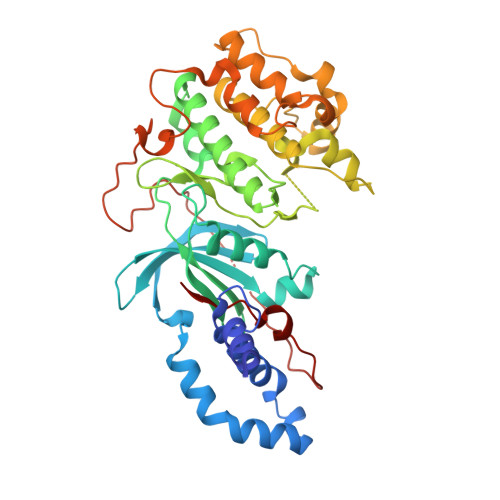
7P6N, 7P6O, 7P6P, 7P6Q - PubMed Abstract:
The Rho kinase (ROCK) pathway is implicated in the pathogenesis of several conditions, including neurological diseases. In Huntington's disease (HD), ROCK is implicated in mutant huntingtin (HTT) aggregation and neurotoxicity, and members of the ROCK pathway are increased in HD mouse models and patients. To validate this mode of action as a potential treatment for HD, we sought a potent, selective, central nervous system (CNS)-penetrant ROCK inhibitor. Identifying a compound that could be dosed orally in mice with selectivity against other AGC kinases, including protein kinase G (PKG), whose inhibition could potentially activate the ROCK pathway, was paramount for the program. We describe the optimization of published ligands to identify a novel series of ROCK inhibitors based on a piperazine core. Morphing of the early series developed in-house by scaffold hopping enabled the identification of a compound exhibiting high potency and desired selectivity and demonstrating a robust pharmacodynamic (PD) effect by the inhibition of ROCK-mediated substrate (MYPT1) phosphorylation after oral dosing.
- Discovery from Charles River, Chesterford Research Park, Saffron Walden CB10 1XL, U.K.
Organizational Affiliation: