7P1K | pdb_00007p1k

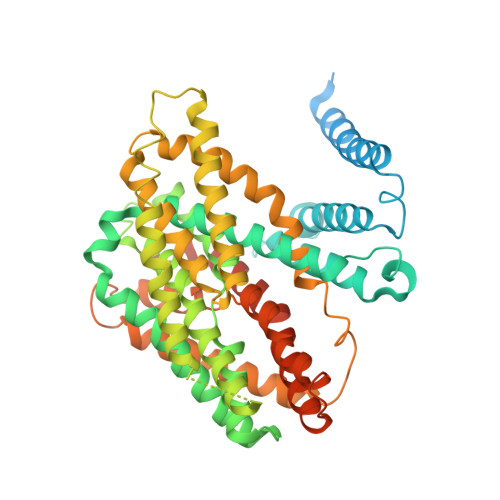
Cryo EM structure of bison NHA2 in nano disc structure


Experimental Data Snapshot

  • Method: ELECTRON MICROSCOPY
  • Resolution: 3.64 Å
  • Aggregation State: PARTICLE 
  • Reconstruction Method: SINGLE PARTICLE 

wwPDB Validation 3D Report Full Report

Validation slider image for 7P1K

This is version 1.4 of the entry. See complete history

Literature

Structure, mechanism and lipid-mediated remodeling of the mammalian Na + /H + exchanger NHA2.

Matsuoka, R.Fudim, R.Jung, S.Zhang, C.Bazzone, A.Chatzikyriakidou, Y.Robinson, C.V.Nomura, N.Iwata, S.Landreh, M.Orellana, L.Beckstein, O.Drew, D.

(2022) Nat Struct Mol Biol 29: 108-120

  • DOI: https://doi.org/10.1038/s41594-022-00738-2
  • Primary Citation Related Structures: 
    7P1I, 7P1J, 7P1K

  • PubMed Abstract: 

    The Na + /H + exchanger SLC9B2, also known as NHA2, correlates with the long-sought-after Na + /Li + exchanger linked to the pathogenesis of diabetes mellitus and essential hypertension in humans. Despite the functional importance of NHA2, structural information and the molecular basis for its ion-exchange mechanism have been lacking. Here we report the cryo-EM structures of bison NHA2 in detergent and in nanodiscs, at 3.0 and 3.5 Å resolution, respectively. The bison NHA2 structure, together with solid-state membrane-based electrophysiology, establishes the molecular basis for electroneutral ion exchange. NHA2 consists of 14 transmembrane (TM) segments, rather than the 13 TMs previously observed in mammalian Na + /H + exchangers (NHEs) and related bacterial antiporters. The additional N-terminal helix in NHA2 forms a unique homodimer interface with a large intracellular gap between the protomers, which closes in the presence of phosphoinositol lipids. We propose that the additional N-terminal helix has evolved as a lipid-mediated remodeling switch for the regulation of NHA2 activity.


  • Organizational Affiliation
    • Department of Biochemistry and Biophysics, Stockholm University, Stockholm, Sweden.

Macromolecule Content 

  • Total Structure Weight: 122.28 kDa 
  • Atom Count: 6,892 
  • Modeled Residue Count: 866 
  • Deposited Residue Count: 1,070 
  • Unique protein chains: 1

Macromolecules

Find similar proteins by:|  3D Structure
Entity ID: 1
MoleculeChains  Sequence LengthOrganismDetailsImage
mitochondrial sodium/hydrogen exchanger 9B2A [auth B],
B [auth A]
535Bison bisonMutation(s): 0 
Membrane Entity: Yes 
UniProt
Find proteins for A0A6P3HVI0 (Bison bison bison)
Explore A0A6P3HVI0 
Go to UniProtKB:  A0A6P3HVI0
Entity Groups
Sequence Clusters30% Identity50% Identity70% Identity90% Identity95% Identity100% Identity
UniProt GroupA0A6P3HVI0
Sequence Annotations
Expand
Reference Sequence

Small Molecules

Ligands 2 Unique
IDChains Name / Formula / InChI Key2D Diagram3D Interactions
T7X
(Subject of Investigation/LOI)

Query on T7X


Download:Ideal Coordinates CCD File
D [auth B],
E [auth B],
M [auth A],
N [auth A]
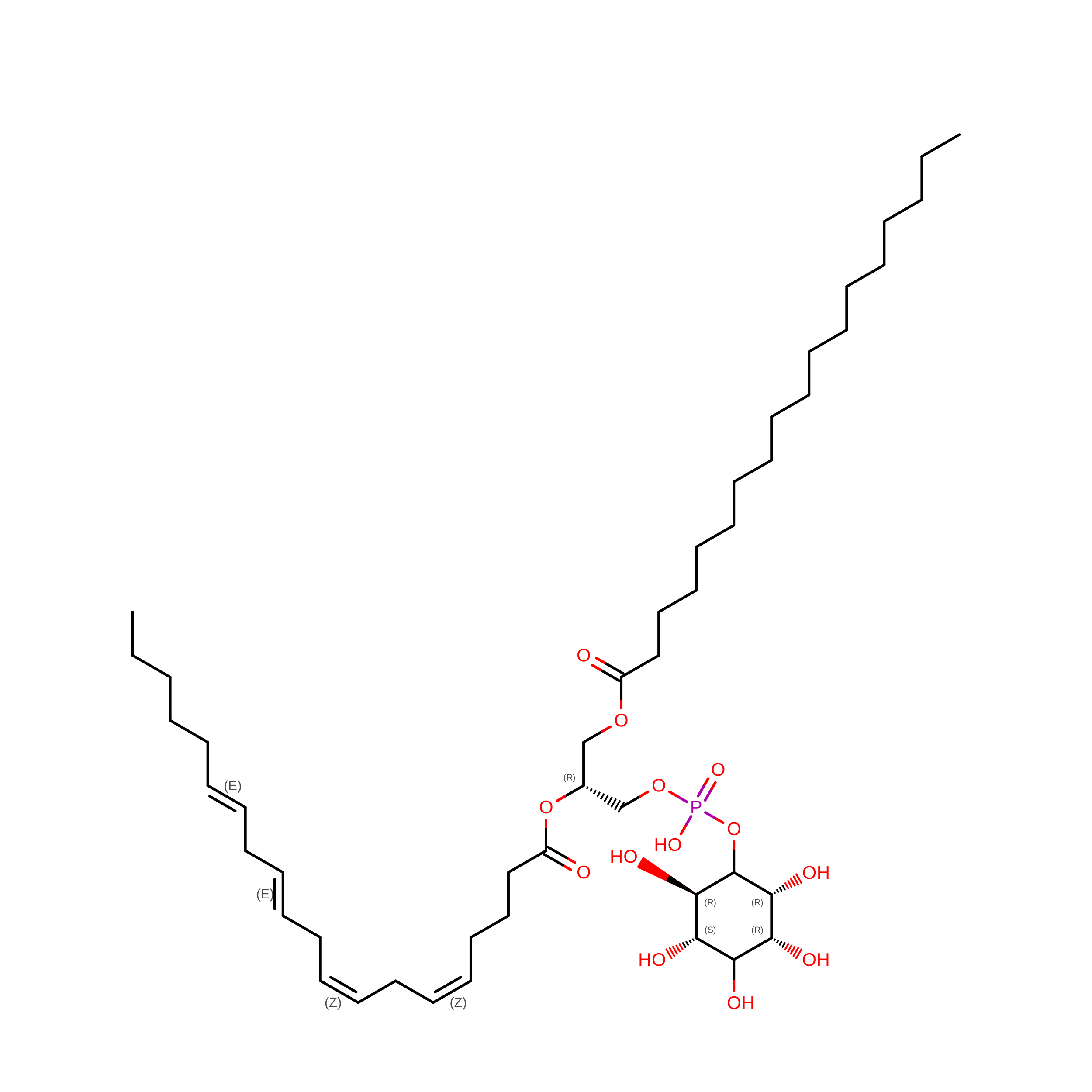
Phosphatidylinositol
C47 H83 O13 P
KRTOMQDUKGRFDJ-TWUHCGEESA-N
Y01
(Subject of Investigation/LOI)

Query on Y01


Download:Ideal Coordinates CCD File
C [auth B]
F [auth B]
G [auth B]
H [auth B]
I [auth A]
C [auth B],
F [auth B],
G [auth B],
H [auth B],
I [auth A],
J [auth A],
K [auth A],
L [auth A]
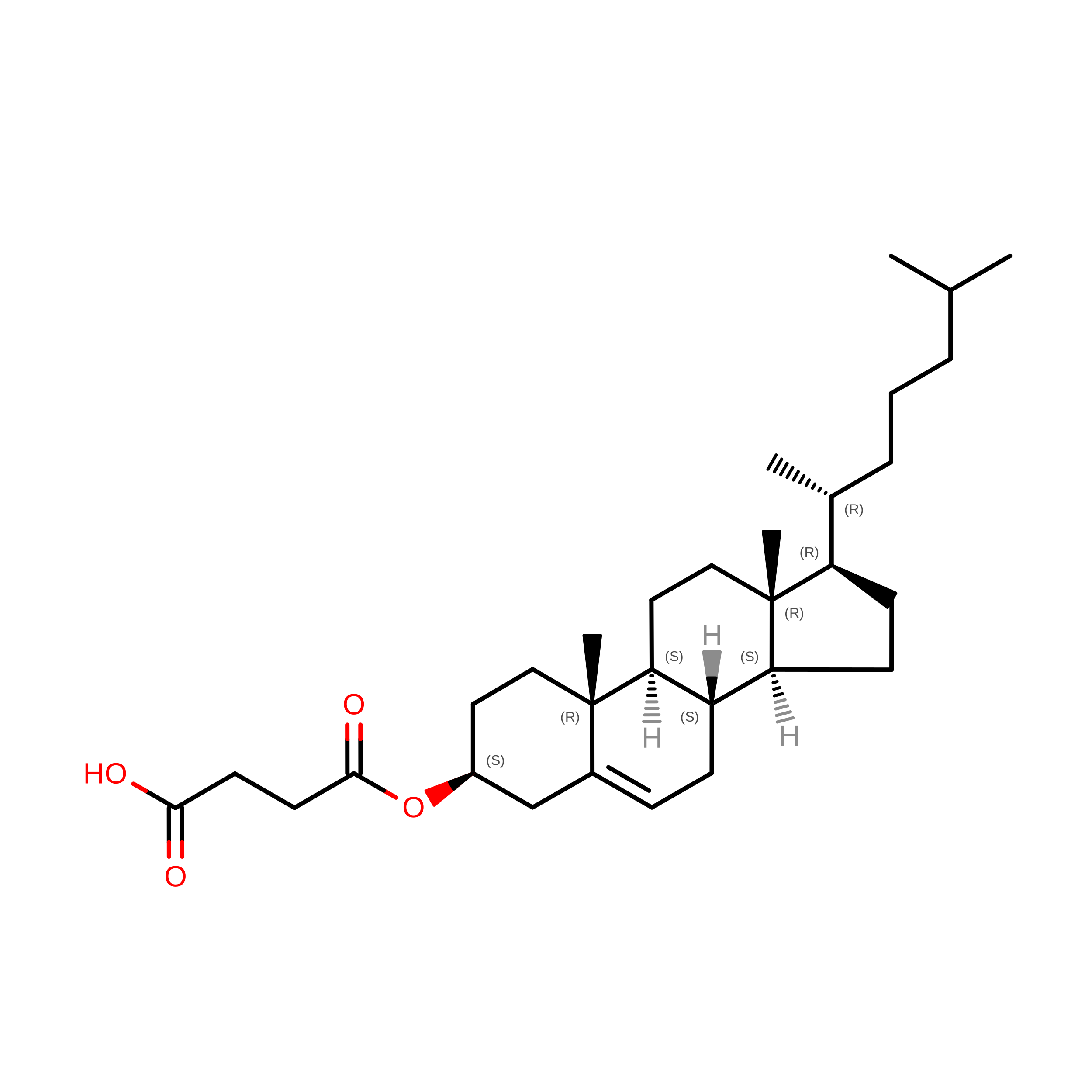
CHOLESTEROL HEMISUCCINATE
C31 H50 O4
WLNARFZDISHUGS-MIXBDBMTSA-N

Experimental Data & Validation

Experimental Data

  • Method: ELECTRON MICROSCOPY
  • Resolution: 3.64 Å
  • Aggregation State: PARTICLE 
  • Reconstruction Method: SINGLE PARTICLE 
EM Software:
TaskSoftware PackageVersion
MODEL REFINEMENTPHENIX
RECONSTRUCTIONRELION3.0

Structure Validation

View Full Validation Report


Entry History 

& Funding Information

Deposition Data


Funding OrganizationLocationGrant Number
Not funded--

Revision History  (Full details and data files)

  • Version 1.0: 2022-01-26
    Type: Initial release
  • Version 1.1: 2022-02-02
    Changes: Structure summary
  • Version 1.2: 2022-03-02
    Changes: Database references
  • Version 1.3: 2024-07-17
    Changes: Data collection
  • Version 1.4: 2025-07-02
    Changes: Data collection, Structure summary