7OO5 | pdb_00007oo5

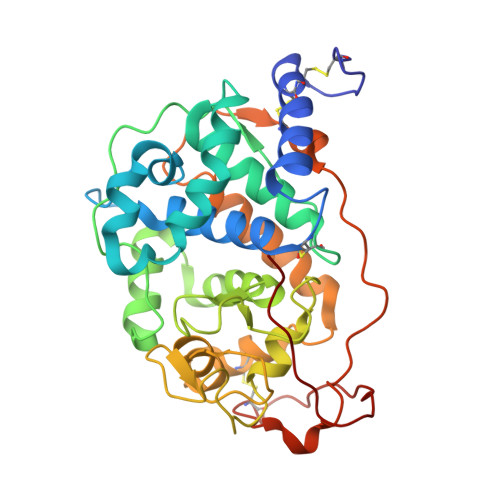
Crystal structure of the lignin peroxidase (ApeLiP) from Agrocybe pediades


Experimental Data Snapshot

  • Method: X-RAY DIFFRACTION
  • Resolution: 1.85 Å
  • R-Value Free: 
    0.269 (Depositor), 0.275 (DCC) 
  • R-Value Work: 
    0.232 (Depositor), 0.242 (DCC) 
  • R-Value Observed: 
    0.234 (Depositor) 

Starting Model: experimental
View more details

wwPDB Validation 3D Report Full Report

Validation slider image for 7OO5

Ligand Structure Quality Assessment 


This is version 1.2 of the entry. See complete history

Literature

Agaricales Mushroom Lignin Peroxidase: From Structure-Function to Degradative Capabilities.

Sanchez-Ruiz, M.I.Ayuso-Fernandez, I.Rencoret, J.Gonzalez-Ramirez, A.M.Linde, D.Davo-Siguero, I.Romero, A.Gutierrez, A.Martinez, A.T.Ruiz-Duenas, F.J.

(2021) Antioxidants (Basel) 10

  • DOI: https://doi.org/10.3390/antiox10091446
  • Primary Citation Related Structures: 
    7OO5

  • PubMed Abstract: 

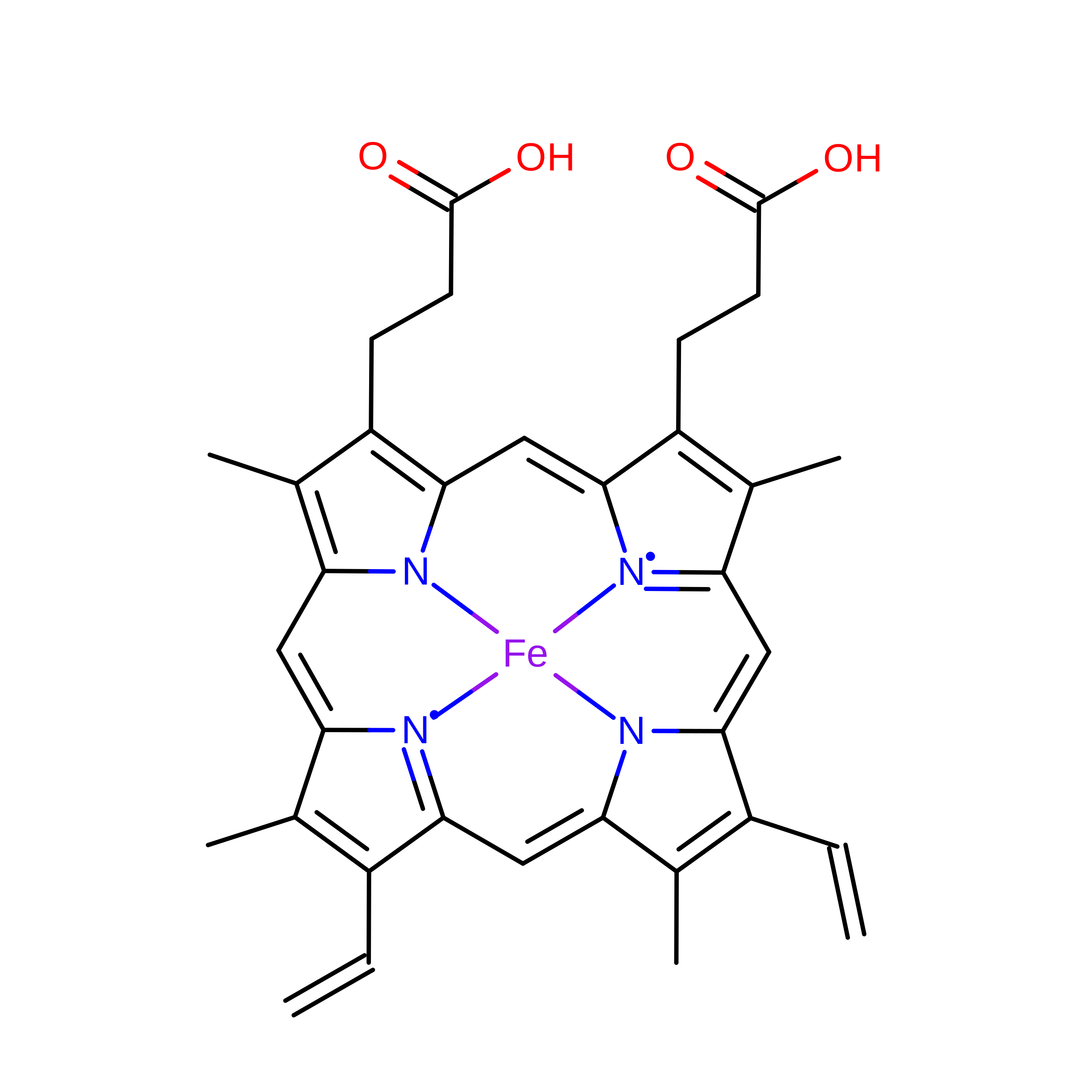
    Lignin biodegradation has been extensively studied in white-rot fungi, which largely belong to order Polyporales. Among the enzymes that wood-rotting polypores secrete, lignin peroxidases (LiPs) have been labeled as the most efficient. Here, we characterize a similar enzyme (ApeLiP) from a fungus of the order Agaricales (with ~13,000 described species), the soil-inhabiting mushroom Agrocybe pediades . X-ray crystallography revealed that ApeLiP is structurally related to Polyporales LiPs, with a conserved heme-pocket and a solvent-exposed tryptophan. Its biochemical characterization shows that ApeLiP can oxidize both phenolic and non-phenolic lignin model-compounds, as well as different dyes. Moreover, using stopped-flow rapid spectrophotometry and 2D-NMR, we demonstrate that ApeLiP can also act on real lignin. Characterization of a variant lacking the above tryptophan residue shows that this is the oxidation site for lignin and other high redox-potential substrates, and also plays a role in phenolic substrate oxidation. The reduction potentials of the catalytic-cycle intermediates were estimated by stopped-flow in equilibrium reactions, showing similar activation by H 2 O 2 , but a lower potential for the rate-limiting step (compound-II reduction) compared to other LiPs. Unexpectedly, ApeLiP was stable from acidic to basic pH, a relevant feature for application considering its different optima for oxidation of phenolic and nonphenolic compounds.


  • Organizational Affiliation
    • Centro de Investigaciones Biológicas "Margarita Salas" (CIB), Consejo Superior de Investigaciones Científicas (CSIC), 28040 Madrid, Spain.

Macromolecule Content 

  • Total Structure Weight: 35.13 kDa 
  • Atom Count: 2,543 
  • Modeled Residue Count: 331 
  • Deposited Residue Count: 331 
  • Unique protein chains: 1

Macromolecules

Find similar proteins by:|  3D Structure
Entity ID: 1
MoleculeChains  Sequence LengthOrganismDetailsImage
lignin peroxidase331Agrocybe pediadesMutation(s): 0 
EC: 1.11.1.14 (PDB Primary Data), 1.11.1 (UniProt)
UniProt
Find proteins for A0A8X6EH08 (Agrocybe pediades)
Explore A0A8X6EH08 
Go to UniProtKB:  A0A8X6EH08
Entity Groups
Sequence Clusters30% Identity50% Identity70% Identity90% Identity95% Identity100% Identity
UniProt GroupA0A8X6EH08
Sequence Annotations
Expand
Reference Sequence

Experimental Data & Validation

Experimental Data

  • Method: X-RAY DIFFRACTION
  • Resolution: 1.85 Å
  • R-Value Free:  0.269 (Depositor), 0.275 (DCC) 
  • R-Value Work:  0.232 (Depositor), 0.242 (DCC) 
  • R-Value Observed: 0.234 (Depositor) 
Space Group: P 21 21 21
Unit Cell:
Length ( Å )Angle ( ˚ )
a = 48.126α = 90
b = 74.95β = 90
c = 82.768γ = 90
Software Package:
Software NamePurpose
REFMACrefinement
PHENIXrefinement
XDSdata reduction
SCALAdata scaling
MOLREPphasing

Structure Validation

View Full Validation Report


Ligand Structure Quality Assessment 


Entry History 

& Funding Information

Deposition Data


Funding OrganizationLocationGrant Number
Spanish Ministry of Economy and CompetitivenessSpainBFU2016-77835-R

Revision History  (Full details and data files)

  • Version 1.0: 2021-10-13
    Type: Initial release
  • Version 1.1: 2024-01-31
    Changes: Data collection, Refinement description
  • Version 1.2: 2024-11-06
    Changes: Structure summary