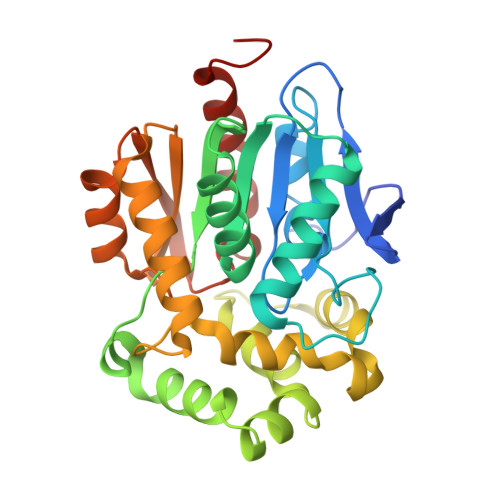
7OND | pdb_00007ond

HaloTag Engineering for Enhanced Fluorogenicity and Kinetics with a Styrylpyridine Dye


Experimental Data Snapshot

  • Method: X-RAY DIFFRACTION
  • Resolution: 1.45 Å
  • R-Value Free: 
    0.186 (Depositor), 0.200 (DCC) 
  • R-Value Work: 
    0.163 (Depositor), 0.170 (DCC) 
  • R-Value Observed: 
    0.164 (Depositor) 

Starting Model: experimental
View more details

wwPDB Validation   3D Report Full Report


Ligand Structure Quality Assessment 


This is version 1.4 of the entry. See complete history


Literature

HaloTag Engineering for Enhanced Fluorogenicity and Kinetics with a Styrylpyridium Dye.

Miro-Vinyals, C.Stein, A.Fischer, S.Ward, T.R.Deliz Liang, A.

(2021) Chembiochem 22: 3398-3401

  • DOI: https://doi.org/10.1002/cbic.202100424
  • Primary Citation of Related Structures:  
    7OND, 7OO4

  • PubMed Abstract: 

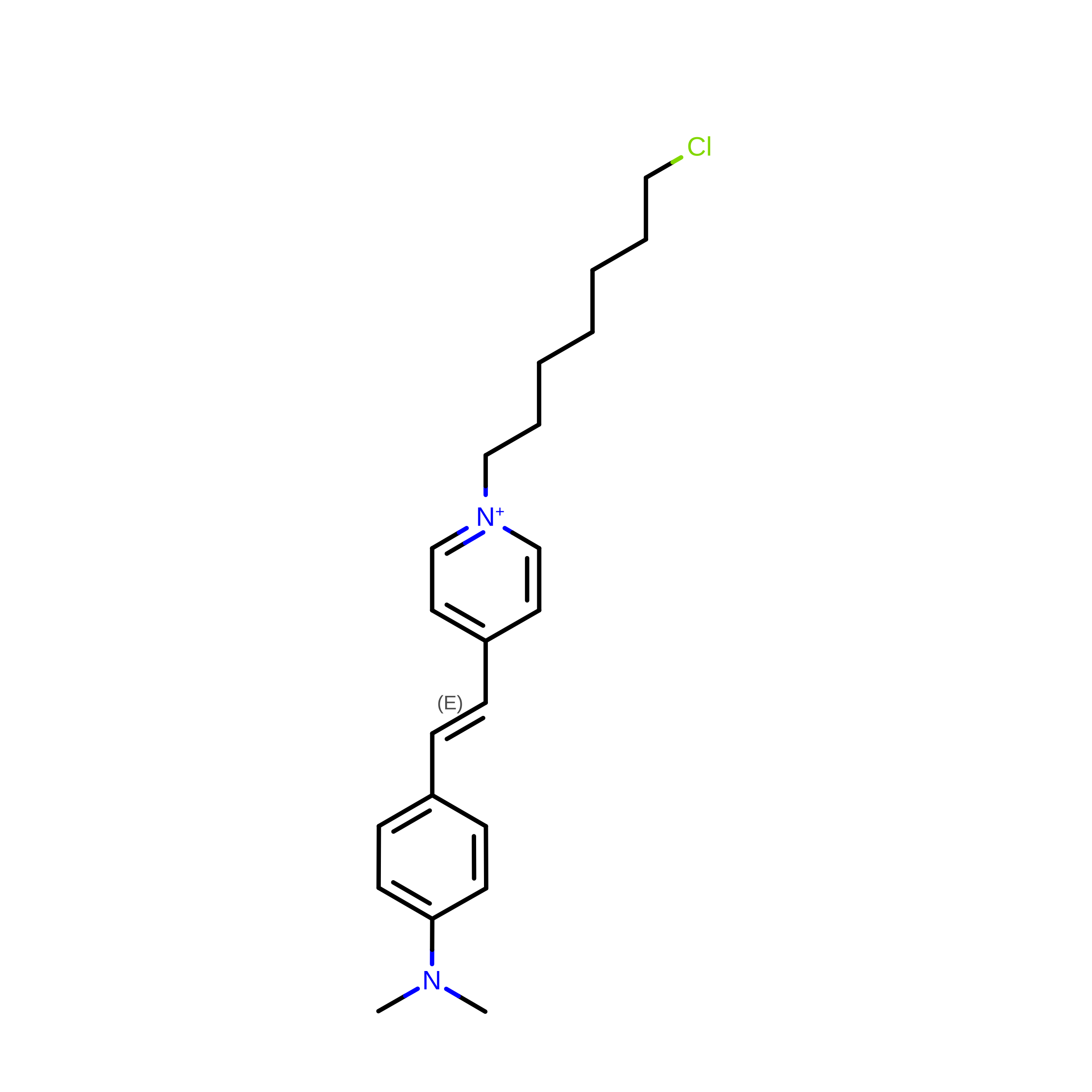
    HaloTag is a small self-labeling protein that is frequently used for creating fluorescent reporters in living cells. The small-molecule dyes used with HaloTag are almost exclusively based on rhodamine scaffolds, which are often expensive and challenging to synthesize. Herein, we report the engineering of HaloTag for use with a chemically accessible, inexpensive fluorophore based on the dimethylamino-styrylpyridium dye. Through directed evolution, the maximum fluorogenicity and the apparent second-order bioconjugation rate constants could be improved up to 4-fold and 42-fold, respectively. One of the top variants, HT-SP5, enabled reliable imaging in mammalian cells, with a 113-fold fluorescence enhancement over the parent protein. Additionally, crystallographic characterization of selected mutants suggests the chemical origin of the fluorescent enhancement. The improved dye system offers a valuable tool for imaging and illustrates the viability of engineering self-labeling proteins for alternative fluorophores.


  • Organizational Affiliation
    • Chemistry Department, University of Basel, NCCR Molecular Systems Engineering, 4002, Basel, Switzerland.

Macromolecules
Find similar proteins by:  (by identity cutoff)  |  3D Structure
Entity ID: 1
MoleculeChains Sequence LengthOrganismDetailsImage
Haloalkane dehalogenase
A, B
303Rhodococcus sp. (in: high G+C Gram-positive bacteria)Mutation(s): 25 
Gene Names: dhaA
EC: 3.8.1.5
UniProt
Find proteins for P0A3G3 (Rhodococcus sp)
Explore P0A3G3 
Go to UniProtKB:  P0A3G3
Entity Groups  
Sequence Clusters30% Identity50% Identity70% Identity90% Identity95% Identity100% Identity
UniProt GroupP0A3G3
Sequence Annotations
Expand
  • Reference Sequence
Experimental Data & Validation

Experimental Data

  • Method: X-RAY DIFFRACTION
  • Resolution: 1.45 Å
  • R-Value Free:  0.186 (Depositor), 0.200 (DCC) 
  • R-Value Work:  0.163 (Depositor), 0.170 (DCC) 
  • R-Value Observed: 0.164 (Depositor) 
Space Group: P 1 21 1
Unit Cell:
Length ( Å )Angle ( ˚ )
a = 47.586α = 90
b = 68.558β = 98.57
c = 81.179γ = 90
Software Package:
Software NamePurpose
REFMACrefinement
PDB_EXTRACTdata extraction
XDSdata reduction
PHASERphasing
Aimlessdata scaling

Structure Validation

View Full Validation Report


Ligand Structure Quality Assessment 


Entry History 

Deposition Data

Revision History  (Full details and data files)

  • Version 1.0: 2021-07-21
    Type: Initial release
  • Version 1.1: 2021-10-20
    Changes: Data collection, Database references
  • Version 1.2: 2021-12-22
    Changes: Database references
  • Version 1.3: 2024-01-31
    Changes: Data collection, Refinement description
  • Version 1.4: 2024-10-23
    Changes: Structure summary